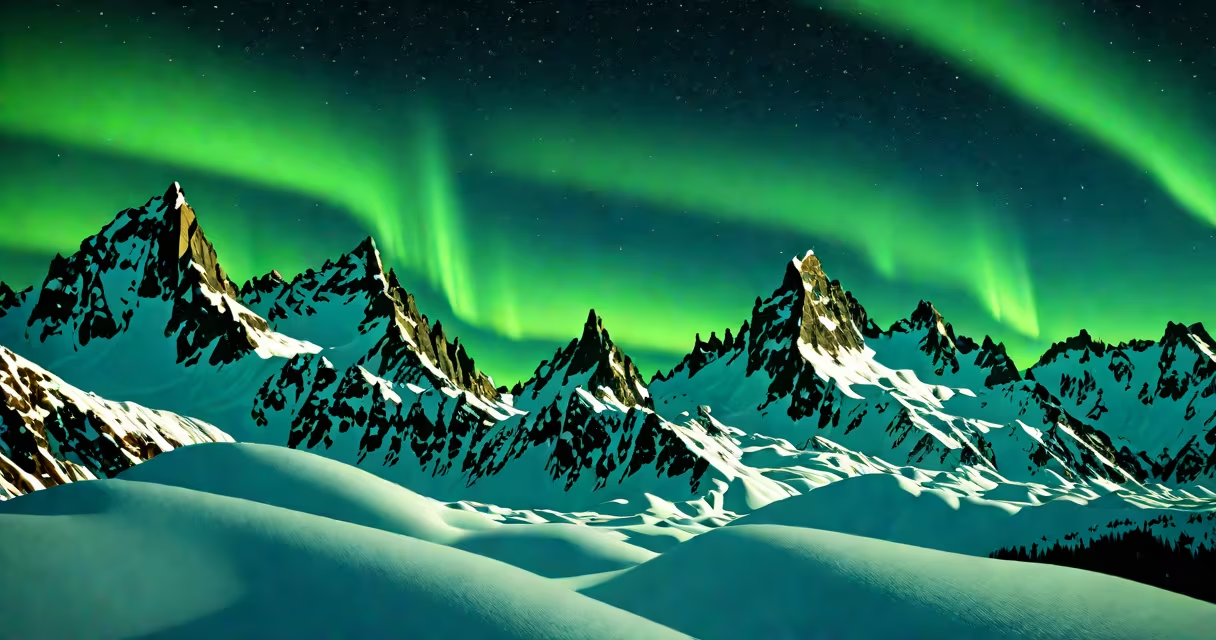
The aurora borealis over mountain peaks is a natural light display caused by charged particles from the sun colliding with Earth's upper atmosphere near the poles, creating shimmering ribbons of green, pink, and violet light that dance above high-altitude terrain.
This phenomenon occurs when solar wind-streams of electrons and protons from the sun-interacts with Earth's magnetosphere. The particles are funneled toward the polar regions along magnetic field lines, where they collide with oxygen and nitrogen molecules in the thermosphere. These collisions excite atmospheric gases, which then release energy as visible light. Green hues dominate because oxygen emits at 557.7 nm wavelength, while reds and purples come from nitrogen and higher-altitude oxygen emissions.
When viewed from mountainous regions-especially those at high latitudes such as northern Scandinavia, Alaska, or the Canadian Rockies-the aurora appears to rise from behind jagged ridges and snow-dusted summits. The contrast between the dark, sharp silhouettes of mountains and the luminous curtains of light creates dramatic visual depth. This setting enhances perception of motion and scale, making the aurora feel both ethereal and immediate.
Auroras form during periods of heightened solar activity, particularly around the peak of the 11-year solar cycle. When coronal mass ejections (CMEs) erupt from the sun, they can trigger geomagnetic storms that intensify auroral displays. These events increase the number of particles entering Earth's magnetosphere, leading to stronger and more widespread auroras-sometimes visible as far south as the northern United States or central Europe.
For the aurora borealis over mountain peaks to be visible, several conditions must align: clear skies, minimal light pollution, and sufficient solar activity. The best viewing times occur between late August and early April, when nights are long enough and dark enough. Midnight to 2 a.m. local time offers the highest probability of visibility due to Earth's magnetic alignment with the solar wind.
Photographers often wait hours in subzero temperatures to capture the aurora over mountain peaks. A camera set to manual mode with ISO 1600-3200, f/2.8 aperture, and 10-20 second exposures reveals details invisible to the naked eye-such as fine structure in the auroral curtains or subtle color gradients. Some long-exposure shots even show stars streaking across the sky due to Earth's rotation.
Auroras vary in form based on geomagnetic activity and atmospheric composition. Common shapes include arcs, bands, rays, and coronas. Arcs appear as broad, horizontal ribbons stretching across the horizon. Bands form wavy structures that move vertically. Rays are vertical columns of light that seem to shoot upward from the horizon, especially noticeable when the aurora is directly overhead. Coronal displays happen when rays converge at the zenith, creating a radiant halo effect.
| Type | Appearance | Typical Altitude | Common Colors |
|---|---|---|---|
| Arc | Smooth, curved band across the sky | 100-250 km | Green, faint red |
| Rays | Vertical columns extending upward | 150-300 km | Green, blue-violet |
| Corona | Converging rays forming a ringed glow | 100-200 km | Green, purple |
| Bands | Wavy, undulating ribbons | 150-250 km | Green, red |
When the aurora borealis over mountain peaks forms a corona, the effect is most striking. The convergence of rays at the zenith gives the illusion of light radiating from a single point directly above the observer. This optical illusion happens because the brain interprets parallel rays as diverging from a distant center, similar to how tree trunks appear to converge in a forest path.
Many assume the aurora borealis over mountain peaks is purely artistic or mythical. In reality, it is a measurable physical process. NASA's THEMIS mission confirmed that auroral substorms originate from magnetic reconnection events in Earth's magnetotail-regions of space where magnetic fields snap and reconnect, releasing stored energy. These events trigger rapid particle acceleration toward the atmosphere.
Another misconception is that auroras are visible everywhere in the Arctic. They are not. Visibility depends on solar wind speed, interplanetary magnetic field orientation, and local weather. For example, in Tromsø, Norway, the aurora is visible on average 200 nights per year-but only if skies are clear. Cloud cover remains the primary obstacle, even in prime locations.
In 2015, a useful geomagnetic storm triggered by a CME led to auroras visible across the contiguous U.S., including states like Michigan and Wisconsin. This rare event demonstrated that auroral activity can extend beyond typical polar zones. However, such displays are fleeting and lack the mountainous backdrop that defines the aurora borealis over mountain peaks.
I spent a week in Banff National Park in December 2022 waiting for the aurora borealis over mountain peaks. On the third night, after three hours of sitting in -15°C (-5°F) weather, the sky erupted in green waves that arced over Mount Rundle. My camera captured a 20-second exposure showing the aurora rising directly from the ridge line-a moment I still recall vividly. The silence, the cold, and the sudden burst of color created a sense of awe that no video or photo can fully convey.
To maximize your chances:
Understanding the science behind the aurora borealis over mountain peaks enhances appreciation. It's not magic-it's physics. But that doesn't diminish its wonder. The same solar particles that cause auroras also power satellite communications and influence power grids. When the aurora dances over snow-capped peaks, it's a visible reminder of Earth's changing connection to the sun.