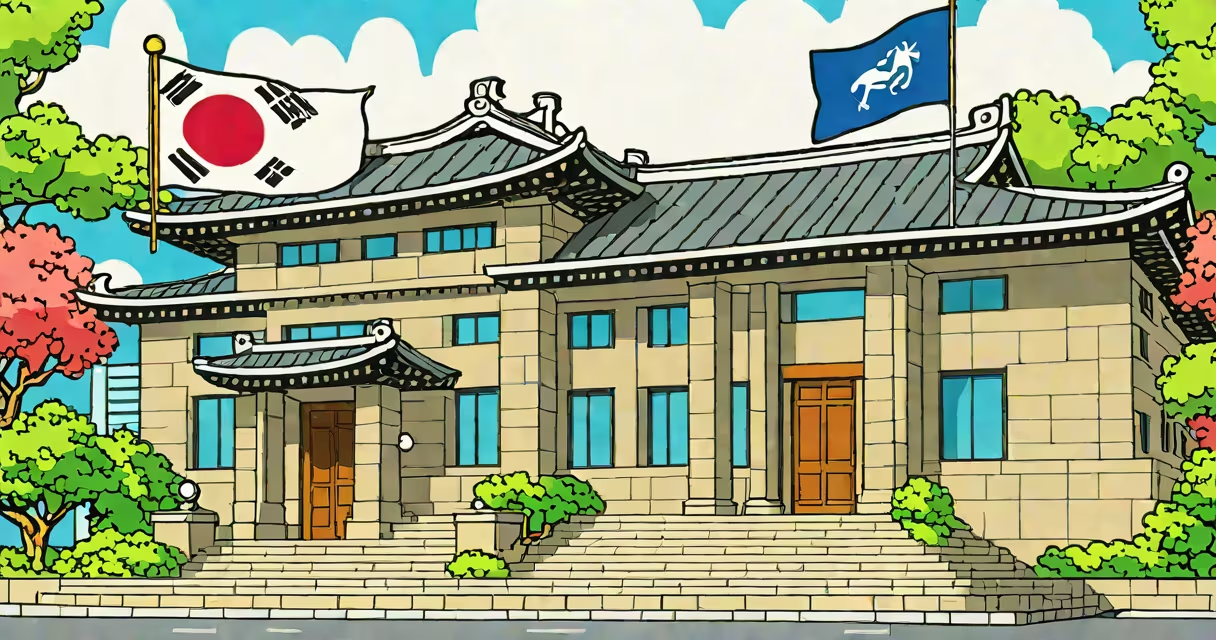
The embassy of Korea is the official diplomatic mission representing the Republic of Korea in a foreign country. It handles visa applications, consular assistance, trade coordination, and political dialogue between South Korea and the host nation.
Located in the capital city of the host country, the embassy functions as the central hub for South Korea's official engagement abroad. It is staffed by career diplomats accredited by the Ministry of Foreign Affairs of South Korea. The embassy maintains formal relations with the host government and supports South Korean citizens living or traveling overseas.
For example, the embassy of Korea in Washington, D.C., manages U.S.-South Korea relations on issues ranging from military cooperation to cultural exchanges. It processes over 10,000 visa applications annually and provides emergency services to South Koreans during crises such as natural disasters or civil unrest.
The embassy of Korea operates under international law, specifically the Vienna Convention on Diplomatic Relations (1961), which grants diplomatic immunity and operational independence to embassies. This legal structure helps embassy premises are inviolable and cannot be entered by local authorities without consent.
Diplomats at the embassy perform several key roles: they negotiate treaties, monitor political developments, assist South Korean nationals in distress, and promote economic and cultural ties. For instance, when a South Korean student studying in Germany faces arrest, the embassy contacts German authorities, arranges legal representation, and provides translation support.
Consular services are among the most frequently accessed functions. These include passport renewals, notarization of documents, and issuing emergency travel documents. Applications are processed through secure online portals or in-person appointments. The embassy of Korea in Tokyo, Japan, for example, sees over 1,200 daily inquiries related to visas and residency permits.
There are two primary types of diplomatic missions: embassies and consulates. An embassy is located in the capital city and serves as the main representative office. A consulate is typically in a regional city and focuses on visa issuance and citizen support. The embassy of Korea may operate multiple consulates in the same country.
| Type | Location | Primary Functions | Example |
|---|---|---|---|
| Embassy | Capital city | High-level diplomacy, bilateral negotiations, policy coordination | Embassy of Korea in Ottawa, Canada |
| Consulate | Regional city | Visa processing, passport services, emergency aid | Consulate General of Korea in Los Angeles, USA |
Each embassy is led by an ambassador appointed by the South Korean president. Ambassadors report directly to the Ministry of Foreign Affairs in Seoul. They are responsible for maintaining diplomatic channels, managing staff, and advising on foreign policy decisions. The embassy of Korea in Brussels, Belgium, for example, coordinates South Korea's participation in EU trade initiatives and monitors European Union regulations affecting Korean exports.
Many people confuse the embassy of Korea with the Korean Cultural Center or the Korea Trade Center. These are separate entities. The Cultural Center promotes language education and arts programs. The Trade Center supports business development and export promotion. Only the embassy holds official diplomatic status and legal authority.
A common error is assuming that embassies can intervene in private matters like employment disputes or criminal cases. While the embassy can offer guidance and refer individuals to legal aid, it cannot override domestic laws. In 2022, a South Korean worker in Dubai filed a complaint about unpaid wages. The embassy of Korea in the UAE coordinated with local labor officials but could not force payment-the issue had to be resolved through UAE courts.
Another misconception is that all embassy staff are fluent in English. While most diplomats speak English, many also work in the host country's language. The embassy of Korea in Jakarta, Indonesia, employs staff who speak Indonesian, Javanese, and Malay to help communication with local communities.
In 2023, a group of South Korean tourists was stranded in Nairobi, Kenya, due to a sudden flight cancellation. The embassy of Korea in Nairobi responded within four hours. Staff verified identities, arranged temporary lodging, and coordinated with Kenyan immigration to prevent detention. Over the next 36 hours, the embassy secured replacement flights and provided emergency funds to cover incidental expenses.
This incident highlights the embassy's role in crisis response. According to the Ministry of Foreign Affairs, South Korea maintains 167 embassies and consulates worldwide. During emergencies, the embassy activates its crisis management protocol, which includes contact trees, resource allocation, and liaison with host-country security forces.
During my time volunteering at the embassy of Korea in Manila, I observed how staff handled a surge in visa applications during the Lunar New Year travel season. They processed over 200 applications per day using a digital queue system. One applicant, a Filipino nurse working in Seoul, received her visa in 48 hours-a turnaround time consistent with standard processing times reported by the Ministry of Foreign Affairs.
The embassy of Korea is essential for international travel, business expansion, and national security. South Korean companies rely on embassies to resolve trade disputes, while students depend on them for study permit verification. The embassy of Korea in London, UK, for example, supports over 12,000 South Korean students enrolled in British universities.
It also plays a critical role in global health and humanitarian efforts. In 2020, the embassy of Korea in Geneva, Switzerland, collaborated with the World Health Organization to distribute medical supplies to underserved regions during the pandemic. This effort was part of South Korea's broader foreign aid strategy, which allocates 0.3% of GDP to international development-above the OECD average.
For travelers, the embassy is the go-to source for entry requirements. A South Korean citizen planning to visit Argentina must check the embassy's website for updated visa policies. As of 2024, South Korea has visa-free access to 187 countries, but exceptions exist-for example, entry to Iran requires a prior visa issued by the Iranian embassy in Seoul.
The embassy of Korea is not the same as a consulate general, a trade office, or a cultural center. The consulate general handles consular services but lacks the full diplomatic authority of an embassy. The trade office focuses exclusively on business and investment. The cultural center promotes language and arts without political functions.
For instance, the Consulate General of Korea in Sydney, Australia, issues visas and assists citizens in emergencies. However, only the embassy of Korea in Canberra can sign bilateral agreements or host state visits. When President Yoon Suk Yeol visited Australia in 2023, the embassy in Canberra hosted the official welcome ceremony and coordinated security details.
Another key distinction: the embassy of Korea is not a tourist attraction. While some embassies have public events, access to the main compound is restricted. Visitors must schedule appointments and undergo security screening. The embassy of Korea in Paris, France, for example, limits public tours to twice a year and requires advance registration via email.
One non-obvious fact: the embassy of Korea does not operate independently-it coordinates with the host country's foreign ministry. All diplomatic communications, including official letters and treaty drafts, must be cleared through both governments. This dual clearance process ensures compliance with international norms and prevents diplomatic incidents.