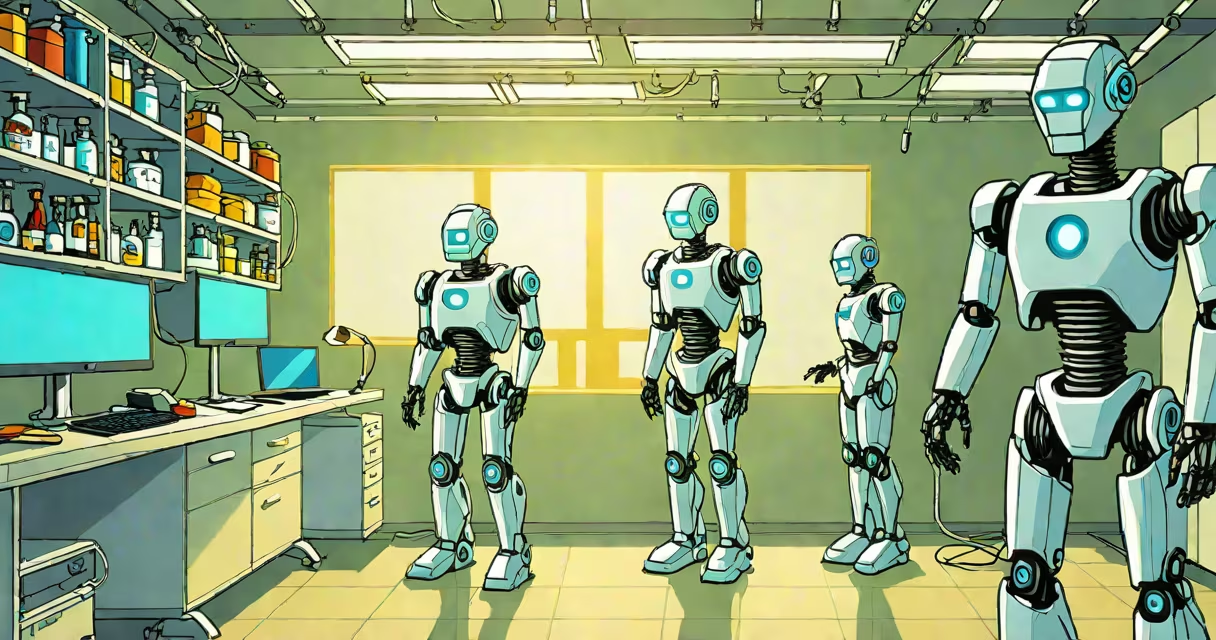
Human like robots are autonomous machines designed to resemble, move like, and interact with humans using artificial intelligence, sensors, and advanced mechanics. They replicate human form, motion, and decision-making in controlled environments.
These robots use machine learning models trained on vast datasets of human gestures, speech patterns, and facial expressions. Their bodies integrate motors, servos, and flexible joints to simulate natural limb movement. Sensors such as LiDAR, stereo cameras, and microphones allow them to perceive surroundings in real time and respond dynamically.
For example, Honda's ASIMO, introduced in 2000, was one of the first walking humanoid robots capable of climbing stairs and recognizing voices. More recently, Boston Dynamics' Atlas performs parkour-style movements, including backflips and balance recovery on uneven terrain. These capabilities stem from real-time feedback loops between perception, planning, and actuation.
Human like robots operate through layered systems: perception, cognition, and action. Perception involves capturing environmental data via cameras, depth sensors, and audio inputs. This data feeds into AI models that interpret context-such as identifying a person's intent or emotional state from tone and posture.
Cognition layers process this input using neural networks trained on human behavior datasets. For instance, a robot deployed in a hospital may learn to recognize distress signals in patient vocalizations and adjust its response accordingly. The system then sends commands to actuators-motors and hydraulic systems-to execute physical actions like turning, reaching, or speaking.
Each movement is calculated in milliseconds. A robot walking across a room uses inverse kinematics to determine joint angles needed to place feet precisely. Real-time adjustments prevent falls even on slippery surfaces. This coordination requires high-speed processors and low-latency communication between hardware and software.
Not all human like robots are built the same. Design choices depend on purpose, environment, and technical constraints. The following table outlines common categories:
| Type | Key Features | Use Case Example |
|---|---|---|
| Service Humanoids | Mobile base, dexterous hands, voice interface | SoftBank Robotics' Pepper assists in retail stores and hotels |
| Research Platforms | High mobility, modular limbs, open-source software | Boston Dynamics' Atlas used in DARPA challenges for changing navigation |
| Medical Assistants | Non-threatening appearance, precision control, sterile design | Toyota's T-HR3 supports elderly care tasks like fetching medication |
| Entertainment Models | Expressive faces, synchronized speech, choreographed movements | Engineered Arts' Ameca robot performs lifelike conversations and facial expressions |
Some robots prioritize realism over function. For example, Hanson Robotics' Sophia uses a silicone face with 62 facial expressions, driven by AI trained on human emotional databases. Her responses are generated using natural language processing models, though she does not possess consciousness.
A lesser-known fact: many human like robots avoid perfect symmetry. Research from MIT's Computer Science and Artificial Intelligence Laboratory shows that slight asymmetry in facial features reduces the "uncanny valley" effect-where near-human appearance triggers discomfort. Robots with minor imperfections in eye placement or jaw movement feel more natural to observers.
Human like robots are often mistaken for sentient beings. They are not conscious. They lack subjective experience, emotions, or self-awareness. What appears as empathy-like saying "I understand" during a conversation-is algorithmic pattern matching, not feeling.
Another confusion: people assume all human like robots walk like humans. But most rely on changing balancing rather than static stability. A robot like Atlas doesn't walk like a person-it uses predictive control to shift weight forward and recover from perturbations mid-step. Its gait resembles a human's only in broad outline.
Even the term "human like" varies. Some robots mimic only upper-body motion. Others replicate full-body coordination. The level of resemblance depends on application. A robot used in therapy may focus on facial expression and tone, while one used in construction prioritizes strength and durability over appearance.
Human like robots are deployed in settings requiring interaction with complex human environments. In healthcare, they assist with rehabilitation exercises. A study published in *Nature Medicine* (2022) found that patients recovering from stroke showed improved engagement when guided by a humanoid robot compared to standard video programs.
In education, robots like NAO are used in classrooms to teach coding and social skills to children with autism. Their consistent, predictable behavior helps reduce anxiety. Teachers report higher participation rates among students who struggle with peer interaction.
One personal observation: during a visit to a Tokyo robotics exhibition in 2023, I watched a group of schoolchildren interact with a humanoid robot demonstrating Japanese history. The robot responded to questions with accurate facts and adjusted its tone based on whether the child spoke quietly or loudly. It didn't speak like a human-but it acted like a teacher.
These systems are not replacements for people. They fill roles where consistency, endurance, or specialized task execution matters. In Japan, where aging populations strain caregiving services, humanoid robots are being tested in nursing homes to monitor vitals and remind residents to take medication.
Despite progress, human like robots face significant hurdles. Power consumption remains high-many require external power sources or frequent battery swaps. A robot like Atlas consumes about 2 kilowatts during changing movement, equivalent to running multiple household appliances simultaneously.
Maintenance is another barrier. Complex joint mechanisms and sensor arrays fail under stress. A 2021 report from the IEEE Robotics and Automation Society noted that 40% of humanoid prototypes experienced motor failure within six months of continuous operation.
Cost is a major factor. A single unit of a high-end humanoid robot can exceed $500,000. That limits deployment to research labs, military projects, and elite institutions. Even basic models cost more than most consumer electronics.
Finally, public trust remains fragile. Surveys by Pew Research Center (2023) show that 67% of Americans express concern about robots replacing human jobs, especially in service roles. When robots appear too human, fear increases-particularly around privacy and autonomy.
Human like robots are advanced machines that simulate human form and behavior using AI, sensors, and mechanical engineering. They are not alive, nor do they think. Their actions result from programmed logic and learned patterns. They serve specific functions in medicine, education, and industry.