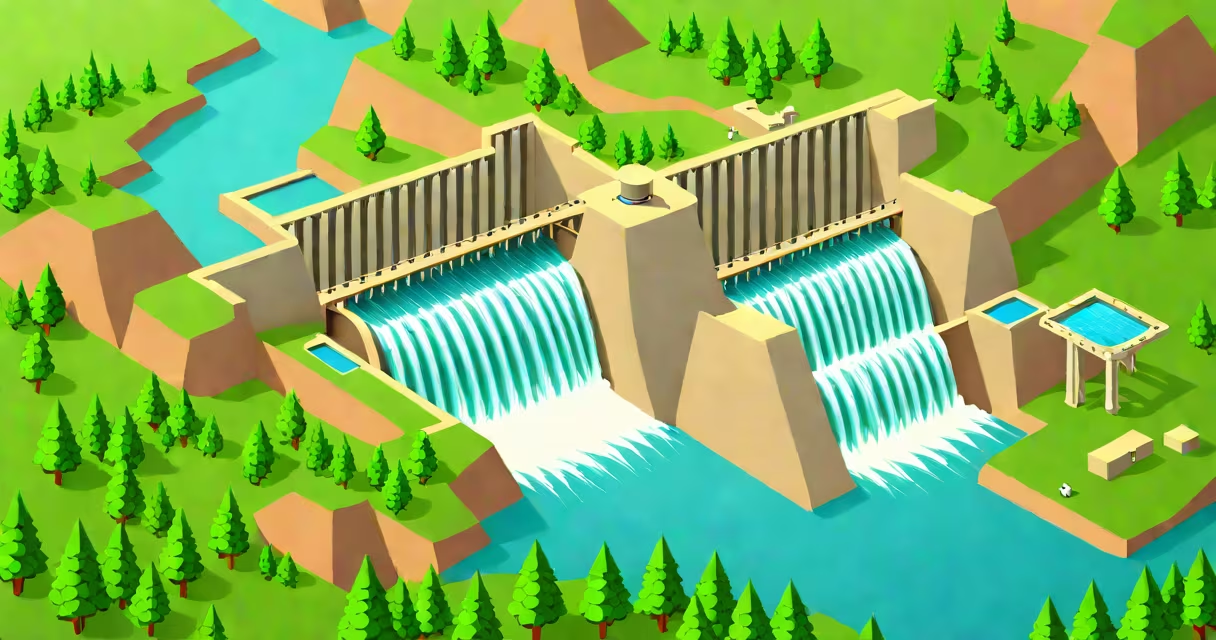
Hydroelectric energy generates electricity by using the kinetic force of moving water, typically from rivers or reservoirs, to turn turbines connected to generators. It is a renewable, low-carbon power source with high efficiency and long operational life.
Hydroelectric plants convert the gravitational potential energy of stored water into mechanical energy via turbines, then into electrical energy. The process relies on consistent water flow, often regulated by dams or run-of-river systems. Most large-scale hydro facilities operate continuously, providing baseload power that supports grid stability.
The global installed capacity of hydroelectric power reached 1,360 gigawatts (GW) by 2023, according to the International Renewable Energy Agency (IRENA). This accounts for about 16% of worldwide electricity generation and over 60% of all renewable electricity. Countries like Norway, Brazil, and Canada derive more than half their electricity from hydro sources.
Water is collected in a reservoir behind a dam. When released, gravity pulls it downward through penstocks-large pipes-to spin turbines at the base of the dam. The spinning turbines drive generators that produce electricity. After passing through the turbines, water flows into a downstream river or channel.
Some systems use run-of-river designs that don't require large reservoirs. These divert part of a river's flow through turbines and return water downstream. They have lower environmental impact but depend on seasonal flow patterns.
A typical large hydro plant operates at 90% efficiency-meaning 90% of the water's energy is converted to electricity. For comparison, coal plants average 33-40% efficiency. The difference stems from the absence of fuel combustion and heat loss in hydro systems.
Hydroelectric projects vary by scale, infrastructure, and location. The main types include:
| Type | How It Works | Use Case | Example |
|---|---|---|---|
| Large-scale storage | Dams store water; release during peak demand | Grid balancing, seasonal supply | Three Gorges Dam, China (22.5 GW) |
| Run-of-river | Uses natural river flow; minimal storage | Low-impact, remote communities | Chaudière River project, Quebec |
| Pumped storage | Stores excess energy by pumping water uphill | Energy storage, grid stabilization | Wenatchee Pumped Storage, Washington State |
Pumped storage is unique because it consumes electricity during off-peak hours to pump water uphill, then releases it during high-demand periods. This makes it a form of grid-scale battery. The U.S. Department of Energy reports that pumped storage provides over 90% of utility-scale energy storage in North America.
Hydroelectric energy is widely deployed due to its reliability, scalability, and low operating costs. Once built, maintenance expenses are minimal. A hydro plant can operate for 50-100 years with proper upkeep, far exceeding the lifespan of most fossil-fuel or solar installations.
Nations with abundant rivers and mountainous terrain-such as Canada, Norway, and the Himalayan region-use hydro to meet domestic needs and export surplus power. In Canada, hydro supplies 60% of national electricity, reducing reliance on oil and gas.
During extreme weather events, hydro plants maintain output while solar and wind may falter. In 2021, Texas experienced a winter storm that crippled solar and wind operations. Hydro plants in neighboring states continued delivering power, underscoring their role in emergency resilience.
Hydroelectric energy is not always environmentally neutral. Large dams disrupt fish migration, alter sediment transport, and flood ecosystems. The construction of the Belo Monte Dam in Brazil displaced over 40,000 people and flooded 500 square kilometers of rainforest. Critics argue such projects undermine biodiversity and Indigenous rights.
However, newer designs incorporate fish ladders, turbine modifications, and environmental flow releases to reduce harm. The World Bank's 2022 guidelines require environmental impact assessments and stakeholder consultations before funding large hydro projects.
A lesser-known fact: hydro plants can respond to grid demands within seconds. Unlike gas turbines, which take minutes to ramp up, hydro turbines adjust instantly. This rapid response capability makes them essential for stabilizing grids with high variable renewable penetration-such as those in Germany and California.
Constructed in 1936, the Hoover Dam on the Colorado River generates about 4 billion kilowatt-hours annually. It powers cities across Nevada, Arizona, and California. The facility maintains a 90% availability rate over decades, with only scheduled maintenance downtime.
Each year, the dam prevents approximately 3 million metric tons of CO₂ emissions compared to coal-fired plants. That's equivalent to removing 650,000 cars from the road annually. The energy produced by Hoover Dam supports over 1.5 million homes.
Despite its age, the dam continues to deliver power efficiently. Modern upgrades include automated monitoring systems and turbine optimization software, extending its useful life well into the 21st century.
While solar and wind are expanding rapidly, they lack dispatchability-the ability to generate on command. Hydroelectric energy fills this gap. Solar panels produce only during daylight; wind turbines depend on wind speed. Hydro can be turned on or off based on demand.
When paired with solar, hydro acts as a buffer. In California, the integration of hydro and solar reduced curtailment (wasted energy) by 30% between 2018 and 2022. This synergy improves system efficiency and lowers carbon intensity.
For context, a 100 MW solar farm requires about 500 acres of land. A comparable hydro plant uses less than 100 acres. Land use efficiency favors hydro in densely populated regions.
Still, solar has lower upfront environmental disruption. Building a dam alters entire watersheds. Solar panels are installed on existing rooftops or degraded land. The choice between them depends on geography, policy, and community priorities.
I visited the Grand Coulee Dam in Washington State in 2019. Standing beneath the massive concrete structure, I watched water cascade through intake gates. The sound was thunderous-like a waterfall trapped inside a machine. Inside the control room, operators monitored real-time load distribution across the Pacific Northwest grid. The precision of timing and flow adjustment impressed me. This wasn't just energy-it was infrastructure engineered for decades of service.
Hydroelectric energy delivers stable, low-emission power with long-term economic and environmental benefits. Its ability to provide continuous electricity, support grid resilience, and integrate with other renewables makes it a critical component of clean energy systems. While not without ecological trade-offs, responsible planning and modern design minimize risks. The advantages of hydroelectric energy-reliability, longevity, and scalability-make it indispensable in the global transition to sustainable power.