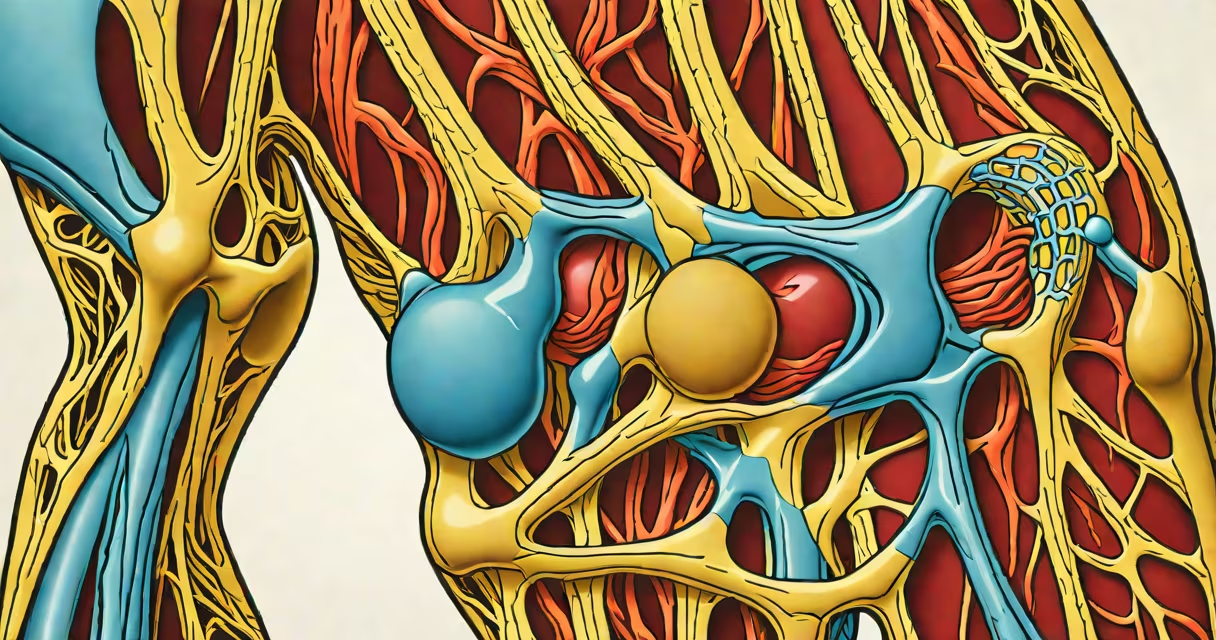
Tendons attach muscles to bones; ligaments connect bones to other bones. This fundamental distinction defines their roles in movement and joint stability.
Tendons transmit force from muscle contraction to bone, enabling motion. When your biceps contract, the tendon pulls on the radius bone in your forearm, bending your elbow. Ligaments stabilize joints by limiting excessive movement. The anterior cruciate ligament (ACL) in the knee prevents the tibia from sliding forward relative to the femur during sudden stops or direction changes.
Both are dense bands of collagen fibers, but they differ in mechanical stress. Tendons endure high tensile loads during changing activity. Ligaments resist shear and torsional forces during joint loading. A torn ACL requires surgical reconstruction because ligaments heal slowly due to poor blood supply. A ruptured Achilles tendon often needs surgical repair or immobilization, but recovery times vary based on severity.
Tendons act as biological pulleys. As skeletal muscles shorten, they pull on tendons, which transfer energy to bones, creating use. The patellar tendon connects the quadriceps muscle to the tibia, allowing leg extension during walking or kicking. Without tendons, muscle contractions would not produce movement.
Ligaments maintain joint integrity. They contain mechanoreceptors that send feedback to the nervous system about joint position-a process called proprioception. This helps you stand upright without looking at your feet. The medial collateral ligament (MCL) on the inner side of the knee resists inward pressure during lateral movements.
A 2018 study published in Journal of Orthopaedic Research found that ligament injuries occur more frequently in sports involving pivoting, such as soccer and basketball, due to sudden rotational stresses. Tendon injuries are more common in activities requiring repetitive strain, like running or weightlifting.
Both tissues consist primarily of type I collagen arranged in parallel bundles. However, ligaments have more elastic fibers and higher water content, making them slightly more flexible. Tendons are stiffer and designed for efficient force transmission.
Microscopically, tendons show a highly organized structure with fibroblasts aligned along the axis of tension. Ligaments display a more complex architecture with interwoven fiber layers, especially in multi-directional joints like the shoulder or ankle.
Research from the National Center for Biotechnology Information shows that ligament cells (fibroblasts) respond differently to mechanical load than tendon cells. Ligament fibroblasts increase collagen synthesis under low-to-moderate strain, while tendon fibroblasts require higher loads to activate repair mechanisms.
People often confuse tendons and ligaments because both are connective tissues involved in joint function. But their roles are distinct: tendons enable movement; ligaments prevent dislocation.
Another misconception is that tendons are "stronger" than ligaments. While tendons withstand greater tensile force, ligaments are critical for joint stability. A torn ACL can disable a person's ability to run or jump, even if the muscles remain intact.
Some assume that stretching improves ligament elasticity. This is incorrect. Ligaments do not stretch beyond their natural length. Overstretching leads to joint instability and increased injury risk. Stretching targets muscles and tendons, not ligaments.
The following table compares key characteristics:
| Feature | Tendon | Ligament |
|---|---|---|
| Function | Connects muscle to bone | Connects bone to bone |
| Example | Achilles tendon (calf muscle to heel bone) | Anterior cruciate ligament (knee) |
| Load Type | High tensile stress during contraction | Shear and rotational stress during joint movement |
| Healing Time | 6-12 weeks (moderate tears) | 3-6 months (complete rupture) |
For example, a runner who strains their Achilles tendon may experience pain during push-off. Recovery involves rest, physical therapy, and gradual return to activity. A basketball player who hyperextends their knee and tears their ACL faces surgery and a rehabilitation period lasting 9-12 months.
I once observed a patient with chronic ankle pain after a sprain. Imaging revealed a partial tear in the posterior tibial tendon, not a ligament. The confusion arose because both structures are near the ankle's medial side. Proper diagnosis required MRI and clinical testing to distinguish tendon from ligament involvement.
Doctors use specific tests to assess each. For tendons, the Thompson test checks for Achilles tendon rupture-squeezing the calf while the foot is relaxed. If the foot doesn't plantarflex, the tendon is likely torn. For ligaments, the Lachman test evaluates ACL integrity by moving the tibia forward under the femur.
Understanding the difference between tendon and ligament is essential for accurate diagnosis and treatment planning. Mistaking one for the other can lead to ineffective rehab or delayed surgery.
When you hear "I pulled my hamstring," you're referring to a tendon injury. When someone says "I tore my ACL," they mean a ligament rupture. These terms reflect precise anatomical locations and functional roles.
Knowing the difference between tendon and ligament helps you interpret medical reports, understand injury recovery timelines, and make informed decisions about physical activity. recovering from a fall, clarity about these tissues supports better outcomes.