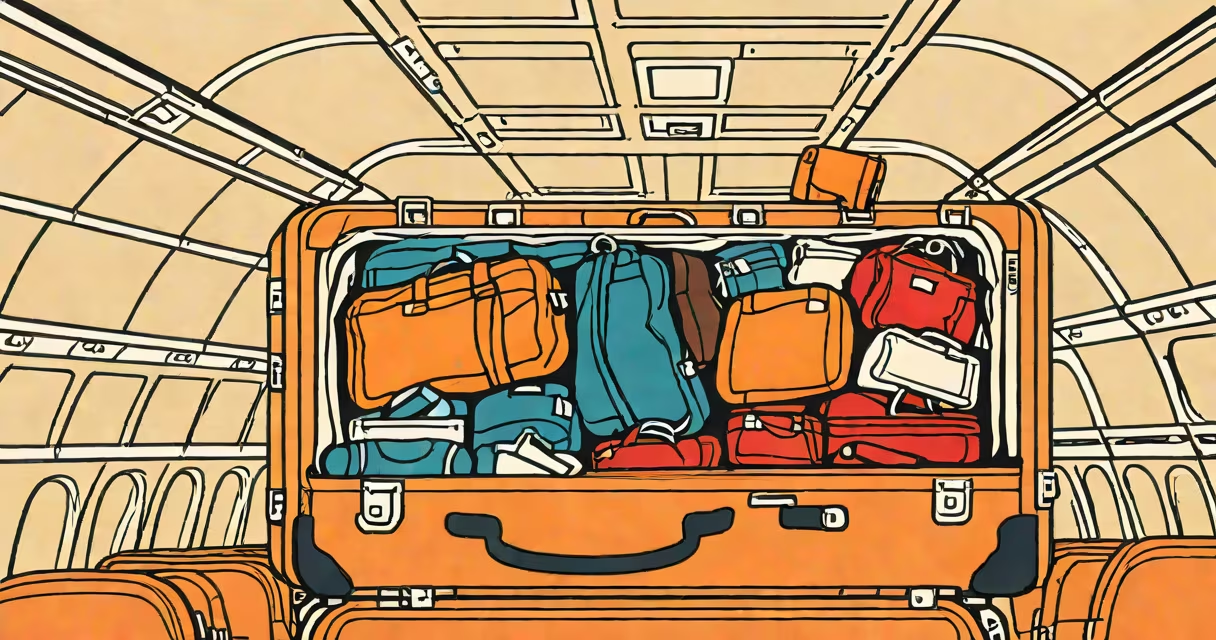
Overhead luggage must fit within standard airline dimensions-typically 22 x 14 x 9 inches (56 x 35 x 23 cm)-to fit in the cabin bin without requiring gate check. This size applies to most domestic and international flights, though exceptions exist based on airline policy and aircraft model.
Carry-on bags must meet both linear and individual dimension limits. The total linear measurement (length + width + height) must not exceed 45 inches (115 cm) for most U.S.-based airlines. A bag measuring 22 x 14 x 9 inches totals exactly 45 inches, making it compliant under this rule. Airlines enforce these limits to ensure consistent bin space and boarding efficiency.
Some airlines allow slightly larger bags if they fit in the bin. Delta allows bags up to 24 x 16 x 10 inches (61 x 41 x 25 cm) if they pass the bin test. United permits bags up to 24 x 16 x 10 inches as long as they fit in the bin and don't require gate check. These variations show that physical fit matters more than strict measurements in practice.
Airlines measure carry-on bags using the maximum external dimensions, including wheels, handles, and side pockets. Bags are measured from the farthest point on each side, not just the base. A bag with a 2-inch handle extension may exceed the 22-inch limit even if the main body is smaller.
To test your bag, place it upright and measure the longest horizontal distance (length), widest side (width), and vertical height. Use a rigid tape measure, not a flexible one. Many travelers fail because they measure only the base or forget to include the handle.
For example, a bag labeled "20 x 14 x 9 inches" may still exceed 22 inches in length if the handle extends beyond the frame. A 22-inch flat surface with a 2-inch handle adds 2 inches to the total length. This bag would fail the 22-inch limit and be rejected at the gate.
Different airlines enforce different standards. While most U.S. carriers follow similar guidelines, international lines often differ. The table below compares common airline policies:
| Airline | Max Linear (inches) | Max Individual Dimensions | Bin Fit Guarantee? |
|---|---|---|---|
| Delta | 45 | 24 x 16 x 10 | No-must fit physically |
| United | 45 | 24 x 16 x 10 | No-bin test required |
| Southwest | 45 | 22 x 14 x 9 | Yes-meets exact specs |
| Lufthansa | 115 cm (45.3 in) | 55 x 40 x 20 cm (21.7 x 15.7 x 7.9 in) | No-size varies by aircraft |
| British Airways | 115 cm (45.3 in) | 56 x 45 x 25 cm (22 x 17.7 x 9.8 in) | No-bin fit required |
Southwest enforces a strict 22 x 14 x 9 inch limit. Their bins are smaller and less forgiving. Even a 0.5-inch difference in height can prevent entry. Delta and United allow larger bags but rely on physical bin testing. A bag that measures 24 x 16 x 10 inches may still be rejected if the bin is narrow or already partially filled.
Non-U.S. airlines often use centimeters. Always convert units correctly. A bag listed as 55 x 40 x 20 cm equals 21.7 x 15.7 x 7.9 inches-just under the 22-inch limit. But rounding errors during conversion can lead to mistakes. Use a calculator or conversion chart to avoid miscalculation.
Many travelers assume that "carry-on" means "fits in the overhead bin." That's not always true. Some airlines allow a personal item (like a purse or laptop bag) plus a carry-on. Others treat the personal item as part of the carry-on allowance. Confusion arises when passengers bring two bags and think they're compliant.
Another misconception is that all overhead bins are the same size. Bins vary by aircraft model. A Boeing 737-800 has a smaller bin than an Airbus A321. A bag that fits in one plane may not fit in another. This is why some passengers are denied boarding despite having a bag that meets the stated size.
One non-obvious fact: overhead bins fill quickly. On a full flight, bins are often half-full by row 10. Passengers boarding early have better success. Late boarding increases the chance of gate check-even with compliant bags. A 2022 study by the International Air Transport Association (IATA) found that 38% of carry-ons were checked at the gate on high-demand routes, even when dimensions were correct.
I once brought a 22 x 14 x 9 inch suitcase on a United flight from Chicago to Denver. The bag met all published size requirements. At the gate, the agent asked me to open it. Inside was a 10-inch-wide camera bag strapped to the side. When closed, the bag extended 23 inches in length. The agent rejected it due to the protruding item.
The bag passed the initial measurement but failed the physical inspection. This happened because the airline considers the bag's total external profile-not just the main body. The camera bag added 1 inch to the length, pushing the total to 23 inches. Even though the main compartment was within limits, the size exceeded the bin threshold.
This incident shows that compliance isn't just about numbers-it's about how the bag presents itself. Items that extend beyond the frame, such as side pockets, handles, or straps, can cause rejection. Always pack tightly and avoid bulky attachments.
If your bag doesn't fit, the airline will ask you to check it at the gate. You'll pay a fee unless you have a free checked bag allowance. Most domestic U.S. flights charge $30-$50 for the first checked bag. International flights cost more.
Some airlines offer a "gate check" service for a small fee. This avoids the long line at the baggage claim. However, the bag is treated as checked luggage and subject to loss or delay. A 2023 report by the U.S. Department of Transportation found that 1 in 15 checked bags were delayed or lost, compared to 1 in 100 for carry-ons.
To avoid issues, measure your bag before leaving home. Use a hard-sided ruler or a travel measuring tool. Pack only essential items. Avoid oversized bags with multiple compartments or detachable wheels. If you're unsure, use a carry-on size guide to verify compliance.
Understanding what size is overhead luggage ensures smoother travel. Stick to the 22 x 14 x 9 inch standard for the highest chance of bin acceptance. Measure accurately. Pack smart. Avoid gate checks and extra fees.