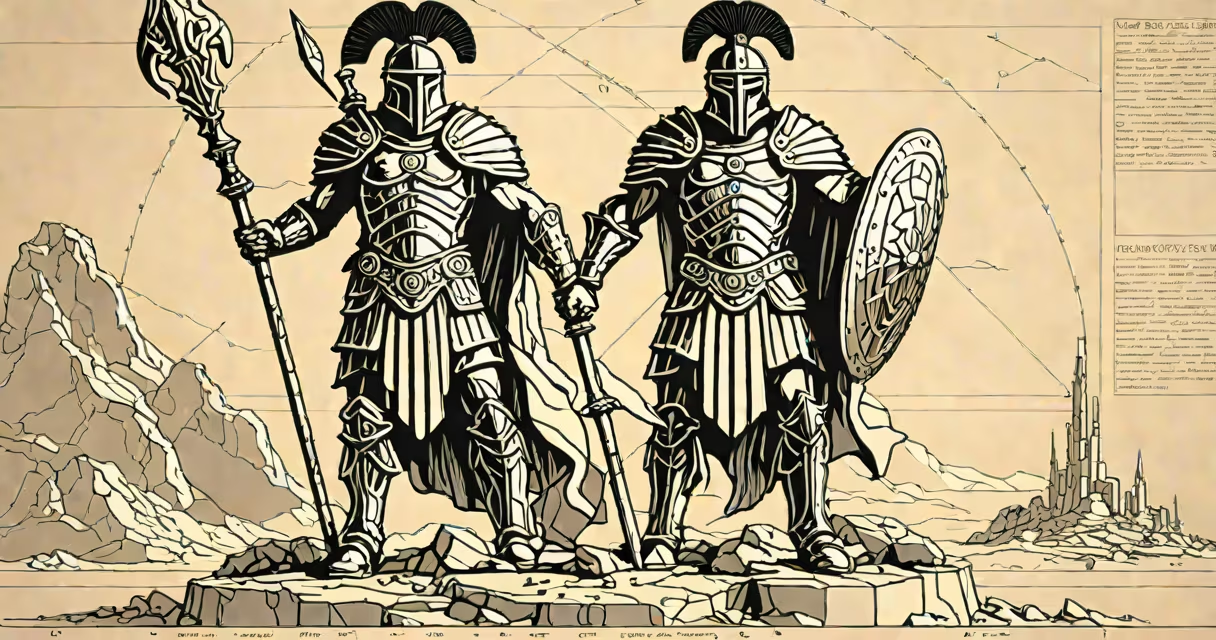
Ares is the ancient Greek god of war, embodying the violent and chaotic aspects of battle rather than strategic military leadership. He is one of the Twelve Olympians and the son of Zeus and Hera. His Roman counterpart is Mars.
Unlike Athena, who represents disciplined warfare and strategy, Ares personifies raw force, bloodshed, and the frenzy of combat. He is often depicted in full armor, wielding a spear and shield, and associated with thunderstorms and the scent of iron.
According to Theoi Project, Ares was not widely worshipped in ancient Greece, despite his prominence in myth. His cult centers were limited, and he was frequently viewed with ambivalence-feared for his destructive nature but acknowledged as necessary in conflict.
In Greek myths, Ares operates as a warrior deity whose actions reflect the unpredictability of war. He intervenes directly in battles, often siding with the side he favors, regardless of moral alignment. His involvement in the Trojan War is well-documented: he supports the Trojans and fights against the Greeks, particularly Achilles.
One key episode occurs in Book V of the Iliad, where Ares wounds Diomedes with a spear. The wounded hero calls out to Athena for help, and she responds by driving Ares from the battlefield. This moment illustrates the tension between divine will and mortal agency-Ares is useful, but not invincible.
Ares is also involved in romantic entanglements. He famously had an affair with Aphrodite, the goddess of love. Their relationship was exposed by Hephaestus, Aphrodite's husband, who trapped them in a golden net during a wedding feast. The incident became a subject of mockery among the gods and is recorded in Hesiod's Theogony.
Ares is associated with several symbols: the spear, sword, helmet, and shield. His sacred animals include the vulture, dog, and boar. The vulture symbolizes death and scavenging, reflecting war's aftermath.
He is often linked to the planet Mars in Roman mythology. The Romans adopted Ares as Mars, but transformed him into a more disciplined and civic-minded figure-Mars was the father of Romulus and Remus and a patron of Rome's military campaigns.
| Aspect | Greek Ares | Roman Mars |
|---|---|---|
| Primary Domain | Violent war, chaos | Legitimate warfare, military discipline |
| Personality | Aggressive, impulsive | Orderly, protective |
| Worship | Limited; few temples | Extensive; major state cult |
| Sacred Animal | Vulture, boar | Wolf, vulture |
Ares is often mistaken for a hero or a champion of justice. He is not. He does not fight for honor, defense of the innocent, or national pride. His motives are personal-victory, glory, and dominance through force.
Another misconception is that Ares was universally feared. While he inspired dread, especially in military contexts, he was also seen as essential. As scholar Sarah Pomeroy notes in Gods and Heroes of the Ancient World, "Ares was not a villain-he was a necessary force, even if dangerous."
There is also confusion about his parentage. Some early texts suggest he was born from the union of Zeus and Hera, but others claim he emerged fully formed from the sky. The most consistent version identifies him as a child of Zeus and Hera, though his birth was not celebrated.
Ares appears in numerous artworks and literary references. The Ares Borghese, a 2nd-century CE marble statue discovered in Rome, shows him nude except for a cloak and helmet, emphasizing his physical power and martial identity.
In modern media, Ares appears in films such as Wonder Woman (2017), where he is portrayed as a fallen god who seeks to destroy humanity. The film takes creative liberties, but it reflects the enduring image of Ares as a threat to peace.
One lesser-known fact: Ares was never officially worshiped in Athens. The city's religious calendar excluded him. When the Athenians needed a war god, they turned to Athena. This distinction highlights how Greek city-states valued different ideals-Athens prioritized wisdom and strategy over brute strength.
During my visit to the National Archaeological Museum in Athens, I saw a small bronze figurine of Ares from the 5th century BCE. It showed him with a raised spear and a fierce expression. The label noted it was likely a votive offering from a soldier, not a temple statue. That detail struck me-this god wasn't honored in ritual, but invoked in private desperation.
Who is Ares? He is not a symbol of honor, victory, or national unity. He is the embodiment of war's brutality-the god who thrives on blood, fear, and chaos. His presence in myths serves as a warning: unchecked violence leads to destruction.
Understanding Ares requires separating him from later romanticized views of war. He is not a role model. He is a reminder of war's true cost. For those interested in ancient deities, exploring Ares offers insight into how early societies grappled with violence and power.