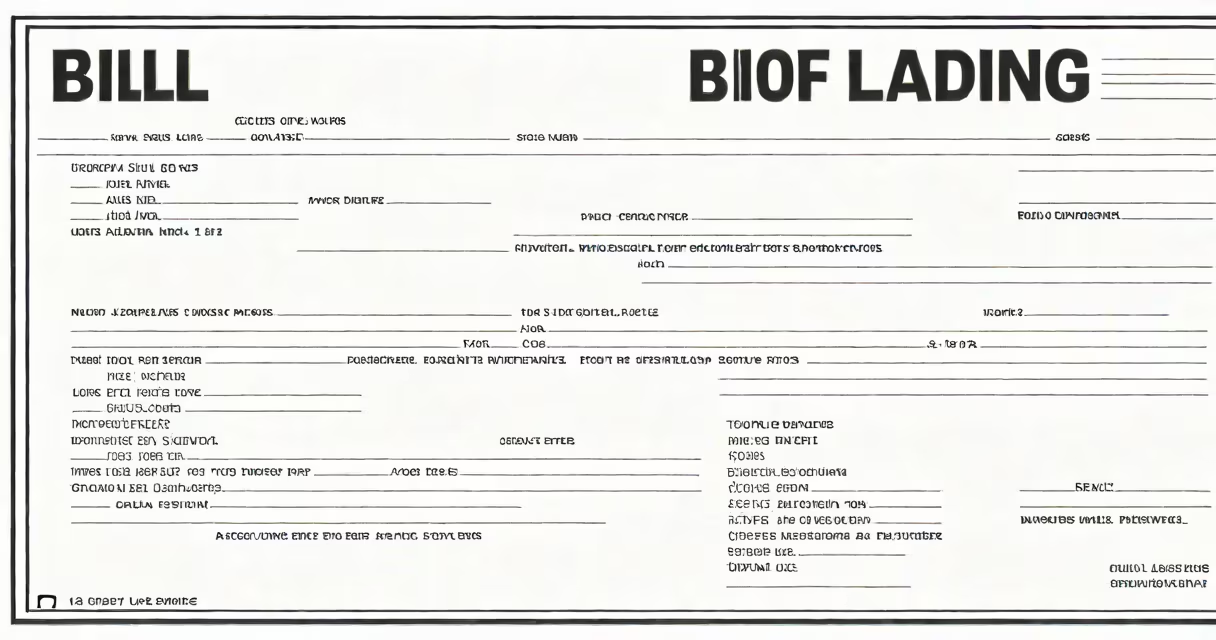
A blank bill of lading is a legally binding shipping document that authorizes the movement of goods and establishes ownership during transit. It contains essential details such as consignor, consignee, description of cargo, route, and carrier information-but leaves key fields uncompleted until finalized.
Used primarily in international trade, the blank bill of lading functions as both a receipt for goods and a contract of carriage. It enables the transfer of title to the cargo upon delivery. The document becomes valid only when completed and signed by the carrier or authorized agent.
According to the International Maritime Organization (IMO), a bill of lading must meet specific requirements under the Hague-Visby Rules to be enforceable in cross-border shipments. A blank version is issued before loading begins, allowing shippers to fill in final details after goods are loaded.
The blank bill of lading begins as a template with predefined sections but no data entered. Once the cargo is loaded onto a vessel, truck, or train, the shipper completes the form with actual shipment details. This includes the precise weight, volume, commodity classification, and destination address.
After completion, the carrier signs the document, confirming receipt of goods. At this point, the bill of lading transforms from a blank template into a legal instrument. The original copy is then sent to the consignee, who uses it to claim the cargo at the port of discharge.
For example, a U.S.-based electronics manufacturer ships 500 units of a new smartphone from Shenzhen to Los Angeles. Before loading, they receive a blank bill of lading from the freight forwarder. After the container is sealed, the forwarder fills in the actual weight (2,400 kg), container number (ABCD1234567), and destination terminal. The carrier signs it, and the document is released to the buyer's bank as part of a letter of credit process.
While the term "blank" implies incompleteness, several standard types exist based on purpose and issuance method:
| Type | Use Case | Key Feature |
|---|---|---|
| Order Bill of Lading | Payment via letter of credit | Requires endorsement to transfer ownership; cannot be transferred without signature |
| Bearer Bill of Lading | Immediate release to whoever holds the document | High risk; allows physical possession to confer title |
| Sea Waybill | Non-negotiable transport; common in domestic or regional routes | No physical document needed; electronic release suffices |
Only the order bill of lading requires a blank version to be filled out before being endorsed. Bearer bills are often issued in blank form because ownership transfers simply by handing over the paper. Sea waybills bypass the need for a blank form entirely-they're filled out at the time of booking.
One common misconception is that a blank bill of lading is always unsafe. In reality, the risk lies not in the blank state itself, but in how it's handled. A properly controlled blank bill-signed only after verification-is standard practice in regulated supply chains.
Many users confuse a blank bill of lading with a pro forma invoice or packing list. These documents serve different roles: the pro forma invoice outlines pricing and payment terms; the packing list details contents and packaging. Neither replaces the bill of lading in customs clearance or title transfer.
Another frequent error is assuming that a blank bill of lading can be used to claim cargo. It cannot. Without completion and signature, it lacks legal force. Attempting to present a blank form to customs results in immediate rejection. The U.S. Customs and Border Protection (CBP) mandates that all bills of lading submitted for import must contain complete, verified data.
Even experienced logistics staff sometimes fail to distinguish between a blank bill and a voided one. A voided bill is a canceled document marked as invalid. It may still be retained for audit purposes but cannot be reused. A blank bill remains usable until completed.
In my experience managing ocean freight for a textile exporter, we once received a blank bill of lading from a shipping line. The form had all required fields but was missing the container seal number and final destination. We flagged it internally and waited until the container was scanned at the terminal before submitting the completed version.
When the document arrived at the port in Rotterdam, the customs broker rejected it due to an incorrect Harmonized System (HS) code. We corrected the entry using the original blank form as a reference, updated the commodity description, and resubmitted. The shipment cleared within 24 hours.
This incident underscored that even a blank bill of lading must follow strict formatting rules. The International Chamber of Commerce (ICC) guidelines specify that all entries must match the actual cargo and comply with Incoterms® 2020. Failure to do so triggers delays and penalties.
Always verify that a blank bill of lading is issued by a recognized carrier or freight forwarder. Unauthorized versions may lack legal standing. Once completed, retain the original for six years-this period aligns with IRS and EU recordkeeping standards for international transactions.
The blank bill of lading is not a formality-it is a foundational tool in global trade. Its proper use ensures secure, traceable, and compliant movement of goods across borders.