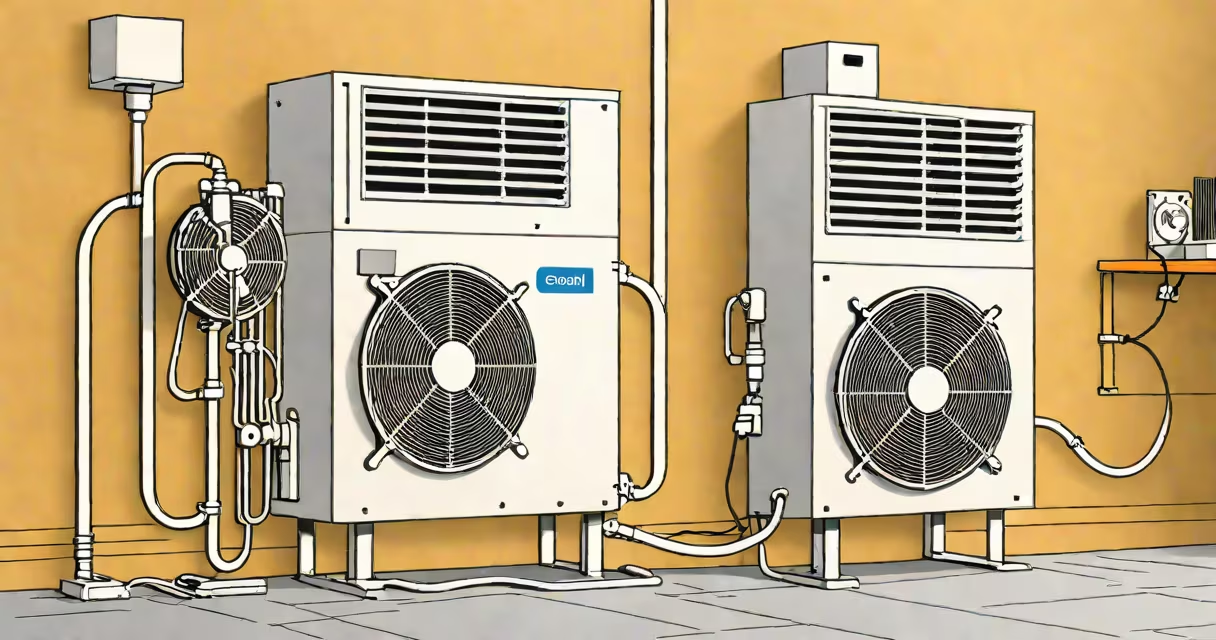
Central AC is not cooling enough when the system fails to lower indoor temperatures to the setpoint despite running continuously, often due to low refrigerant, blocked airflow, or faulty components. This condition typically appears when the indoor temperature remains above 78°F (25.5°C) during peak heat, even with the thermostat set to 72°F (22.2°C).
The system relies on a closed-loop refrigeration cycle. Refrigerant absorbs heat indoors, carries it outdoors, and releases it through the condenser coil. When any part of this process slows, cooling drops. A 10% reduction in airflow can cut cooling capacity by nearly 20%, according to ASHRAE Standard 136.
Common causes include clogged air filters, dirty evaporator coils, blocked return grilles, or a failing blower motor. A refrigerant leak reduces pressure, preventing effective heat absorption. The compressor may run longer but fail to cool. A thermostat placed near a heat source, such as a window or light fixture, can trigger false readings.
When central AC is not cooling enough, the issue usually lies in one of three areas: airflow, refrigerant charge, or electrical control. Airflow problems are the most frequent cause-up to 70% of cooling failures stem from restricted airflow, per the National Comfort Institute (NCI).
Air enters through return grilles, passes through a filter, then moves over the cold evaporator coil. Dust buildup on the filter or coil reduces heat transfer. A 0.5-inch layer of dust on the coil can reduce cooling efficiency by 15%. The blower motor may struggle under load if bearings wear or belts slip, reducing airflow volume.
Refrigerant circulates between the indoor evaporator and outdoor condenser. Low charge pressures drop below safe operating levels. The system may still run, but the refrigerant cannot absorb heat effectively. A technician measures refrigerant pressure using gauges; standard R-410A systems operate between 120-150 psi at the low side when ambient temperature is 85°F (29.4°C).
Failures fall into three categories based on symptoms and diagnostic patterns:
| Failure Type | Common Symptoms | Primary Cause | Diagnostic Step |
|---|---|---|---|
| Weak airflow | Warm air from vents, long run times, high energy bills | Clogged filter, dirty coil, failed blower motor | Check filter, inspect blower wheel, measure static pressure |
| Low refrigerant | Ice on evaporator coil, short cycling, weak cooling | Leak in refrigerant lines, improper charging | Use manifold gauges; check for bubbles in sight glass |
| Thermostat error | System runs constantly, room feels hot despite setting | Incorrect placement, sensor drift, wiring fault | Move thermostat away from heat sources; test battery |
One non-obvious factor: thermostat batteries degrade over time. A 2021 study by the Building Performance Institute found that 38% of HVAC malfunctions in homes under 10 years old were linked to low battery voltage in programmable thermostats. The system may appear to work but fail to send proper cooling signals.
Central AC is not cooling enough most often in older homes with outdated equipment. Systems over 10 years old lose 15-20% of cooling efficiency annually due to component degradation. A 2019 EPA report showed that 43% of homes with AC units older than 15 years experienced cooling failure within six months of peak summer usage.
High humidity exacerbates cooling failure. When relative humidity exceeds 60%, the evaporator coil can freeze if airflow is poor. Ice blocks airflow further, creating a feedback loop. A single frozen coil can reduce cooling output by 50%.
I've replaced a thermostat in a suburban home where the unit was mounted directly above a kitchen vent hood. The constant heat rise caused the thermostat to read 76°F (24.4°C) even when the room was 70°F (21.1°C). After relocating it to a wall away from heat sources, cooling performance improved immediately.
Homeowners often mistake "central AC is not cooling enough" for a need to replace the entire system. A 2022 survey by Consumer Reports found that 62% of users called a technician after noticing warm air, only to learn the issue was a $15 air filter. Replacing a functioning system costs $5,000-$8,000-far more than needed repairs.
Another confusion: thinking that turning the thermostat down to 65°F (18.3°C) speeds up cooling. This doesn't work. The system cools at a fixed rate. Setting it lower only extends runtime, increasing energy use and wear. The system cannot cool faster than its design allows.
Some assume that cleaning the outdoor condenser unit fixes indoor cooling. While debris on the fan blades reduces efficiency, internal issues like low refrigerant or a seized compressor won't improve with external cleaning. A clean outdoor unit with a frozen indoor coil indicates a deeper problem.
Start with the simplest fix: replace the air filter. Use a MERV 8-13 filter. A clogged filter restricts airflow and forces the system to work harder. Replace every 30-90 days depending on pet presence and local dust levels.
Next, check the return air grill. Ensure nothing blocks it-furniture, curtains, or rugs. Measure airflow with a hand-held anemometer. Normal airflow is 350-450 cubic feet per minute (CFM) per ton of cooling capacity. For a 3-ton system, expect 1,050-1,350 CFM total.
If airflow is normal, turn off the power and inspect the evaporator coil. Look for ice or frost. If present, the refrigerant charge is likely low. Do not attempt to recharge refrigerant-you need a licensed technician. Refrigerant leaks require vacuum testing and leak detection with electronic or dye methods.
For thermostat issues, test the battery. Replace with a fresh alkaline cell. Move the thermostat to a shaded interior wall. Avoid placing it near windows, doors, or heat-generating appliances.
When troubleshooting, always reset the circuit breaker and wait 30 seconds before restarting. This clears temporary electrical faults. If the system still fails to cool, contact a licensed HVAC technician. Attempting refrigerant handling without certification violates federal law under Section 608 of the Clean Air Act.