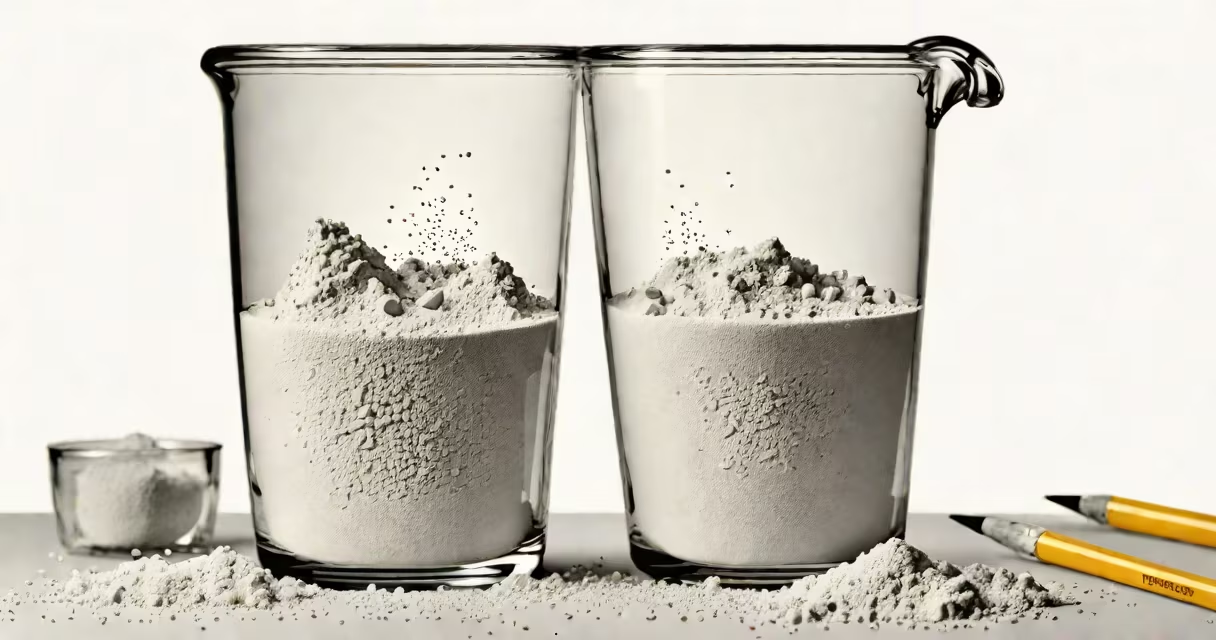
A mixture in chemistry is a physical combination of two or more substances where each component retains its chemical identity and properties. No new compound forms during mixing, and the original substances can be separated using physical methods.
Mixtures form when materials combine without undergoing a chemical reaction. The components do not bond chemically, so they can be isolated through processes like filtration, distillation, evaporation, or magnetic separation. This distinguishes them from chemical compounds, where atoms bond to form new substances with different properties.
For example, dissolving sugar in water creates a mixture. The sugar molecules remain intact, and you can recover them by boiling off the water. The resulting syrup is not a new chemical-it's still sugar and water, just combined.
Chemical mixtures rely on physical interactions, not chemical bonds. Substances in a mixture maintain their individual chemical formulas and behaviors. When you stir oil into water, the two liquids don't react-they simply coexist, forming a visible boundary between layers.
Because no chemical change occurs, the process is reversible. You can separate most mixtures using mechanical or physical techniques. For instance, filtering coffee grounds from brewed coffee removes solids without altering the liquid's chemical makeup.
Even complex systems like air qualify as mixtures. Air contains nitrogen (78%), oxygen (21%), argon (0.9%), carbon dioxide (0.04%), and trace gases-all physically blended, none transformed into new compounds.
Chemists classify mixtures based on uniformity and particle size. The two primary categories are homogeneous and heterogeneous mixtures.
| Type | Appearance | Particle Size | Examples | Separation Method |
|---|---|---|---|---|
| Homogeneous | Uniform throughout; single phase | Atomic to molecular scale | Saltwater, air, brass alloy | Distillation, evaporation |
| Heterogeneous | Non-uniform; visible differences | Larger than molecular scale | Sand and iron filings, salad dressing, muddy water | Filtration, decanting, magnetism |
Homogeneous mixtures appear consistent across samples. Saltwater looks the same whether you take a spoonful from the top or bottom. These are often called solutions, especially when a solid dissolves in a liquid.
Heterogeneous mixtures show visible boundaries between components. A bowl of cereal with milk separates into solid pieces and liquid. The components can be seen with the naked eye and are easily distinguished.
Some mixtures fall between these categories. Colloids, such as milk or fog, contain particles too small to settle out but large enough to scatter light. They appear uniform but aren't truly homogeneous at the microscopic level.
People often confuse mixtures with compounds. A compound results from a chemical reaction-atoms bond to form a new substance with unique properties. Water (H₂O) is a compound; it cannot be broken down into hydrogen and oxygen by physical means alone.
By contrast, a mixture like saltwater can be separated into salt and water through evaporation. The salt remains NaCl, and the water stays H₂O-no new substances formed.
Another misunderstanding is that all mixtures are safe or stable. Some mixtures, like gasoline and air, are flammable. Others, like certain metal alloys, degrade under heat or moisture. Stability depends on the components, not the mixture itself.
Understanding mixtures enables practical applications across industries. In pharmaceuticals, drug delivery systems rely on suspensions-heterogeneous mixtures where active ingredients remain suspended in a carrier fluid. These must be shaken before use to ensure even dosing.
In environmental science, wastewater treatment uses filtration and sedimentation to separate pollutants from water. These are physical separation techniques applied to heterogeneous mixtures.
Industrial refining processes depend on distillation to separate crude oil into fractions like gasoline, diesel, and kerosene. Each fraction boils at a different temperature-a property exploited because the components remain chemically unchanged.
I once observed a lab experiment where students separated a mixture of iron filings, salt, and sand. Using a magnet, they removed the iron. Then they dissolved the salt in water, filtered out the sand, and evaporated the water to recover dry salt. The entire process relied only on physical properties-no chemicals were added or altered.
Not all combinations are mixtures. A solution requires solute and solvent interaction, but even then, no chemical reaction occurs. Sugar dissolving in tea is a physical change. The sugar molecules remain intact, and you can retrieve them by boiling the liquid.
One non-obvious fact: mixtures can have variable composition. Unlike pure substances, which have fixed ratios (like water always being H₂O), mixtures can vary in concentration. Air can contain 0.04% CO₂ or 0.06%, depending on location and time. This variability is a sign of mixtures.
Also, mixtures don't follow the law of definite proportions. Pure compounds do-water is always 11.2% hydrogen by mass. But saltwater can be 1% or 10% salt, depending on dilution. This flexibility defines mixtures.
Understanding mixtures connects to other core ideas in chemistry. For example, isotopes definition in chemistry explains how atoms of the same element differ in neutron count. These variations affect atomic mass but not chemical behavior-important when analyzing mixtures containing elements with multiple isotopes.
The mole definition chemistry provides a way to quantify substances in mixtures. A 1-mole sample of sodium chloride contains 6.022 × 10²³ formula units. This allows precise measurement when preparing mixtures for experiments or industrial processes.
Green chemistry principles emphasize reducing waste and avoiding hazardous mixtures. Designing processes that use safer solvents or minimize byproducts improves safety and sustainability. definition of green chemistry addresses how chemistry can be both effective and environmentally responsible.
The definition of mixture in chemistry describes a physical blend of substances that do not react chemically. Components retain their identities and can be separated by physical means. Homogeneous and heterogeneous mixtures differ in appearance and separation method. Recognizing mixtures helps explain everyday phenomena-from cooking to pollution control-and supports advanced work in medicine, materials science, and environmental engineering.