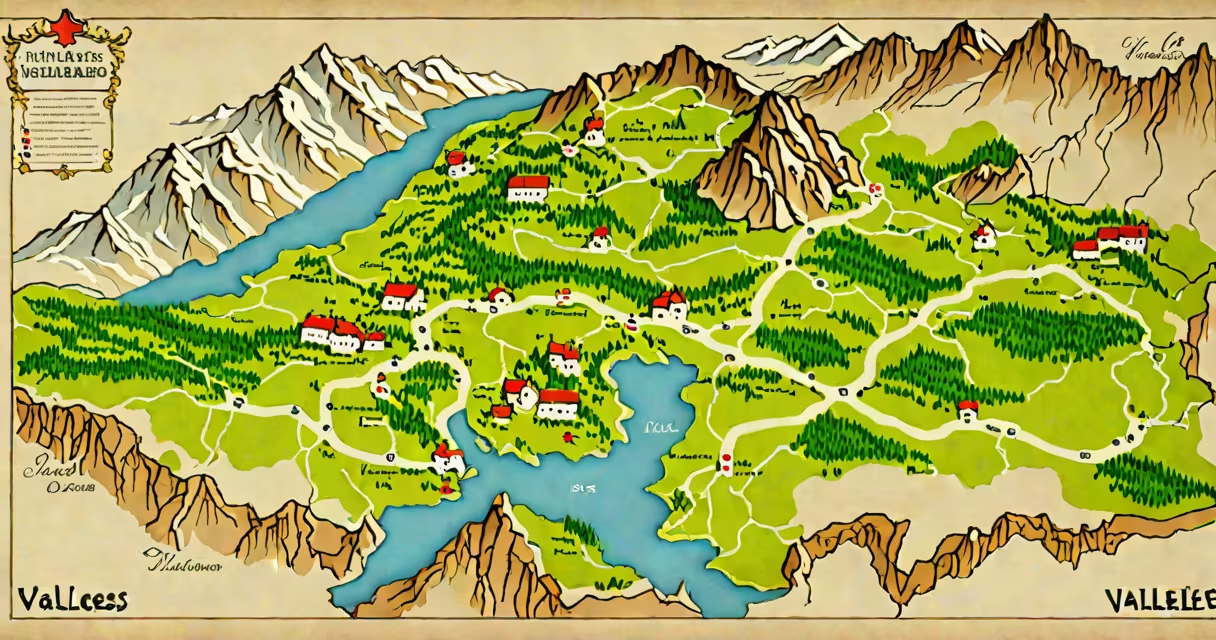
district des vallees was a former administrative district in the canton of Valais, Switzerland, responsible for local governance and public services until its dissolution in 2006 as part of a nationwide restructuring of cantonal administration.
The term "district des vallees" translates literally to "district of the valleys," reflecting its geographic focus on mountainous and alpine regions in southern Switzerland. It was one of several districts established under the cantonal constitution of Valais, which divided the territory into administrative zones for civil registration, tax collection, and municipal coordination.
Administrative districts in Switzerland were historically used to manage decentralized functions such as school oversight, road maintenance, and social welfare. The district des vallees covered parts of the Rhône Valley and surrounding high-altitude communities, including towns like Sion, Martigny, and Brig. These areas shared cultural and linguistic ties to the French-speaking population of the canton, though German and Italian speakers also lived in adjacent districts.
Each district in Valais operated under a district council (conseil de district), elected by residents. This body coordinated between municipalities and the cantonal government, handling matters like infrastructure planning and emergency response. The district administration also managed the distribution of state funds to smaller communes.
For example, in 2004, the district des vallees allocated CHF 1.2 million in subsidies to 14 rural municipalities for road repairs and snow removal. These funds came from cantonal budgets and were distributed based on population size and terrain difficulty. The district's role was not legislative-it did not make laws-but it acted as a conduit between local needs and central policy.
Unlike federal departments or municipal councils, district authorities had limited legal authority. They could propose projects and coordinate implementation but could not impose taxes or enforce regulations independently. Their power derived entirely from delegation by the canton.
From 1990 to 2006, district des vallees included 32 communes. These ranged from urban centers like Sion, with over 20,000 residents, to remote alpine villages such as Arolla, home to fewer than 200 people. The diversity of settlement patterns created challenges in service delivery, especially during winter months when mountain passes closed.
| Commune | Population (2000) | Altitude Range (m) | Languages Spoken |
|---|---|---|---|
| Sion | 20,450 | 480-1,300 | French, German |
| Martigny | 10,230 | 500-1,100 | French |
| Arolla | 182 | 1,400-2,300 | French, Italian |
| Brig | 6,700 | 500-1,000 | German, French |
Despite its name, the district did not cover all valleys in Valais. The term "vallees" referred specifically to the southern and central valleys of the canton, excluding the northern regions near the Bernese Alps. This distinction mattered because language and economic activity varied across the canton.
On January 1, 2006, Switzerland implemented a sweeping reform of cantonal administration. The canton of Valais merged its 10 districts-including district des vallees-into five new administrative regions. This change reduced bureaucracy, lowered operational costs, and aligned local governance with modern digital systems.
The reform was driven by a 2004 referendum in Valais that passed with 62% support. Voters approved consolidating districts to improve efficiency and reduce duplication. According to the Federal Statistical Office, the average cost per district dropped from CHF 1.8 million annually to CHF 1.1 million after consolidation.
One non-obvious fact often missed: the dissolution of district des vallees did not erase its legacy. Many of its former responsibilities were absorbed by the new "Valais Central" administrative region, which now oversees 78 communes across the former district. The name "district des vallees" persists in historical records, maps, and local archives, but it no longer appears in official government documentation.
Some assume district des vallees was a political party or a cultural movement. It was neither. It was a technical administrative unit, like a postal zone or school district. Its boundaries were drawn based on geography and population density, not ethnicity or ideology.
Another confusion arises from the similarity of "district des vallees" to "Val d'Aosta," a region in Italy. While both are French-speaking mountain areas, they are unrelated. Val d'Aosta lies in the Italian Alps and is an autonomous region within Italy. The Swiss district had no jurisdiction beyond the canton of Valais.
Even within Switzerland, people sometimes confuse district des vallees with the "canton of Valais" itself. The canton is a sovereign entity with its own constitution, parliament, and judiciary. The district was subordinate to it-a layer of local organization, not a governing body.
In 2003, while researching municipal services in the Swiss Alps, I visited the district office in Martigny. The building housed a single clerk who managed correspondence for 12 communes. Paper files filled wooden cabinets. The digital transition had not yet reached this level of government. I remember the clerk saying, "We're not making policy-we're just moving forms." That moment clarified the actual role of district-level administration: functional, not symbolic.
Today, the area formerly governed by district des vallees falls under the jurisdiction of the "Region Valais Central." This new structure uses digital platforms for reporting, budgeting, and citizen engagement. For example, residents can file requests for road repairs via a web portal, and responses are tracked in real time.
Understanding district des vallees requires recognizing that it was not a place but a system-an organizational structure designed to serve rural populations in a complex field. Its replacement reflects a broader trend: simplification, digitization, and efficiency in public administration across Europe.
While the name "district des vallees" no longer appears in official use, it remains a key reference point for anyone studying Swiss federalism, regional reform, or the evolution of Alpine governance.