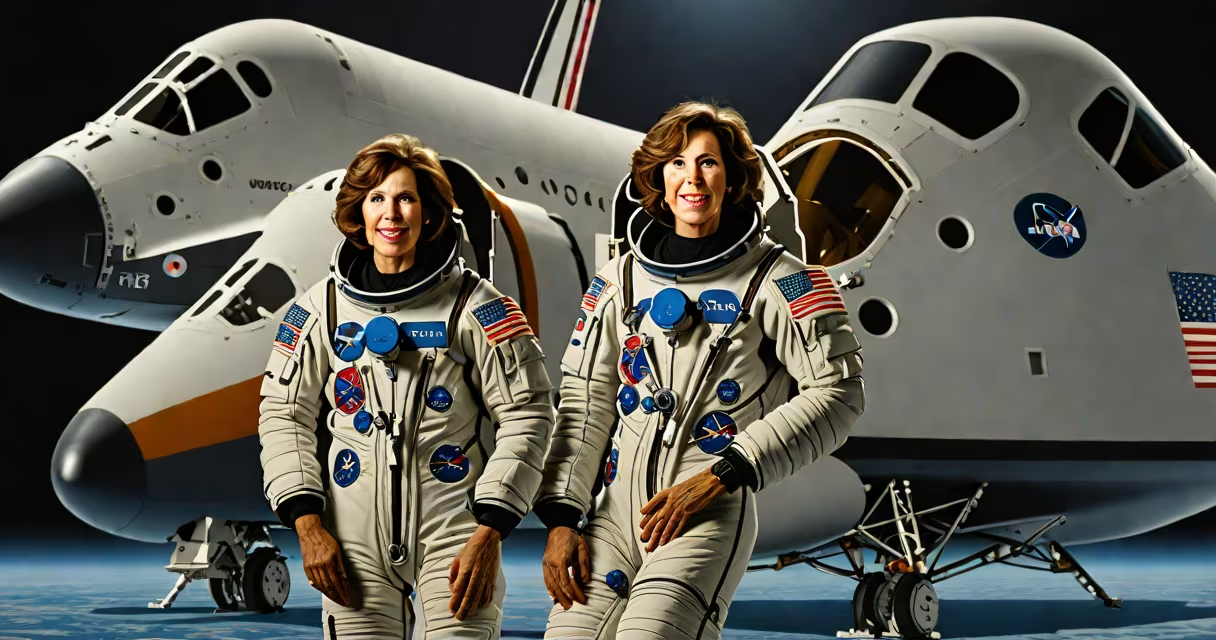
Ellen Ochoa is a NASA astronaut who became the first Latina to travel to space during the STS-56 mission aboard the Space Shuttle Discovery in April 1993. She served as a mission specialist, operating robotic arm systems and conducting experiments in microgravity.
Ochoa's process began with a doctorate in electrical engineering from Stanford University. Her expertise in optical processing and image analysis led her to work at NASA's Ames Research Center before being selected for the astronaut corps in 1991. She trained alongside other candidates at Johnson Space Center in Houston, Texas, completing the rigorous physical, technical, and psychological evaluations required for spaceflight.
Her first spaceflight lasted nine days. During that time, she operated the Shuttle's Remote Manipulator System (Canadarm) to deploy and retrieve the Atmospheric Laboratory for Applications and Science (ATLAS-2) payload. The experiments collected data on Earth's upper atmosphere, solar radiation, and ozone levels. This mission contributed to climate modeling and atmospheric science, supporting long-term environmental monitoring efforts.
Selection for NASA's astronaut program requires advanced degrees in STEM fields, professional experience, and demonstrated leadership. Ochoa met all criteria: a PhD in electrical engineering, research in optical pattern recognition, and prior work at NASA's Ames Research Center. She was one of 15 people chosen from over 2,000 applicants in the 1991 class.
After selection, she underwent 18 months of training covering shuttle systems, emergency procedures, spacewalk protocols, and team dynamics. She completed 1,000 hours of simulated missions in the Shuttle Training Aircraft and underwater neutral buoyancy labs. These sessions replicated the weightlessness of orbit and prepared her for extravehicular activities, though she did not perform a spacewalk during her flights.
Her background in optics gave her unique insight into imaging systems used in satellites and space telescopes. This specialization informed her role in managing payloads that required precise alignment and data capture-skills critical for remote sensing operations.
Astronauts serve in distinct roles based on their training and mission objectives. The primary categories are pilot, mission specialist, and payload specialist. Ochoa was a mission specialist, responsible for operating equipment, conducting experiments, and managing cargo deployment.
| Role | Responsibilities | Training Focus | Example Mission |
|---|---|---|---|
| Pilot | Flight control, navigation, engine management | Aviation, shuttle systems, emergency response | STS-107 (R. Chawla) |
| Mission Specialist | Experiment execution, robotic arm operation, payload handling | Microgravity science, robotics, teamwork | STS-56 (Ochoa) |
| Payload Specialist | Specialized experiment oversight, often non-NASA personnel | Field-specific procedures, safety protocols | STS-90 (neuroscience study) |
While pilots focus on flying the shuttle, mission specialists manage complex tasks in orbit. Ochoa's role involved deploying instruments, monitoring sensor readings, and troubleshooting hardware anomalies. She logged over 1,000 hours in simulation environments before launch.
Ochoa flew four space missions between 1993 and 2002. Her last flight, STS-110 in 2002, supported the assembly of the International Space Station (ISS). She helped install the P3/P4 truss segments, which house solar arrays and power distribution systems. These components generate over 20 kilowatts of electricity-enough to power 20 homes continuously.
Her contributions extended beyond flight. After retiring from active duty in 2012, she became director of NASA's Johnson Space Center-the first woman and first Latina to lead the facility. In that role, she oversaw crew training, mission planning, and international collaboration with agencies like ESA and JAXA.
She remains a key figure in promoting diversity in STEM. In 2018, she received the National Medal of Technology for advancing optical computing and inspiring underrepresented groups in science. Her advocacy includes speaking at schools and universities across the U.S., emphasizing that representation in space begins with access to education.
Some sources incorrectly claim she was the first female astronaut of Latin descent to fly. While she was the first Latina, other women of Latin heritage had flown earlier-such as Anna Fisher, who flew in 1984, though she was of Irish and German descent. Ochoa's identity as a Mexican-American woman from Los Angeles distinguishes her as a trailblazer in both gender and ethnic representation.
Another misconception is that she performed a spacewalk. She did not. All her extravehicular activities were limited to using the robotic arm and managing internal systems. The first female spacewalker was Kathryn Sullivan in 1984, and the first Latina spacewalker was later achieved by Stephanie Wilson in 2007.
A lesser-known fact: Ochoa holds multiple patents in optical processing technology. One patent, filed in 1992, describes a method for detecting patterns in images using Fourier transforms-a technique now used in satellite imaging and facial recognition software. Her inventions continue to influence aerospace and computer vision applications.
I once attended a public lecture at the California Science Center where Ochoa spoke about her early life in San Diego. She described growing up in a household where both parents valued education, even though neither had college degrees. Her mother worked as a school secretary; her father was a machinist. They emphasized reading, math, and curiosity.
She recalled struggling with calculus in high school but improving through daily practice. "I didn't have a tutor," she said. "But I kept trying. That's what matters." Her story illustrates that success in STEM isn't about innate talent-it's about persistence and support systems.
Today, Ochoa's name appears on educational programs across the country. The NASA Office of Diversity and Inclusion hosts annual events named in her honor. Schools in Texas, New Mexico, and California have adopted her biography into science curricula. Her presence in textbooks and museum exhibits helps young girls, especially those from Latinx communities, see themselves reflected in science narratives.
Ellen Ochoa astronaut broke barriers not through grand declarations, but through quiet excellence. Her career demonstrates that representation in space begins with inclusion in classrooms, laboratories, and engineering firms. She continues to inspire new generations through mentorship, policy work, and public engagement.
Her legacy extends beyond spaceflight. As director of Johnson Space Center, she advocated for expanded access to STEM education in underserved communities. She championed programs that provide scholarships, internships, and teacher training-efforts that align with NASA's goal of increasing workforce diversity.
Understanding Ellen Ochoa astronaut reveals more than a single person's achievements. It shows how systemic support, academic rigor, and cultural visibility combine to expand human potential. Her process proves that space is not reserved for a select few-but accessible to anyone willing to learn, adapt, and reach beyond Earth.