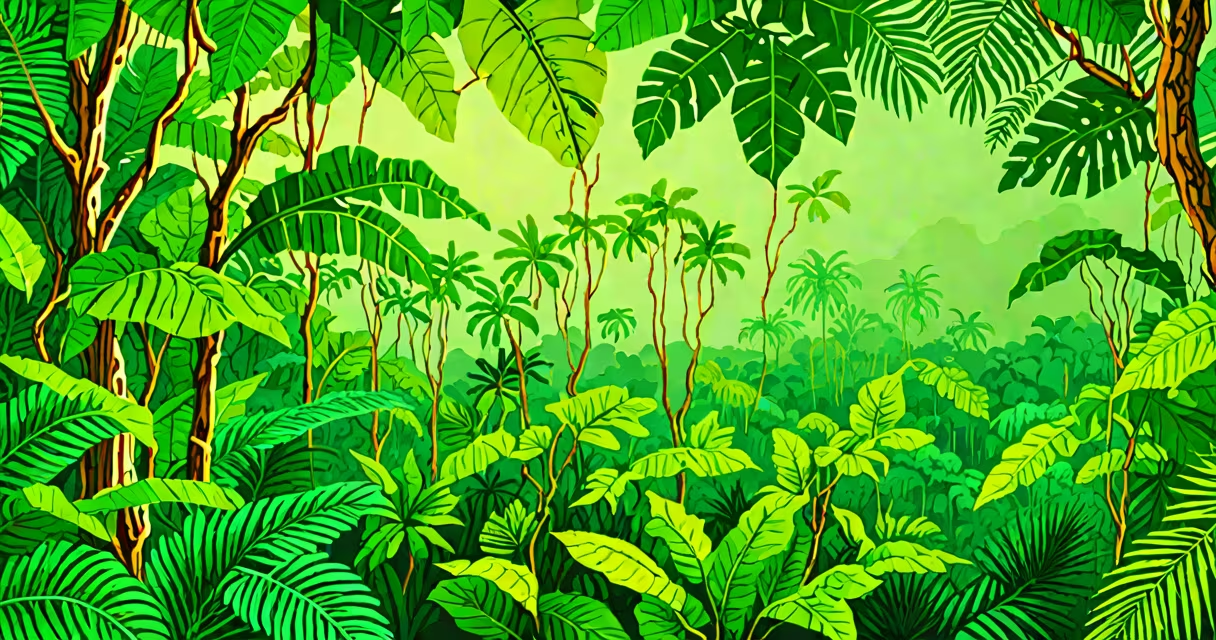
Tropical rainforests are dense, warm, and wet forests near the equator that support more plant and animal life than any other terrestrial system. They cover less than 10% of Earth's land area but contain over half of the planet's known species.
These ecosystems thrive in regions with consistent temperatures between 20°C and 30°C (68°F-86°F) and annual rainfall exceeding 150 cm (60 inches). They form in areas like the Amazon Basin, Congo River Basin, and Southeast Asia's islands, where sunlight, heat, and moisture combine to fuel rapid plant growth.
Despite their ecological importance, tropical rainforests face severe threats from logging, agriculture, mining, and infrastructure projects. The World Bank estimates that 17% of the Amazon rainforest was lost between 1970 and 2020 due to human activity.
Energy flows through tropical rainforests via photosynthesis. Sunlight penetrates the forest canopy, enabling trees and vines to convert carbon dioxide and water into glucose and oxygen. This process supports nearly all life within the biome.
Decomposition happens rapidly due to high humidity and temperature. Leaf litter and dead wood break down in weeks rather than years, returning nutrients to the soil. However, most nutrients remain locked in living biomass-not in the soil-making the system highly sensitive to disturbance.
A single hectare of tropical rainforest can host over 480 tree species, compared to just 20 in a typical temperate forest. This extreme diversity arises from complex interactions among plants, insects, birds, mammals, fungi, and microbes.
Tropical rainforests have four distinct vertical layers:
| Layer | Height | Key Features |
|---|---|---|
| Emergent | 45-55 m (150-180 ft) | Isolated tall trees like kapok and Brazil nut; exposed to wind and sun. |
| Canopy | 25-45 m (80-150 ft) | Dense network of leaves; home to 80% of rainforest animals including monkeys, birds, and insects. |
| Understory | 5-25 m (15-80 ft) | Low light; hosts shade-tolerant shrubs, ferns, and young trees. |
| Forest floor | Ground level | Dark, damp, sparsely vegetated; dominated by decomposing material and scavengers like ants and beetles. |
The canopy acts as a biological filter, intercepting up to 90% of incoming sunlight. This limits understory growth and shapes the entire food web.
Three major tropical rainforest types exist based on geography and climate:
Each region has evolved distinct adaptations. For example, Borneo's dipterocarp trees produce winged seeds that spiral downward, increasing dispersal distance. In contrast, Amazonian trees often rely on large mammals like tapirs to spread seeds.
Tropical rainforests regulate global climate by absorbing atmospheric carbon. A 2021 study published in Nature found that intact tropical forests remove approximately 1.4 billion metric tons of CO₂ annually-equivalent to the emissions of 300 million cars.
They also influence weather patterns. Evapotranspiration from rainforest trees releases vast amounts of water vapor into the atmosphere. In the Amazon, this process generates "flying rivers"-moisture-laden air currents that travel thousands of kilometers, affecting rainfall in distant regions like the Andes and central Brazil.
One non-obvious fact: tropical rainforests contribute to planetary albedo (reflectivity). Their dark green canopy absorbs more solar radiation than reflective surfaces like snow or deserts. Yet their role in cloud formation offsets this by increasing local albedo through increased evaporation and condensation.
Many assume tropical rainforests are "jungles" filled with dense undergrowth. In reality, the forest floor beneath the canopy is often surprisingly open due to limited light penetration. Thick vegetation typically occurs in gaps created by fallen trees.
Another myth is that rainforest soils are nutrient-rich. On the contrary, most tropical rainforest soils are poor in nutrients. The majority of essential minerals reside in the living biomass above ground. When trees are cut, nutrients are quickly leached away by heavy rains, making regeneration difficult.
I observed this firsthand during a field visit to the Daintree Rainforest in Queensland, Australia. After a small clearing was made for research access, invasive grasses colonized the area within six months. Native seedlings failed to establish despite abundant rainfall-proof that soil fertility is not the limiting factor, but competition and microclimate are.
Over 80% of the world's terrestrial biodiversity resides in tropical rainforests. The International Union for Conservation of Nature (IUCN) lists 1,050 species as critically endangered due to habitat loss in these regions, including the Sumatran tiger and the golden lion tamarin.
Deforestation rates remain alarmingly high. According to Global Forest Watch, the world lost 11.8 million hectares of tropical primary forest between 2001 and 2020-an area larger than the UK. Brazil accounted for 44% of this loss, primarily driven by cattle ranching and soy farming.
Efforts to protect rainforests include REDD+ (Reducing Emissions from Deforestation and Forest Degradation), a UN-backed program that provides financial incentives to developing nations for preserving forests. Countries like Costa Rica and Gabon have reduced deforestation through policy integration and community-based management.
Conservation success stories exist. In the Peruvian Amazon, indigenous communities using traditional land stewardship practices have maintained forest cover at 95% over 30 years. These groups manage over 100 million hectares of rainforest-more than national parks-and demonstrate that human presence can coexist with preservation.
Tropical rainforests are not just collections of trees-they are changing, interconnected systems important to Earth's climate, biodiversity, and human well-being. Understanding facts about tropical rainforests reveals their fragility and irreplaceable value. Protecting them requires recognizing both their ecological complexity and the cultural roles of those who live within them.