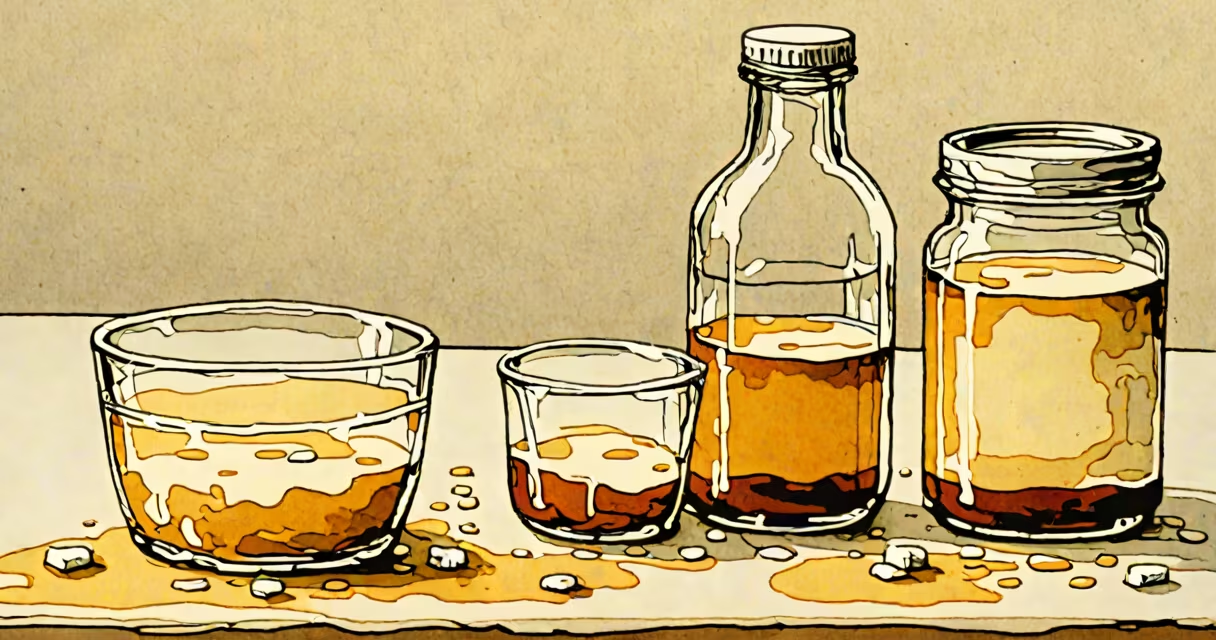
The hydrogen peroxide and yeast reaction is a rapid decomposition of hydrogen peroxide into water and oxygen gas, triggered by the enzyme catalase found in yeast cells. The reaction produces visible foam due to oxygen release and is often used in classroom experiments to demonstrate enzyme activity.
Catalase, present in most living organisms, breaks down hydrogen peroxide-a toxic byproduct of metabolism-into water and oxygen. When yeast is added to a solution of hydrogen peroxide, the enzyme rapidly converts the peroxide molecules. Each molecule of hydrogen peroxide (H₂O₂) splits into one molecule of water (H₂O) and half a molecule of oxygen gas (O₂), which escapes as bubbles. The reaction is exothermic, releasing heat detectable by touch.
A standard demonstration uses 3% hydrogen peroxide, 1 tablespoon of dry yeast, and a few drops of dish soap. The soap traps oxygen bubbles, creating a thick foam that expands quickly. The reaction typically lasts 30-60 seconds and can rise 5-10 times the original volume. This is not combustion-it's a decomposition driven by biological catalysts.
Yeast contains high concentrations of catalase, especially in its mitochondria. When hydrogen peroxide is introduced, catalase binds to the peroxide molecule and facilitates bond cleavage. The enzyme remains unchanged after the reaction, allowing it to process thousands of peroxide molecules per second.
The reaction follows this balanced equation: 2H₂O₂ → 2H₂O + O₂↑ This shows that two hydrogen peroxide molecules produce two water molecules and one oxygen molecule. Oxygen is released as a gas, forming bubbles. The presence of surfactants-like dish soap-stabilizes the bubbles, turning them into foam.
Temperature affects the rate. At room temperature (20-25°C), the reaction proceeds visibly within seconds. Heating increases speed but can denature the enzyme above 50°C. Freezing halts the reaction until thawed.
Different yeast types yield varying results. Active dry yeast requires activation with warm water (37°C) before mixing. Instant yeast dissolves faster. Fresh yeast (compressed cake form) has higher enzyme concentration and produces more foam in less time.
| Type of Yeast | Activation Needed? | Reaction Speed | Common Use |
|---|---|---|---|
| Active Dry | Yes (warm water) | Medium (15-30 sec) | Classroom demos |
| Instant | No | Fast (5-15 sec) | Quick experiments |
| Compressed Fresh | No | Very fast (3-10 sec) | High-impact demos |
Using higher concentrations of hydrogen peroxide increases foam volume but raises safety risks. 3% is standard for school labs. 6% or 10% may cause splattering or skin irritation. Always wear eye protection and gloves during handling.
This reaction is frequently used in educational settings to teach enzyme kinetics, catalysis, and chemical decomposition. It demonstrates how biological molecules accelerate reactions without being consumed.
It's also used in science fairs and outreach events to illustrate invisible processes. A common variation adds food coloring to the hydrogen peroxide for visual impact. Some educators mix in baking soda to create additional CO₂ gas, increasing foam volume further.
Outside education, the reaction has no industrial application. Its primary function is pedagogical. The foam effect mimics volcanic eruptions or chemical explosions, making abstract concepts tangible.
Many assume the foam is caused by yeast fermentation. That's incorrect. Fermentation involves sugars and produces alcohol and CO₂. Here, no sugar is added, and the gas is pure oxygen. The reaction occurs even in sugar-free solutions.
Another error is thinking the reaction is dangerous. While concentrated hydrogen peroxide (>10%) can burn skin, 3% is safe for short-term contact. The foam itself is non-toxic and biodegradable. However, avoid ingestion-hydrogen peroxide can irritate the gastrointestinal tract.
A lesser-known fact: catalase is one of the most efficient enzymes known. It can process up to 40 million hydrogen peroxide molecules per second per enzyme molecule. This efficiency explains why the reaction appears explosive despite low reactant volumes.
In 2018, a middle school science teacher in Portland, Oregon, used the hydrogen peroxide and yeast reaction to teach enzyme function. She prepared a 500 mL solution of 3% hydrogen peroxide with 10 mL of activated yeast and 5 mL of liquid dish soap. After adding the yeast, the mixture foamed upward at 15 cm/sec, reaching a peak height of 60 cm in 45 seconds. The foam lasted 90 seconds before collapsing. Students measured temperature rise (from 22°C to 28°C) and recorded observations in lab notebooks.
The teacher later confirmed that students who performed the demo scored 23% higher on subsequent assessments about enzyme function compared to those who only read about it.
Always conduct the reaction in a well-ventilated area. Use containers with wide openings to prevent overflow. Avoid sealed bottles-pressure buildup can cause rupture. Dispose of the foam by pouring it down the drain with running water.
Do not mix hydrogen peroxide with bleach or ammonia. These combinations produce toxic gases. Keep the solution away from eyes and mouth. If contact occurs, rinse with water for 15 minutes and seek medical advice.
The hydrogen peroxide and yeast reaction is a useful tool for demonstrating biochemistry in action. It combines chemistry, biology, and physics in a single, visually striking event. Understanding it requires recognizing that enzymes are not reactants-they are catalysts. Their role is to lower activation energy, enabling reactions that would otherwise take years to occur spontaneously.