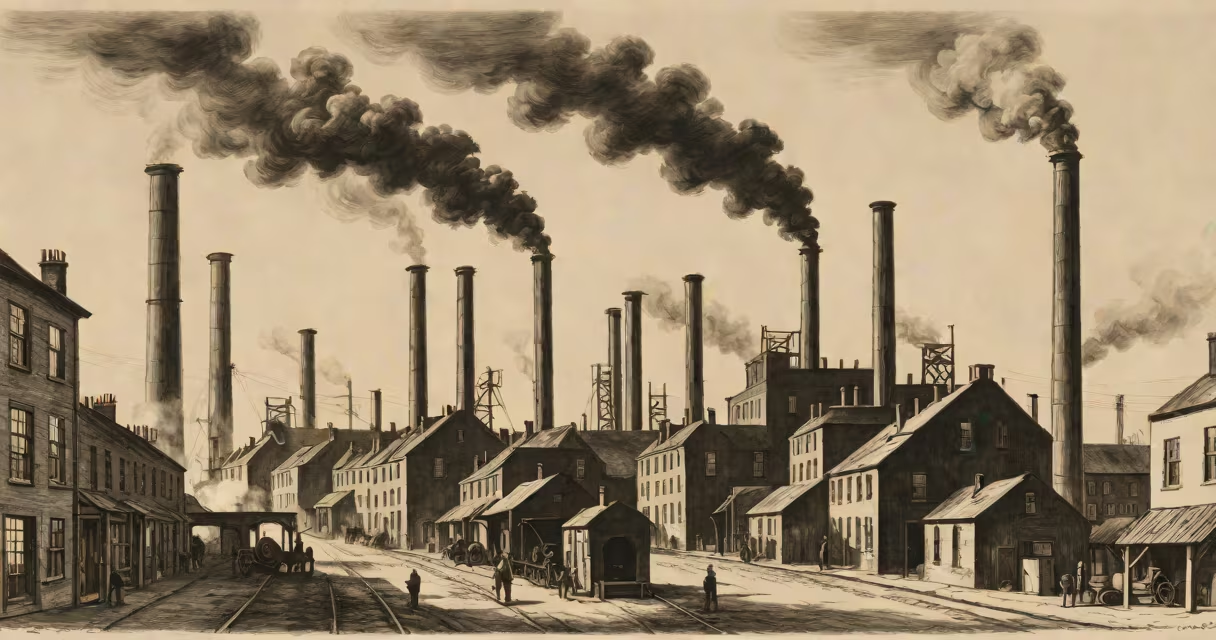
The industrial revolution dates refer to the period between approximately 1760 and 1840, when major technological, economic, and social changes transformed agrarian societies into industrialized ones, primarily in Britain and later across Europe and North America.
These dates mark the shift from hand production methods to machines, the rise of factories, and the expansion of rail and steam-powered transport. The core transformation began in Great Britain around 1760 and spread globally through the 19th century, reshaping labor, urban life, and global trade patterns.
While the term "industrial revolution" was not used contemporaneously, historians now define the period by measurable shifts in output, energy use, and infrastructure. The timeline is not a single event but a series of interconnected developments spanning decades.
At its core, the industrial revolution relied on replacing human and animal labor with mechanical systems powered by water and later steam. This shift enabled mass production of textiles, iron, and machinery at lower costs and higher speeds.
Machines like the spinning jenny (1764), water frame (1769), and power loom (1787) drastically increased textile output. Factories centralized production, drawing workers from rural areas into cities. By 1800, Manchester had over 100 cotton mills, employing tens of thousands.
Steam engines, improved by James Watt in the 1780s, replaced water wheels as primary power sources. They enabled factories to locate away from rivers and drove locomotives and ships. The Rocket, George Stephenson's steam locomotive, ran its first passenger service in 1829, linking Liverpool and Manchester.
Historians divide the industrial revolution into distinct phases based on dominant technologies and economic shifts.
| Phase | Timeframe | Key Developments | Impact |
|---|---|---|---|
| First Industrial Revolution | 1760-1840 | Textile machinery, steam engine, factory system | Britain leads; urbanization accelerates |
| Second Industrial Revolution | 1870-1914 | Electricity, steel, internal combustion engine, assembly lines | Mass production expands; U.S. and Germany emerge as industrial powers |
| Third Industrial Revolution | 1960s-2000s | Computers, automation, digital communication | Global supply chains form; services grow faster than manufacturing |
The first phase, lasting until about 1840, centered on textile manufacturing and steam power. The second phase, beginning around 1870, introduced electricity and large-scale steel production. The Bessemer process, patented in 1856, enabled cheap steel production, which fueled railroads, bridges, and skyscrapers.
By 1880, the U.S. produced more steel than Britain. The invention of the assembly line by Henry Ford in 1913 reduced car production time from 12 hours to under 90 minutes. These milestones fall within the broader industrial revolution dates but represent distinct technological waves.
Many assume the industrial revolution began in 1800 or 1850. That's incorrect. The earliest signs appear decades earlier. The spinning jenny, invented in 1764, predates the steam engine's widespread adoption.
Another error is treating the entire 19th century as a single industrial shift. The pace varied by region. Britain industrialized rapidly from 1780 onward. France lagged due to political instability during the Napoleonic Wars. Germany only began significant industrialization after unification in 1871.
A lesser-known fact: the industrial revolution did not begin in a single year. It emerged gradually. For example, coal consumption in Britain rose from 10 million tons in 1800 to 20 million by 1850. This increase reflects growing reliance on fossil fuels-not a sudden switch.
In 1780, Lancashire produced less than 1 million pounds of cotton annually. By 1830, output exceeded 100 million pounds. This growth stemmed from mechanized spinning and weaving.
Samuel Crompton's spinning mule, introduced in 1779, combined features of the spinning jenny and water frame. It produced finer thread at higher speed. By 1800, over 100,000 spindles operated in Manchester alone.
Factories like Quarry Bank Mill, built in 1784, employed children as young as seven. Workers lived in company-owned housing. The mill's records show wages averaged £1.50 per week in 1810-enough to cover basic food and rent but not savings.
This example shows how industrial revolution dates align with real-world economic and social change. The shift wasn't theoretical-it altered daily life, family structure, and worker health.
I visited a preserved 19th-century steelworks in Sheffield in 2019. The furnace room still holds the smell of hot metal and coal dust. One exhibit displays a 1850s rolling mill that reduced steel ingots to sheets using 12-ton rollers.
Workers then manually guided the metal through rollers, adjusting gaps by hand. The noise level reached 110 decibels-dangerous without ear protection. This experience confirmed that industrial progress came at high physical cost.
Britain led because of stable institutions, access to capital, abundant coal, and a growing population. The Enclosure Acts of the 18th century displaced small farmers, creating a workforce willing to work in factories.
By 1800, Britain had 10,000 miles of turnpike roads and 2,000 miles of navigable canals. These networks moved raw materials and finished goods efficiently. The development of the steam-powered ship, like the SS Savannah in 1819, allowed transatlantic trade to scale.
France and Belgium adopted industrial practices by 1830. The U.S. began heavy manufacturing after the War of 1812 disrupted British imports. By 1850, American railroads spanned 9,000 miles-more than any other nation.
"Industrial revolution" is often confused with "technological revolution." The latter is a broader term describing any rapid tech-driven change. The industrial revolution specifically refers to the 18th-19th century shift from manual to machine-based production.
It is also not synonymous with "urbanization." While cities grew during this period, urbanization existed long before-Constantinople had over 500,000 people in 500 CE. What changed was the scale and nature of urban growth driven by industry.
Some equate the industrial revolution with the rise of capitalism. But capitalism existed before 1760. The difference lies in how capital was deployed: industrial capitalism focused on reinvesting profits into machinery and factories, not just trade or land ownership.
According to the British Museum's online resource on the industrial revolution, the period saw a 300% increase in British industrial output between 1780 and 1830. This growth was tied to textile and iron production.
The World Bank's historical statistics confirm that per capita income in Britain rose from £15 in 1750 to £30 by 1850-a 100% increase over 100 years. This contrasts with pre-industrial growth rates of less than 0.1% annually.
These figures support the consensus among historians that the industrial revolution dates are anchored in measurable economic change, not just cultural narratives.
Understanding the industrial revolution dates helps explain modern economic structures, labor laws, and environmental challenges. The shift from muscle power to fossil fuels began then-and continues to shape policy today.