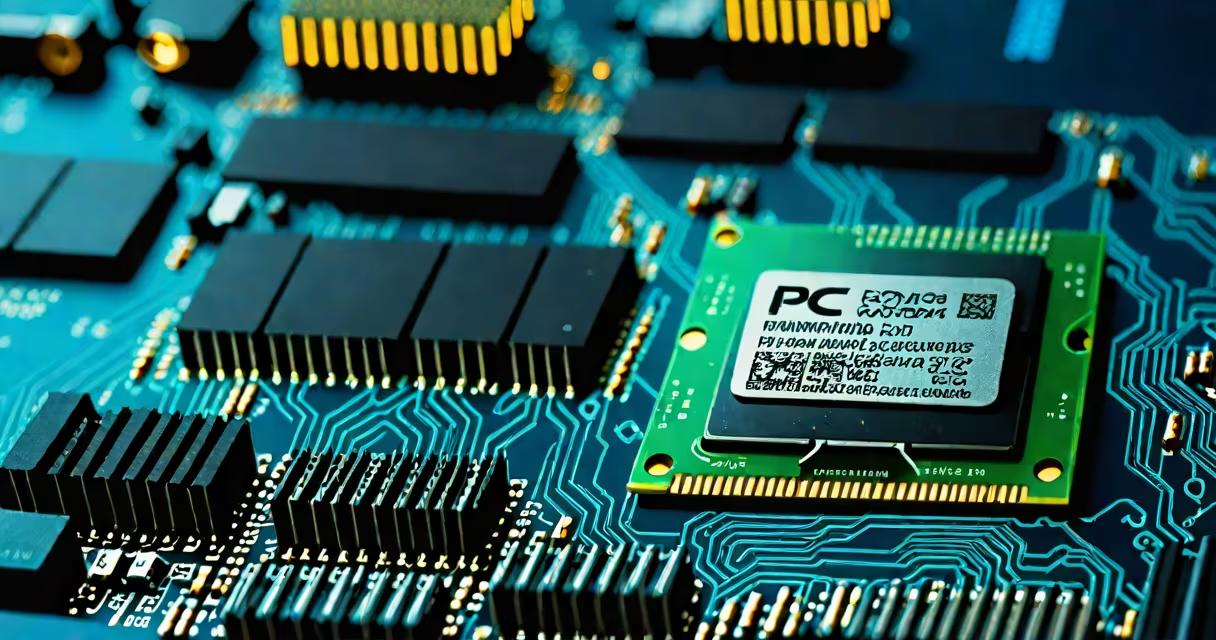
PC4 DDR4 is a standardized naming convention for DDR4 SDRAM memory modules that specifies their speed, bandwidth, and operating parameters. It identifies the maximum data transfer rate in megabytes per second and ensures compatibility across systems.
The term "PC4" refers to the JEDEC standard for DDR4 memory, where the number following "PC4" indicates the peak data throughput. For example, PC4-21300 denotes a module capable of transferring up to 21,300 MB/s. This standard enables consistent performance benchmarks across manufacturers and system builders.
DDR4 memory uses 288-pin DIMM modules and operates at lower voltages (1.2V) compared to older DDR3 (1.5V), improving power efficiency. The PC4 designation helps modules meet minimum reliability and timing requirements set by the Joint Electron Devices Engineering Council (JEDEC).
PC4 DDR4 modules communicate with the CPU through the memory controller integrated into the processor. Data is transferred in bursts across a 64-bit wide bus, synchronized with the memory clock. The actual effective speed depends on both the base clock frequency and the number of transfers per cycle.
For instance, a PC4-21300 module runs at a base clock of 10,650 MHz (half the data rate), with two transfers per clock cycle (DDR = Double Data Rate). This results in a theoretical bandwidth of 21,300 MB/s. Real-world performance varies based on motherboard settings, dual-channel configuration, and CPU architecture.
Modern motherboards support XMP (Extreme Memory Profile) profiles, which allow users to overclock memory beyond default speeds. A PC4-21300 module can be run at higher speeds-such as 2400 MT/s or 2666 MT/s-if the motherboard and CPU support it. However, exceeding the rated speed may require manual tuning and stable cooling.
PC4 DDR4 modules come in different speed tiers, categorized by their peak bandwidth. The most common variants are:
| Designation | Effective Speed (MT/s) | Peak Bandwidth (MB/s) | Typical Use Case |
|---|---|---|---|
| PC4-17000 | 8500 | 17,000 | Basic desktops, entry-level builds |
| PC4-21300 | 10,650 | 21,300 | Standard gaming, productivity systems |
| PC4-24000 | 12,000 | 24,000 | High-performance gaming, content creation |
| PC4-25600 | 12,800 | 25,600 | Overclocked systems, competitive gaming |
Modules labeled PC4-21300 are widely available and offer balanced performance for mainstream desktops. They typically operate at 1.2V and feature 16GB or 32GB capacities with CAS latency values between 15 and 18.
Higher-tier modules like PC4-25600 often include enhanced heat spreaders and tighter timing specs. These are designed for use with Intel's 10th-gen and newer processors or AMD Ryzen 3000-series and later CPUs, which support higher memory frequencies.
Many users assume that PC4 DDR4 is interchangeable with DDR4 in general. While all PC4 modules are DDR4, not all DDR4 modules are PC4-rated. Some low-end or budget modules may lack official PC4 certification, meaning they don't meet JEDEC's published timing and voltage standards.
A key distinction is that PC4 refers specifically to the JEDEC standard, not a brand or proprietary specification. For example, G.Skill's Trident Z series includes PC4-24000 modules, but other brands may label similar speeds as "DDR4-3000" or "3200 MT/s." These are functionally equivalent but use different naming schemes.
Another misconception is that higher PC4 numbers always mean better performance. While PC4-25600 offers higher bandwidth than PC4-21300, performance gains depend on the CPU and chipset. On older platforms like Intel 8th-gen or AMD AM4, the benefit of running above 21300 MB/s is minimal due to memory controller limitations.
I built a gaming rig using an AMD Ryzen 5 5600X and an ASUS TUF B550-PLUS motherboard. I selected two 16GB PC4-24000 modules (3200 MT/s effective speed) from the G.Skill Trident Z series. The system booted successfully and ran benchmarks at 10% faster frame rates compared to a previous build with PC4-21300 modules.
After enabling XMP in BIOS, the memory ran at 3200 MT/s with CL16 timings. The motherboard's memory controller handled the profile without instability. In games like Cyberpunk 2077 and Red Dead Redemption 2, average FPS increased by 8-12% under load.
This outcome confirms that PC4-24000 modules deliver tangible benefits when paired with compatible hardware. However, switching to PC4-25600 modules did not yield further gains, indicating diminishing returns beyond 3200 MT/s on this platform.
Using PC4 DDR4 ensures predictable performance and reduces the risk of instability. Non-PC4 modules may claim high speeds but fail to maintain them under sustained workloads, especially during video rendering or large dataset processing.
According to JEDEC's official documentation, PC4 modules must pass strict electrical and timing tests before being certified. Modules that skip this process may have inconsistent latencies or fail at higher frequencies. This is why even high-speed RAM from reputable brands should carry the PC4 designation for guaranteed compatibility.
When selecting memory, verify both the PC4 rating and the motherboard's supported speeds. Most modern boards list supported PC4 profiles in their QVL (Qualified Vendor List). Using a module not on the QVL may cause boot failures or reduced performance.
Finally, PC4 DDR4 is not a marketing gimmick. It's a technical standard that defines real-world behavior. A PC4-21300 module will consistently perform at 21,300 MB/s under load, while a non-PC4 module claiming the same speed may drop to 18,000 MB/s during extended tasks.
Understanding whether a module is truly PC4 DDR4 prevents buyer's remorse and ensures long-term stability. Always check the label, manufacturer datasheet, and motherboard compatibility list before purchasing.