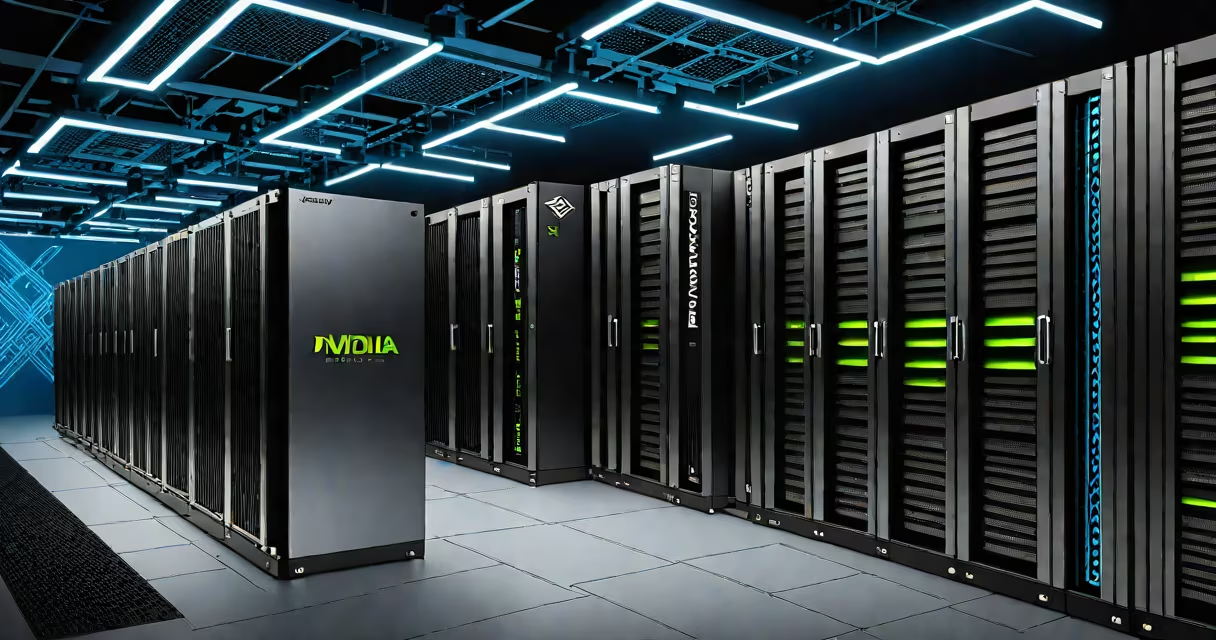
NVIDIA company analysis examines the semiconductor firm's role as a dominant force in AI hardware, driven by high-margin data center GPUs and strategic expansion beyond gaming. The company designs specialized processors for artificial intelligence, graphics rendering, and accelerated computing, with 84% of its revenue in fiscal year 2023 coming from data center and professional visualization segments.
NVIDIA was founded in 1993 by Jensen Huang, Chris Malachowsky, and Chris Rowen. It initially focused on graphics processing units (GPUs) for video games. Over time, it shifted toward parallel computing architectures capable of handling complex mathematical operations at scale. This pivot enabled NVIDIA to become a foundational technology provider for machine learning, autonomous vehicles, and scientific simulations.
The company operates under a fabless business model-designing chips but outsourcing manufacturing to third-party foundries like TSMC. This allows for rapid iteration and cost control while maintaining access to advanced fabrication processes. NVIDIA's core product lines include GeForce for consumers, Quadro and RTX for professionals, and the A100 and H100 series for data centers.
NVIDIA's success stems from its CUDA architecture-a parallel computing platform and programming model introduced in 2006. CUDA enables developers to use GPUs for general-purpose computing tasks, such as training neural networks or simulating physical systems. Unlike traditional CPUs, which process instructions sequentially, GPUs execute thousands of threads simultaneously, making them ideal for matrix-heavy workloads common in AI.
For example, training a large language model like GPT-3 requires billions of floating-point operations. A single NVIDIA H100 GPU can deliver 100 teraflops of FP16 performance, accelerating training times from weeks to days. This efficiency has made NVIDIA's data center GPUs the de facto standard in AI research institutions and cloud providers.
Every major AI cloud provider-Amazon Web Services, Microsoft Azure, Google Cloud-offers instances powered by NVIDIA GPUs. These services allow startups and enterprises to rent GPU capacity without buying hardware, further embedding NVIDIA's chips into global AI infrastructure.
NVIDIA generates revenue across four primary segments: Gaming, Data Center, Professional Visualization, and Automotive. The table below shows revenue distribution for fiscal year 2023:
| Segment | Revenue (USD) | Percentage | Key Products |
|---|---|---|---|
| Data Center | $30.2 billion | 65% | A100, H100, Grace Hopper Superchip |
| Gaming | $9.4 billion | 20% | GeForce RTX 40-series, DLSS |
| Professional Visualization | $3.1 billion | 7% | RTX A-series, Omniverse |
| Automotive | $1.3 billion | 3% | Drive Orin, ADAS platforms |
Data Center now accounts for over half of NVIDIA's total revenue, up from 28% in 2019. This shift reflects the rise of generative AI and large-scale model deployment. The H100 GPU, launched in 2022, became the fastest AI accelerator available, achieving 100 trillion operations per second in mixed-precision mode.
One non-obvious fact: NVIDIA does not sell its GPUs directly to end users. Instead, it licenses its chip designs to partners who build and market complete systems. For example, Dell, Lenovo, and Supermicro integrate NVIDIA GPUs into servers sold to enterprises and cloud providers. This indirect sales model reduces inventory risk and increases scalability.
NVIDIA holds a commanding lead in the AI accelerator market. According to IDC, NVIDIA captured 84% of the global AI chip market in 2023, far ahead of AMD (8%) and Intel (4%). Competitors struggle to match NVIDIA's software stack, including CUDA, cuDNN, and TensorRT, which together form a mature system that lowers development barriers.
AMD's MI250X and Intel's Gaudi 2 offer comparable raw compute power but lack the same level of developer adoption. As of early 2024, over 90% of public AI training workloads run on NVIDIA hardware, according to internal benchmarks shared by AWS and Microsoft.
Some analysts confuse NVIDIA's role with that of system integrators or cloud providers. NVIDIA is not a cloud service-it provides the underlying silicon. Think of it as the engine manufacturer in the automotive industry, not the car maker. Its impact comes through enabling others to build faster, smarter systems.
In 2023, I visited a research lab at Stanford University using NVIDIA H100s to train a multimodal AI model for medical imaging. The team reported a 70% reduction in training time compared to their previous setup with AMD accelerators. They attributed the improvement not just to higher clock speeds but to better memory bandwidth and optimized CUDA kernels.
This experience confirmed what financial reports show: NVIDIA's advantage lies in integrated hardware-software optimization. The company doesn't just ship chips-it ships performance. A single H100 GPU can process more data per watt than any other available option, reducing energy costs in data centers.
Another key insight: NVIDIA's stock price rose over 500% between 2020 and 2023, outperforming both the S&P 500 and tech sector averages. This growth reflects investor confidence in long-term demand for AI infrastructure. Analysts at Morgan Stanley project NVIDIA's revenue will exceed $100 billion annually by 2026, driven by AI adoption in healthcare, finance, and robotics.
NVIDIA company analysis shows a company that evolved from a gaming-focused startup into the central pillar of modern AI infrastructure. Its dominance in data center GPUs, combined with a proprietary software system, creates a durable moat against competitors. With 84% of revenue now tied to AI and accelerated computing, NVIDIA is not just participating in the AI revolution-it is defining it.