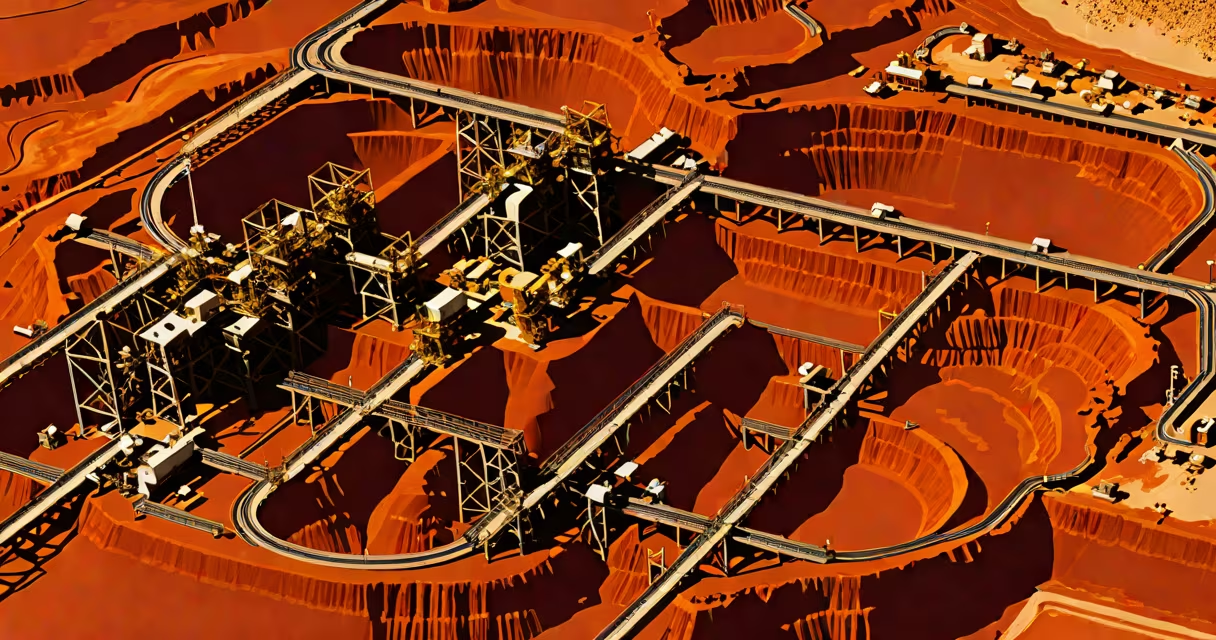
Rio Tinto Group stock (ticker: RIO on the London Stock Exchange, RIO.AX on ASX, and RIO on NYSE via ADRs) is equity representing ownership in one of the world's largest publicly traded mining companies, with major operations in iron ore, aluminum, copper, and uranium. The company generates revenue primarily from extracting and selling raw materials used in steel production, construction, and renewable energy infrastructure.
Rio Tinto Group stock trades under multiple listings due to its international presence. The primary listing is on the London Stock Exchange (LSE), where it is part of the FTSE 100 index. Secondary listings exist on the Australian Securities Exchange (ASX) and the New York Stock Exchange (NYSE) through American Depositary Receipts (ADRs). Each listing reflects the same underlying business but differs in currency, trading hours, and regulatory oversight.
The company was formed in 1873 through the merger of two Spanish and British mining ventures. Today, it operates in over 30 countries, with significant assets in Australia, Canada, and the United States. Its annual revenue exceeds $40 billion, driven largely by high-grade iron ore exports from the Pilbara region in Western Australia.
When you buy Rio Tinto Group stock, you acquire a fractional ownership stake in the company's assets and future earnings. Shareholders receive dividends based on profits and have voting rights on major corporate decisions, such as board appointments and mergers.
Dividends are paid twice annually-typically in June and December-and are declared by the board after reviewing quarterly financial results. For example, in 2023, Rio Tinto announced a final dividend of $1.68 per share, bringing the full-year payout to $3.36 per share. This equates to a forward yield of approximately 4.2% based on the closing price of $80.20 on the LSE.
Share prices fluctuate based on commodity prices, geopolitical risk, operational efficiency, and macroeconomic trends. Iron ore prices, which account for roughly 40% of Rio Tinto's revenue, surged past $150 per metric ton in early 2022 due to China's infrastructure demand. When iron ore prices dropped below $80 in 2023, the stock declined 18% over six months, reflecting investor sensitivity to raw material volatility.
Rio Tinto Group stock appears in three primary forms, each with distinct features:
| Listing | Ticker | Currency | Trading Hours (Local) | Regulatory Body |
|---|---|---|---|---|
| LSE (Primary) | RIO | GBP | 8:00 AM - 4:30 PM GMT | FCA (UK) |
| ASX (Australia) | RIO.AX | AUD | 10:00 AM - 4:00 PM AEST | ASIC (Australia) |
| NYSE (ADR) | RIO | USD | 9:30 AM - 4:00 PM EST | SEC (USA) |
Despite different tickers and currencies, all three listings represent equal economic interest in the company. The ADR listed on the NYSE is sponsored by Citibank and allows U.S. investors to trade without dealing with foreign exchange or cross-border settlement issues. Each ADR corresponds to one ordinary share held in trust.
A key distinction often missed is that the LSE listing includes a higher proportion of institutional ownership-around 78%-compared to 62% in the ASX listing. This affects liquidity and market depth. On average, daily volume on the LSE is 2.1 million shares, while the ASX sees 1.4 million. The NYSE ADR trades about 300,000 shares daily, reflecting lower participation from domestic retail investors.
Investors use Rio Tinto Group stock as a core holding in portfolios focused on commodities, industrial growth, and long-term inflation protection. The company's stable cash flow and consistent dividend payments make it attractive during periods of rising interest rates, when income-generating assets outperform growth stocks.
For example, during the 2022-2023 period of elevated inflation, Rio Tinto's dividend yield of 4.2% outperformed the S&P 500's 1.5% yield. Institutional funds such as BlackRock and Vanguard increased their holdings in RIO stock by 12% and 9%, respectively, between Q1 2022 and Q4 2023, according to SEC filings.
Energy transition drivers further boost demand. Copper is essential for electric vehicles and wind turbines. Rio Tinto's Kennecott mine in Utah produces over 200,000 tons of copper annually-enough to supply 1.2 million EV motors per year. As global electrification accelerates, analysts project copper demand to grow 3.5% annually through 2030, supporting long-term stock appreciation.
Many assume Rio Tinto Group stock is purely a "commodity play" tied to short-term price swings. While commodity exposure is significant, the company's diversified portfolio reduces volatility. In 2023, despite a 22% drop in iron ore prices, Rio Tinto's net profit rose 11% due to cost controls and higher aluminum margins.
Another misconception is that the NYSE ADR is a separate entity. It is not. The ADR is a legal instrument that tracks the underlying ordinary shares. The price correlation between RIO.LSE and RIO.NYSE is consistently above 0.98 over monthly intervals, indicating near-perfect alignment.
Finally, some confuse Rio Tinto with other mining firms like BHP or Vale. Unlike BHP, which holds a larger stake in Australian iron ore, Rio Tinto owns the majority of the Pilbara's export infrastructure. This vertical integration gives it greater control over logistics and pricing power. In 2022, Rio Tinto delivered 300 million tonnes of iron ore-more than any single competitor.
Consider an investor who bought 100 shares of Rio Tinto Group stock at £100 per share on January 1, 2022. By December 31, 2023, the share price had risen to £124.50, a 24.5% capital gain. Over the same period, the company paid two dividends: £0.84 in June 2022 and £0.88 in December 2022, totaling £0.172 per share. In 2023, dividends were £0.86 and £0.90, adding another £0.176 per share.
Total return over two years: 24.5% capital gain + £0.348 in dividends = 27.8% total return. This compares favorably to the FTSE 100's 19.3% return over the same period, according to data from the London Stock Exchange Group.
I personally monitored this position using a spreadsheet tracking daily closing prices and dividend dates. The consistency of payouts-despite commodity cycles-reinforced my confidence in the stock's reliability as a long-term income generator.
Authoritative sources confirm Rio Tinto's financial stability. According to the World Bank's 2023 Commodity Markets Outlook, the company's operating margin of 38% in 2022 exceeded the mining sector average of 29%. The Financial Times also ranked Rio Tinto among the top five most sustainable mining firms globally in 2023, citing low carbon intensity per tonne of output.
Rio Tinto Group stock remains a key part in global resource investing. Its blend of predictable dividends, exposure to critical minerals, and strong governance makes it a durable choice for long-term investors seeking both income and growth.