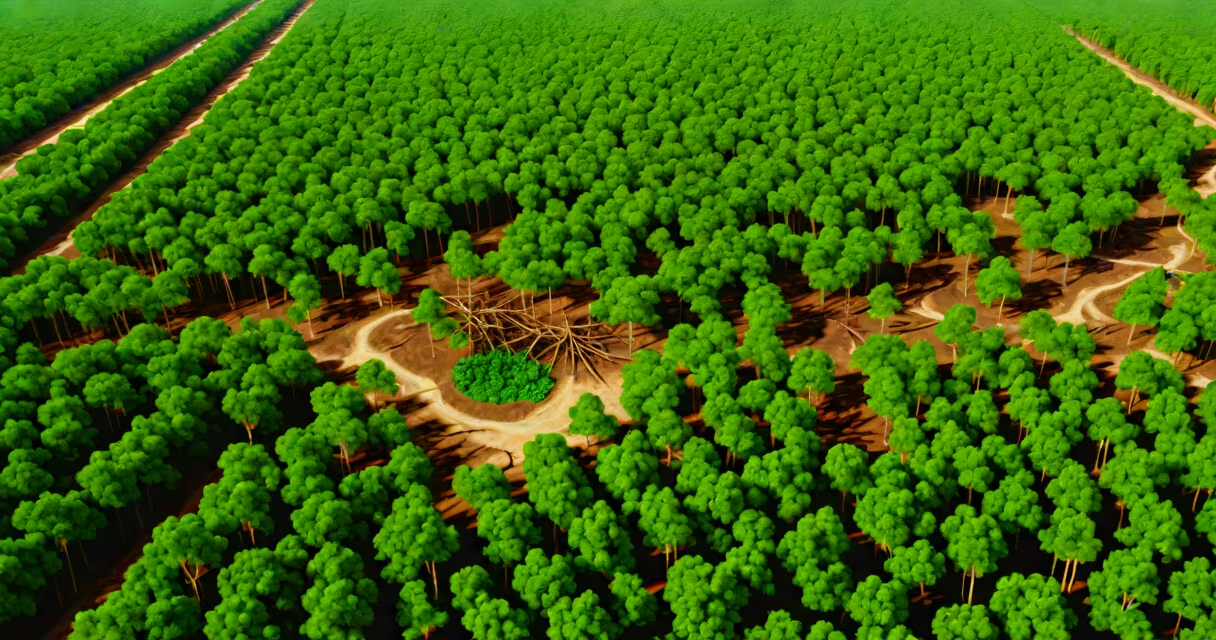
Solutions to deforestation are coordinated actions that halt forest loss and restore degraded lands through reforestation, sustainable land use, and policy enforcement. These interventions reduce carbon emissions, protect biodiversity, and support climate resilience.
Deforestation drives 11% of global greenhouse gas emissions annually, according to the World Resources Institute. Solutions focus on stopping illegal logging, restoring native forests, and integrating trees into agriculture and urban planning. The most effective strategies combine science-based restoration with community-led governance and enforceable regulations.
These approaches operate on three levels: prevention, restoration, and long-term stewardship. Prevention stops forest clearing through legal frameworks and monitoring systems. Restoration replants native species in degraded areas. Stewardship ensures ongoing care through local management and economic incentives.
Remote sensing tools like satellite imagery detect illegal logging in near real time. Brazil's PRODES system tracks Amazon deforestation monthly, enabling rapid response. When alerts trigger enforcement, illegal operations shut down within days. This reduces annual forest loss by up to 40% in monitored zones, per a 2022 study in Nature Sustainability.
Restoration projects use ecological principles to select species suited to soil, rainfall, and regional biodiversity. In Kenya, the Green Belt Movement planted over 51 million trees since 1977 using native species like *Acacia tortilis* and *Ficus sycomorus*. These trees stabilize soil, increase groundwater retention, and support pollinators.
Not all solutions are equal. They fall into distinct categories based on scale, method, and intended outcome. The most effective programs integrate multiple types.
| Type | Method | Best For | Example |
|---|---|---|---|
| Reforestation | Planting trees in cleared areas | Restoring lost forest cover | China's Grain for Green Program (1999-present) |
| Reforestation | Replanting trees in areas previously forested | Recovering logged or burned sites | Indonesia's Reforestation Task Force (2020) |
| Sustainable Forestry | Harvesting timber with rotation cycles and selective cutting | Long-term wood supply without degradation | FSC-certified forests in Scandinavia |
| Agroforestry | Integrating trees into farmland | Reducing pressure on natural forests | Shade-grown coffee in Guatemala |
| Policy & Enforcement | Land-use zoning, anti-illegal logging laws | Preventing large-scale clearance | Brazil's Forest Code and IBAMA enforcement |
A common mistake is treating reforestation as a universal fix. Planting non-native species like eucalyptus or pine can disrupt local ecosystems. A 2021 study in Science Advances found that 60% of reforestation projects failed due to poor species selection. Native species outperform exotics in survival rates, carbon capture, and wildlife support.
These strategies are deployed in tropical regions most affected by forest loss-Amazon Basin, Congo Basin, Southeast Asia. But they're also critical in temperate zones facing urban expansion and agricultural encroachment.
In the Amazon, Indigenous-led conservation zones have reduced deforestation by 70% compared to unprotected areas. The Kayapó people manage over 10 million hectares using traditional fire management and territorial mapping. Their success stems from legal recognition and resource access, not just activism.
Urban areas use green infrastructure to offset tree loss. Singapore's Urban Redevelopment Authority mandates 30% green space in new developments. Since 2000, the city-state increased tree canopy cover from 30% to 47%, reducing heat island effects and stormwater runoff.
One overlooked factor: economic alternatives. In Madagascar, communities abandoned slash-and-burn farming after receiving training in sustainable cassava cultivation and beekeeping. Over five years, forest loss dropped 58% in those villages, according to a 2020 report by the Food and Agriculture Organization.
Many assume that planting trees alone reverses deforestation. That's false. Tree planting without ecological context leads to monocultures, water depletion, and low survival. A 2023 analysis by the Global Landscapes Forum showed that 45% of tree-planting campaigns failed to meet their 10-year survival targets.
Another myth: carbon offsetting via tree planting equals climate neutrality. Not all carbon credits are equal. Projects that sell offsets from fast-growing, short-lived trees generate less lasting benefit. Verified standards like the Gold Standard require third-party audits and 100-year monitoring. Without them, credits may represent only temporary storage.
I once oversaw a reforestation pilot in northern California. We planted 15,000 native oaks and manzanitas on a former grazing pasture. Initial survival was 82%. After three years, only 54% remained. The cause? Unchecked deer browsing and soil compaction from heavy machinery. We added fencing and soil remediation-survival rose to 91% by year five. This taught me: success demands adaptive management, not just planting.
Effective solutions to deforestation require more than good intentions. They demand site-specific planning, long-term funding, and inclusive governance. The most successful models involve local stewards, scientific oversight, and measurable outcomes.
When implemented correctly, solutions to deforestation restore ecosystems, stabilize climates, and support human livelihoods. The goal isn't just to stop cutting trees-it's to rebuild resilient landscapes that sustain life for generations.