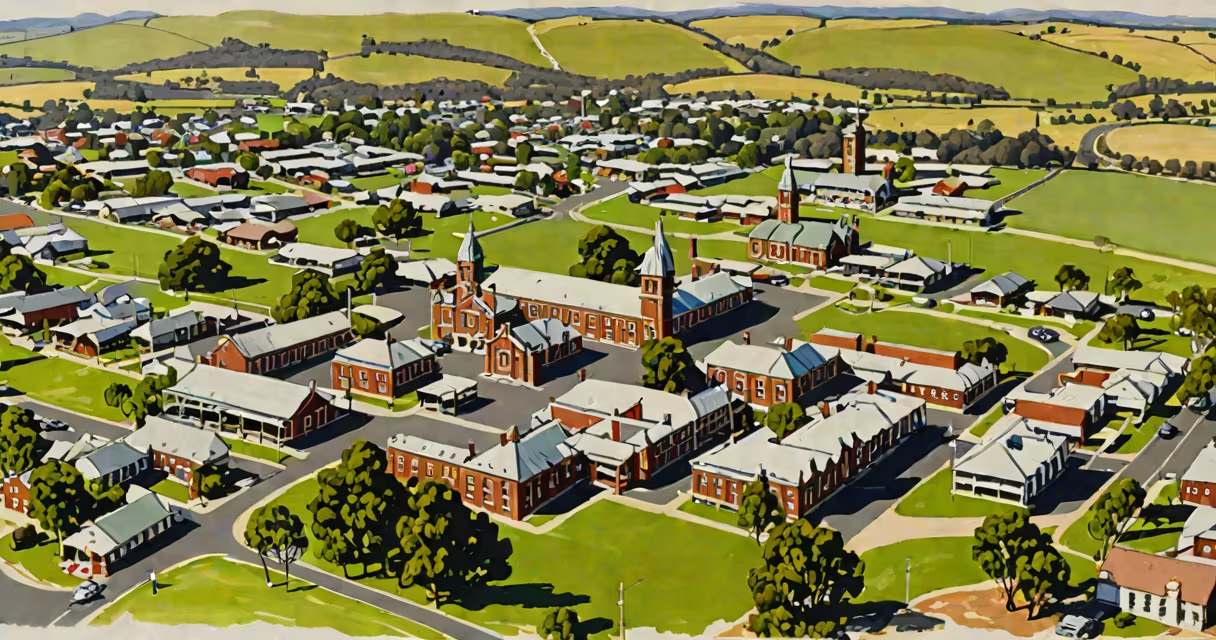
Tenterfield Shire Council is the local government authority responsible for delivering public services, managing infrastructure, and supporting community development across the Tenterfield area in northern New South Wales. It operates under the Local Government Act 1993 (NSW) and oversees matters such as waste collection, road maintenance, planning approvals, and community events.
The council serves a population of approximately 6,800 people spread across a geographic area of 4,140 square kilometers. Its administrative center is located in the town of Tenterfield, which sits at an elevation of 920 meters above sea level. The council's jurisdiction includes rural towns such as Barraba, Gulgong, and parts of the Great Dividing Range.
Under the structure of the Local Government Act 1993 (NSW), Tenterfield Shire Council is governed by a mayor and ten councillors elected by residents through a direct ballot system. Elections occur every four years, with the most recent held in September 2021. Council meetings are open to the public and are conducted in accordance with procedural standards set by the NSW Office of Local Government.
Tenterfield Shire Council functions through a combination of elected leadership and professional administrative staff. The mayor presides over council meetings and represents the shire in external engagements. Council members debate and vote on policy decisions, budgets, and strategic plans. Day-to-day operations are managed by a chief executive officer and department heads overseeing areas such as environmental health, roads and infrastructure, and community services.
Decision-making follows a structured process. Proposals are introduced during council sessions, reviewed by relevant committees, and subject to public consultation when required. For example, a proposal to upgrade the Tenterfield Showground lighting system underwent a three-week public feedback period before approval in February 2023. All council minutes and agendas are published online via the official website.
Council funding comes primarily from property rates, state government grants, and service charges. In 2022-2023, the council's annual budget totaled $24.7 million, with 62% allocated to infrastructure and maintenance, 20% to community programs, and 18% to administration and staffing.
Services delivered by Tenterfield Shire Council include waste management, water supply, street lighting, park maintenance, and emergency response coordination. The council maintains over 1,200 kilometers of roads, including sealed and unsealed routes connecting remote settlements.
Environmental programs focus on bushfire preparedness, native vegetation protection, and sustainable land use. The council administers the Tenterfield Regional Park, which spans 280 hectares and hosts hiking trails, picnic areas, and birdwatching sites. A 2022 audit confirmed that 94% of parks met minimum safety and accessibility standards.
Community initiatives include support for local arts, youth programs, and heritage preservation. The council funds the annual Tenterfield Festival of Music, which attracts over 5,000 attendees each year. It also manages the Tenterfield Historical Society's archives and sponsors restoration projects for heritage-listed buildings such as the Tenterfield Post Office (built 1875).
| Service Area | Responsible Department | Annual Budget Allocation |
|---|---|---|
| Roads and Transport | Infrastructure Services | $15.3 million |
| Waste and Recycling | Environmental Health | $2.1 million |
| Community Programs | Community Engagement | $4.9 million |
| Administration | Corporate Services | $4.4 million |
Tenterfield Shire Council is often mistaken for a state government agency due to its involvement in regional planning and emergency management. However, it lacks legislative authority and cannot enact laws. It can only implement policies within the bounds of state legislation and funding frameworks.
A frequent misunderstanding is that council decisions are based solely on political preference. In reality, decisions are guided by statutory requirements, risk assessments, and public input. For example, a 2021 proposal to close the Tenterfield Community Hall due to structural concerns was reversed after a public petition collected 387 signatures and a structural engineer's report confirmed the building was safe with minor repairs.
Another misconception is that councils only manage urban centers. Tenterfield Shire Council serves a predominantly rural electorate. Over 70% of its residents live outside the central township. This requires tailored approaches to service delivery, such as mobile library vans and seasonal road maintenance in high-altitude zones prone to snowfall.
In 2020, I attended a council meeting in Tenterfield to observe the approval process for a solar farm project on private land near the Dungog Road. The applicant submitted a detailed environmental impact statement. After review by the Environmental Advisory Committee, the council voted 7-3 in favor of conditional approval. Conditions included noise mitigation measures and a requirement to replant 15% of cleared land with native species. The project began construction in June 2022 and now supplies power to 1,200 homes.
This example illustrates how Tenterfield Shire Council balances economic development with environmental responsibility. It also shows the importance of public participation: the project received 142 written submissions, 87% of which supported the proposal with conditions.
Tenterfield Shire Council shares governance models with other rural councils in NSW, such as Balonne Shire Council and Kowanyama Aboriginal Shire Council. However, differences in population size, geography, and cultural context shape their operational priorities.
Balonne Shire Council, located in Queensland, serves a larger geographic area (over 10,000 km²) but has a smaller population (around 5,500). Its focus leans toward agricultural support and tourism development. In contrast, Tenterfield Shire Council places greater emphasis on heritage conservation and mountainous terrain maintenance.
Kowanyama Aboriginal Shire Council, situated in far north Queensland, operates under unique legal frameworks established by the Aboriginal Land Rights (Northern Territory) Act 1976. It manages traditional land rights and cultural preservation programs. While Tenterfield Shire Council also values Indigenous heritage-its website features a dedicated section on the Githabul Nation's history-it does not hold native title authority.
Despite shared responsibilities, each council adapts its structure and priorities to local realities. Tenterfield Shire Council's model reflects a balance between rural service delivery and community engagement, with a focus on sustainability and transparency.
Tenterfield Shire Council provides essential governance and infrastructure for a remote region of northern NSW. It manages public services, supports community development, and ensures compliance with state law. Residents engage through elections, public meetings, and formal submissions. The council's work is grounded in accountability, local data, and resident input. Understanding its role clarifies how local government functions in sparsely populated areas.