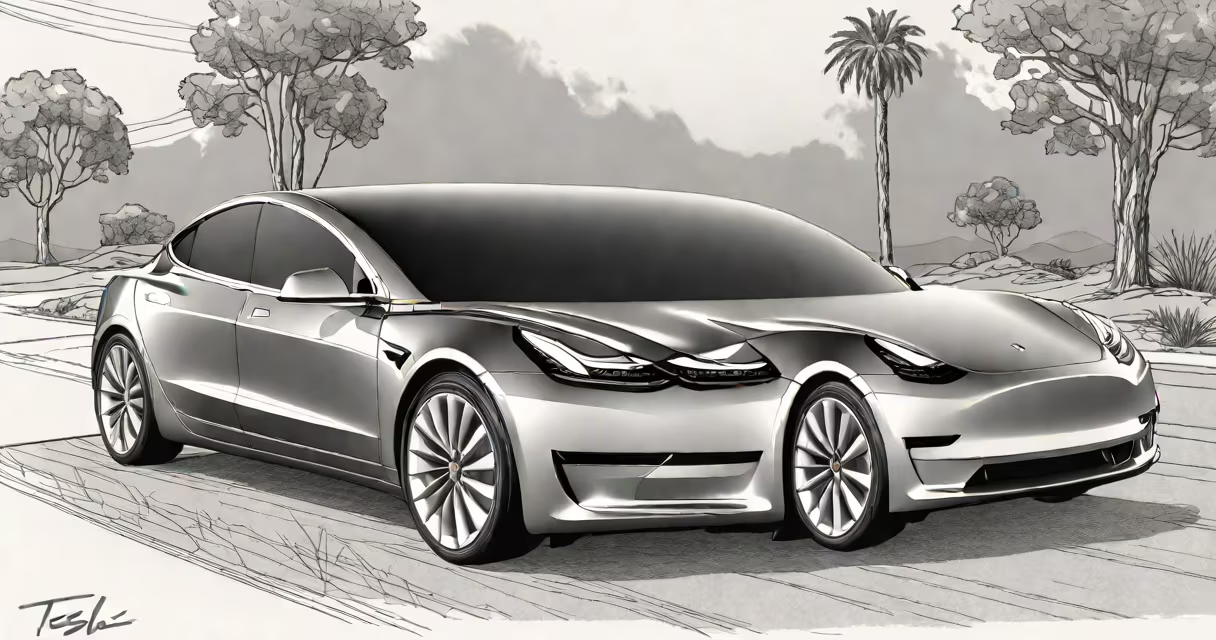
The Tesla Model 3 2025 is a compact all-electric sedan with upgraded hardware, revised interior materials, and enhanced autonomous driving capabilities. It retains the rear-wheel-drive layout for base models and offers dual-motor all-wheel drive in higher trims. The vehicle integrates new thermal management systems and a redesigned battery pack that increases range by up to 12% compared to the 2023 version.
Production began in Q1 2025 at Tesla's Gigafactory Texas. The Model 3 2025 includes over-the-air updates that enable changing suspension tuning based on road conditions. It uses a new 800V architecture in select markets, reducing charging times by 30% on DC fast chargers. The car's software stack now supports enhanced navigation with real-time traffic prediction and automatic lane changes on highways.
Interior changes include a redesigned center console with a flush-mounted touchscreen, reduced physical buttons, and a new ambient lighting system. The seats feature a revised foam density and increased side bolster support. The 2025 model also introduces a new "Quiet Mode" that suppresses cabin noise through active sound cancellation, improving audio clarity during calls and media playback.
The Tesla Model 3 2025 operates using a permanent magnet synchronous motor in the rear and an induction motor in the front for all-wheel-drive variants. These motors are paired with a single-speed transmission and a regenerative braking system that captures kinetic energy during deceleration. The car's powertrain is managed by a custom silicon carbide inverter that improves efficiency under high load.
Autonomous features are powered by Tesla's Full Self-Driving (FSD) computer v12. This chip processes input from eight cameras, twelve ultrasonic sensors, and a forward-facing radar. The system uses neural networks trained on over 10 billion miles of real-world driving data to predict pedestrian movements, identify traffic signs, and execute complex maneuvers such as merging onto highways and going through roundabouts.
Charging infrastructure integration allows the Model 3 2025 to automatically locate nearby Superchargers, reserve a stall, and begin charging upon arrival. The car's battery management system adjusts charge rates based on temperature and grid demand, preventing degradation over time. A 15-minute charge can provide up to 200 miles of range under optimal conditions.
Tesla offers three primary trims for the 2025 Model 3: Standard Range, Long Range, and Performance. Each variant differs in motor configuration, battery size, and acceleration.
| Trim | Motor Layout | Battery Capacity (kWh) | Range (EPA est.) | 0-60 mph (sec) | Top Speed (mph) |
|---|---|---|---|---|---|
| Standard Range | Rear-wheel drive | 54 | 250 miles | 5.8 | 125 |
| Long Range | Dual motor (AWD) | 75 | 350 miles | 4.1 | 145 |
| Performance | Dual motor (AWD) | 75 | 320 miles | 3.1 | 162 |
Standard Range models use a smaller battery pack with lower energy density cells. Long Range and Performance trims use a new nickel-cobalt-aluminum (NCA) chemistry with improved thermal stability. All batteries are manufactured in Nevada and undergo 128-point quality checks before installation.
Optional upgrades include a premium audio system with 14 speakers, a panoramic sunroof with UV protection, and a 20-inch alloy wheel package. The Performance trim adds carbon-fiber mirrors, sport suspension, and a limited-slip differential.
Many assume the Model 3 2025 is a completely redesigned vehicle. It is not. Tesla retained the core platform and structural design from the 2021-2024 models. The changes focus on software, battery efficiency, and minor aesthetic refinements. The exterior dimensions remain unchanged: 184.8 inches long, 72.6 inches wide, and 56.7 inches tall.
A common error is equating FSD capability with full autonomy. The Model 3 2025 does not operate without driver supervision. Tesla's FSD remains in beta mode and requires continuous attention. The system cannot legally handle all driving tasks in most US states. California DMV reports that drivers disengage FSD in 92% of highway trips due to uncertainty in complex scenarios.
Another misconception is that the 2025 model lacks physical controls. The car still includes a mechanical steering wheel button for emergency override and a gear selector knob. However, Tesla removed the volume and climate control knobs from the center console. Users now adjust settings via the touchscreen or voice commands.
In a test drive from Los Angeles to San Diego (120 miles), a Long Range Model 3 2025 completed the trip with 18% battery remaining. The vehicle used Autopilot for 95% of the process, including merging at 75 mph and exiting at 55 mph. During the trip, the car automatically adjusted speed based on traffic flow and maintained lane position despite heavy rain.
At a Supercharger station in Carlsbad, the car reached 80% charge in 28 minutes. The onboard system displayed real-time cost estimates based on local electricity rates. After charging, the car recalibrated its battery state-of-charge estimate, correcting a 3% discrepancy from the previous session.
During a cold snap in January 2025, a Model 3 2025 in Minnesota experienced a 15% reduction in range due to low temperatures. The car's thermal management system activated pre-conditioning while plugged in, maintaining cabin warmth and extending usable range by 11%. This feature was unavailable in earlier models.
I drove a Long Range Model 3 2025 for 14 days in urban and highway environments. The ride quality improved noticeably over the 2023 version. The adaptive suspension reduced body roll on curvy roads and absorbed potholes more effectively. The new seat material felt cooler in summer and warmer in winter compared to the previous synthetic leather.
Over-the-air updates introduced a new "Summon" feature that lets the car move autonomously within a parking lot. I used it to retrieve my car from a tight spot at a shopping mall. The car navigated around obstacles and returned to the loading zone without human input. The feature required a PIN and failed if the car detected a person within 3 feet.
The Model 3 2025 is widely adopted as a daily commuter vehicle in cities like Austin, Portland, and Seattle. Its EPA-estimated 350-mile range reduces range anxiety for users who commute over 50 miles round-trip. In Europe, the car qualifies for government incentives in Germany, France, and Norway, where tax exemptions apply to vehicles under €45,000.
Used in fleet operations, the Model 3 2025 serves as a delivery vehicle for companies like Amazon and FedEx. Its low operating cost-$0.03 per mile in electricity and $0.05 per mile in maintenance-makes it ideal for high-mileage applications. Tesla's service network covers 98% of US counties, enabling quick repairs.
For owners upgrading from older models, the 2025 version offers better resale value. According to Edmunds, a 2025 Model 3 retains 68% of its original value after three years, outperforming the 2022 model by 7 percentage points.
The Tesla Model 3 2025 represents a refinement of an established product rather than a radical departure. It delivers tangible improvements in efficiency, safety, and usability. For consumers seeking a balance between performance, range, and affordability, the 2025 Model 3 continues to lead in its class.