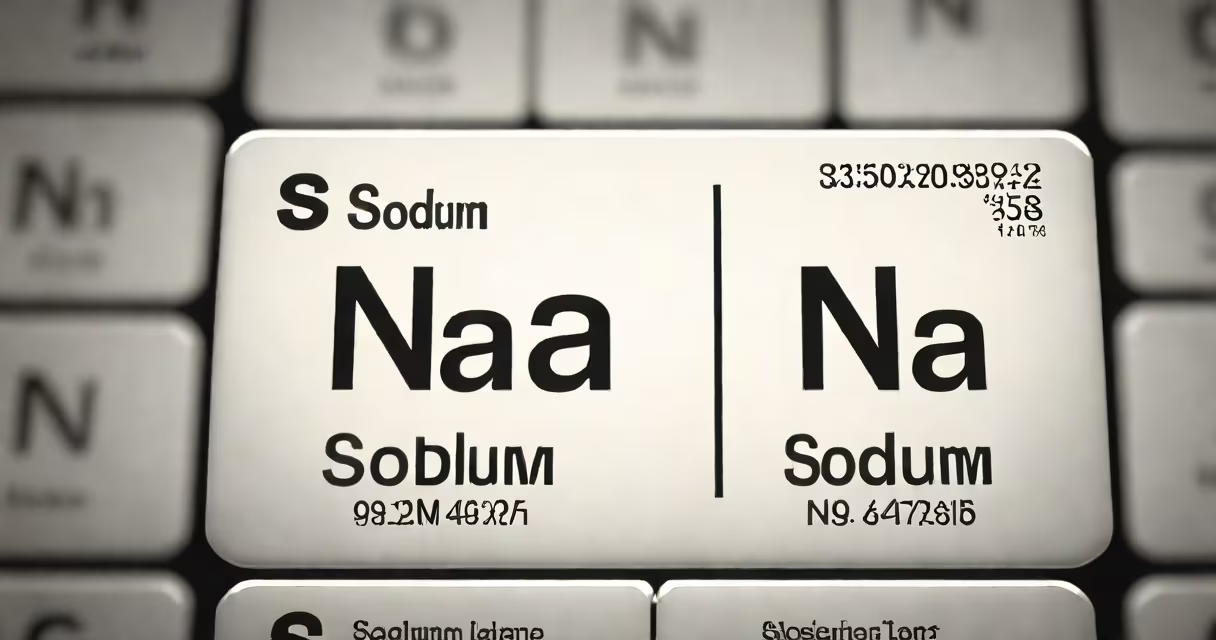
The chemical symbol for sodium is Na. This two-letter designation, derived from the Latin word *natrium*, identifies the element with atomic number 11 in the periodic table.
Sodium is a soft, silvery-white metal that reacts violently with water. It belongs to Group 1 of the periodic table-alkali metals-and is highly reactive due to its single valence electron. The symbol Na appears in all chemical formulas involving sodium, such as sodium chloride (NaCl), sodium bicarbonate (NaHCO₃), and sodium hydroxide (NaOH).
Chemical symbols are standardized by the International Union of Pure and Applied Chemistry (IUPAC). The use of Na instead of a more intuitive abbreviation like So or S reflects historical naming conventions rooted in Latin. The name *natrium* was used in ancient Egypt and later adopted by European chemists before being formalized in modern chemistry.
Each chemical symbol consists of one or two letters. The first letter is always capitalized; the second, if present, is lowercase. For example, sodium is Na, chlorine is Cl, and calcium is Ca. These symbols are universally recognized in scientific literature, lab reports, and textbooks.
When writing chemical equations, symbols allow concise representation of reactions. For instance, the reaction between sodium and water is written as:
2Na + 2H₂O → 2NaOH + H₂This equation uses Na to represent sodium atoms, enabling quick comprehension across languages and disciplines.
Every element has a unique symbol. Sodium's symbol, Na, distinguishes it from other elements with similar properties, such as potassium (K) or lithium (Li). Confusing Na with K leads to incorrect interpretations-potassium is K because its Latin name is *kalium*.
Chemical symbols fall into three categories based on their linguistic roots:
| Origin Type | Example Elements | Symbol Source |
|---|---|---|
| Latin | Sodium, Potassium, Iron | Na, K, Fe |
| Greek | Oxygen, Nitrogen | O, N |
| Modern English | Hydrogen, Carbon | H, C |
Sodium's symbol Na comes from *natrium*, a term used in alchemy and early chemistry. The Latin root persists despite the element's common name being "sodium" in English. This naming convention explains why mercury is Hg (from *hydrargyrum*) and gold is Au (from *aurum*).
A common misconception is that all symbols follow the English name. They do not. For example, tungsten is W (from *wolfram*), and lead is Pb (from *plumbum*). The symbol Na is often misremembered as "So" or "S," but both are incorrect and can cause errors in laboratory settings.
Confusion between sodium (Na) and sulfur (S) is frequent among beginners. Both appear in compound names like sodium sulfate (Na₂SO₄), where Na represents sodium and S represents sulfur. Misreading Na as S results in incorrect molar mass calculations and flawed experimental outcomes.
In food science, sodium content is labeled in milligrams per serving. A product listing "300 mg sodium" refers to elemental sodium, not the entire compound. To convert this to Na, multiply by 0.4 (since Na makes up about 40% of NaCl by mass). Thus, 300 mg of sodium corresponds to approximately 750 mg of salt (NaCl).
During my time working in a clinical lab, I once saw a patient's blood test report list "Na: 138 mmol/L." This value indicated serum sodium concentration. A reading below 135 mmol/L signals hyponatremia, a condition linked to confusion, seizures, and coma. Accurate interpretation of Na in medical contexts is critical-misreading the symbol could delay treatment.
The symbol Na appears in countless applications:
Even in everyday life, Na appears in ingredient lists. When you see "sodium bicarbonate" on a baking powder label, the Na stands for sodium. This compound decomposes under heat to release CO₂, causing dough to rise. Without accurate symbol recognition, consumers cannot assess ingredients correctly.
The chemical symbol for sodium is Na. This standard notation ensures clarity across global scientific communication, from classroom equations to pharmaceutical research. Its origin in Latin underscores how language shapes scientific identity. Always verify symbols against IUPAC standards to avoid errors in chemistry, medicine, and industry.