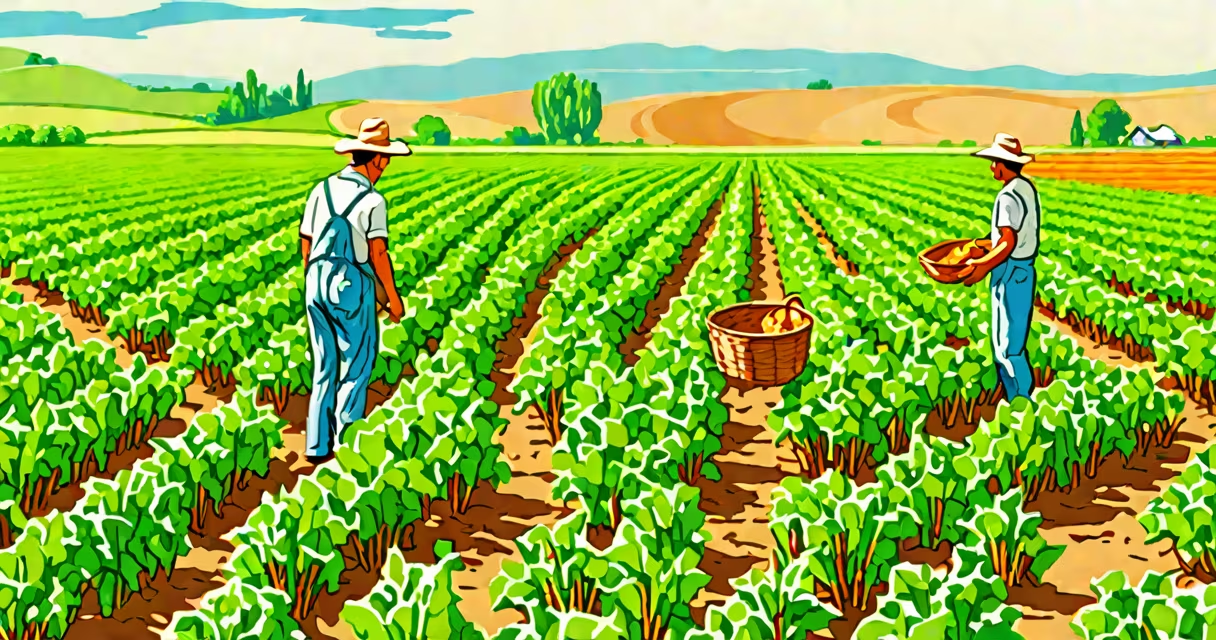
Sustainable agriculture maintains productivity while protecting natural resources, improving soil quality, reducing pollution, and supporting long-term food security. It integrates ecological principles into farming systems to ensure resilience across seasons and generations.
Unlike conventional methods that rely heavily on synthetic inputs, sustainable agriculture uses crop rotation, cover cropping, reduced tillage, integrated pest management, and diversified livestock systems. These practices preserve biodiversity, improve water retention, and minimize greenhouse gas emissions. The goal is not just yield but system stability.
Research from the USDA National Agricultural Library confirms that farms using sustainable techniques see 10-30% higher yields over 10 years due to improved soil structure and nutrient cycling. A 2021 study published in Nature Sustainability found that diversified cropping systems reduced nitrogen runoff by 45% compared to monocultures.
At its core, sustainable agriculture balances economic viability, environmental protection, and social well-being. It operates on closed-loop principles: waste becomes input, and energy flows through multiple biological pathways rather than relying on external fossil fuels.
For example, a farm might grow corn one year, plant winter rye as a cover crop the next, then rotate in soybeans and pasture-raised cattle. The rye prevents erosion, fixes nitrogen, and suppresses weeds. Cattle manure fertilizes the fields. Corn residue feeds livestock. This cycle reduces dependency on chemical fertilizers and pesticides.
A real-world case is the Rodale Institute's Farming Systems Trial, which ran for 30 years. It showed that organic systems matched conventional yields in normal years and outperformed them during droughts. In 2016, the trial reported that the organic plots sequestered 1,000 pounds of carbon per acre annually-equivalent to removing 12 cars from the road per hectare.
Not all sustainable approaches are the same. Different models suit different climates, soils, and community needs. The most effective systems combine multiple strategies.
| Type | Core Practice | Primary Advantage | Example Location |
|---|---|---|---|
| Crop Rotation | Alternating crops in sequence | Reduces pests, builds soil fertility | Midwest U.S. corn-soybean rotations |
| Conservation Tillage | Minimal soil disturbance | Prevents erosion, retains moisture | Great Plains, USA |
| Agroforestry | Integrating trees with crops/livestock | Improves microclimate, increases biodiversity | West Africa, cocoa farms with shade trees |
| Integrated Pest Management (IPM) | Using natural predators and thresholds | Reduces pesticide use by 50-70% | California almond orchards |
One common misconception is that sustainable agriculture produces less food. In reality, smallholder farmers in sub-Saharan Africa who adopted conservation agriculture saw yields increase by 20-50% within three years, according to FAO reports.
Many assume sustainable agriculture is synonymous with organic farming. While both prioritize environmental health, organic certification requires strict limits on synthetic inputs and often involves higher labor costs. Not all sustainable farms are certified organic, and not all organic farms practice sustainability beyond compliance.
Another error is equating sustainability with low-tech. Modern precision tools-like GPS-guided tractors, soil sensors, and drone-based monitoring-are increasingly part of sustainable systems. These technologies reduce over-application of water and fertilizer, lowering environmental impact without sacrificing efficiency.
I once visited a 200-acre dairy farm in Wisconsin that combined rotational grazing, solar panels, and composting manure into biogas. The farm reduced its methane emissions by 60% and cut fuel costs by 40%. It wasn't labeled "organic," but its practices met all key benchmarks for sustainability.
Climate change makes resilient farming essential. Extreme weather events disrupt supply chains. Sustainable agriculture buffers against volatility. A 2023 report from the IPCC noted that diversified farms experienced 30% less yield loss during heatwaves than monocultures.
Water scarcity affects 2.1 billion people globally. Sustainable irrigation techniques-such as drip systems paired with mulching-can reduce water use by up to 60% while maintaining crop output. In India's Andhra Pradesh, farmers using these methods increased their rice yields by 25% despite declining rainfall.
Long-term food security depends on healthy ecosystems. When soil degrades, nutrients vanish. The UN estimates that 1.5 million hectares of farmland are lost annually to desertification. Sustainable agriculture reverses this trend. By restoring organic matter, it increases water-holding capacity and root development.
The advantages of sustainable agriculture extend beyond the farm gate. They support cleaner air, healthier diets, stable rural economies, and stronger climate resilience. It's not a niche alternative-it's a necessary evolution of how we grow food.