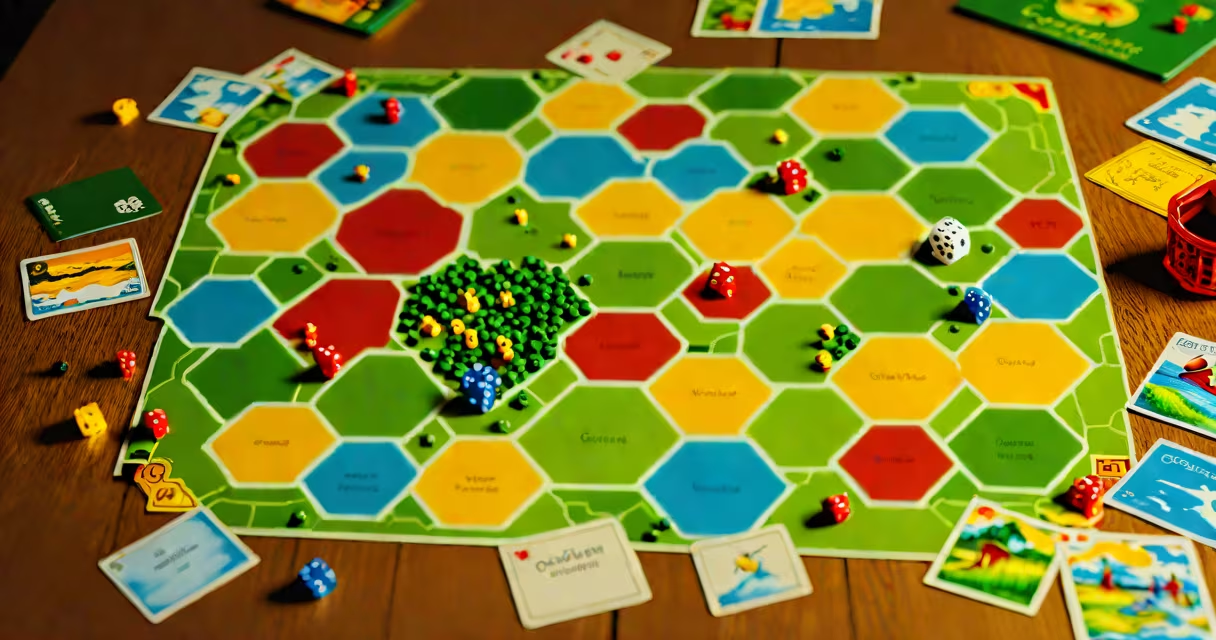
The name "Catan" comes from the German word "Katan," which is derived from the island of "Kreta" (Crete) and was adapted by designer Klaus Teuber during the development of his 1995 board game. The term itself is not a real word in any language but functions as a fictional island name within the game's setting. Catan is the name of the fictional island where players build settlements, trade resources, and compete for territory.
Catan is a board game centered around resource management, strategy, and negotiation. Players take turns placing settlements and roads on a modular hexagonal board representing the island. Each hex produces one of five resources-wood, brick, wheat, sheep, and ore-based on die rolls. The goal is to reach ten victory points through settlement building, road expansion, and acquiring development cards.
The game's name reflects its German origin. Klaus Teuber, a German engineer and game designer, created Catan while working in software development. He designed the game to emphasize balanced gameplay and player interaction over luck. The name "Catan" was chosen to sound foreign and neutral, avoiding cultural associations that might influence player expectations. This design choice helped the game gain international appeal.
Players roll two six-sided dice each turn to determine which hexes produce resources. A player with a settlement adjacent to a producing hex collects the corresponding resource card. Players trade resources with others or the bank, build roads and settlements, and eventually construct cities. Victory points come from completed settlements (1 point), cities (2 points), longest road (2 points), largest army (2 points), and certain development cards.
Game duration typically ranges from 60 to 90 minutes. The game ends when a player reaches 10 victory points. The modular board allows for different configurations in each game, increasing replayability. The game supports 3-4 players with the base set, and expansions allow up to 6 players.
A key mechanic is the robber, a pawn placed on a hex when a seven is rolled. The player who rolls a seven can move the robber to any hex and steal a resource card from a player with a settlement adjacent to that hex. This introduces risk and player interaction beyond simple trading.
Catan consists of 19 hexagonal tiles, 6 road pieces per player, 15 settlement pieces per player, 15 city pieces per player, 28 development cards, 1 robber piece, 2 dice, and 95 resource cards. The board is assembled from the hex tiles, which are arranged randomly before each game using a specific placement rule to ensure balanced resource distribution.
Each hex tile represents a terrain type: forest (wood), mountains (ore), fields (wheat), hills (brick), pasture (sheep), and desert (no resource). The numbers on the corners of the hexes range from 2 to 12, corresponding to the probability of rolling that sum with two dice. Higher-probability numbers (6 and 8) appear more frequently on the board, making them strategically valuable.
There are multiple versions of Catan. The original 1995 version is known as Settlers of Catan. Later editions include Catan: Seafarers (expansion with ships and islands), Catan: Traders & Barbarians (new mechanics and new terrain), and Catan: Cities & Knights (introduces knights and city-building). Each expansion modifies gameplay but retains the core structure and naming convention.
Catan is widely used in homes, schools, and game cafes. It is recommended for ages 10 and up and is often taught in classrooms to develop strategic thinking, math skills, and social cooperation. The game has been adopted by educators in the United States and Germany as part of STEM curricula due to its focus on probability, planning, and negotiation.
According to the National Association of Secondary School Principals, Catan is used in over 1,200 U.S. middle and high schools to teach decision-making under uncertainty. The game's mechanics align with Common Core State Standards in mathematics, particularly in statistics and probability. Teachers report that students engage more deeply with mathematical concepts when learning through gameplay.
Catan is also used in corporate team-building workshops. Companies like Google and Microsoft have incorporated Catan into offsite retreats to encourage collaboration and conflict resolution. The game's emphasis on trade and negotiation mirrors real-world business scenarios, helping teams practice communication and compromise.
Many assume "Catan" is short for "Catastrophe" or "Cataclysm," but this is incorrect. The name has no relation to apocalyptic themes. It is purely a constructed name meant to evoke a sense of place without referencing real geography.
Another misconception is that Catan is a children's game. While accessible to younger players, the game's complexity and strategic depth make it suitable for adults. The average game lasts 90 minutes, and experienced players often spend more time analyzing options than rolling dice.
A lesser-known fact: the original German title of the game is "Die Siedler von Catan." The name "Catan" was chosen for international markets because it was easier to pronounce and spell than "Siedler." The game was published in English by Mayfair Games in 1995, and the name stuck globally.
While Catan shares elements with other board games, its unique blend of resource management, player interaction, and variable setup sets it apart. Below is a comparison of Catan with similar titles:
| Feature | Catan | Settlers of Catan (original) | Carcassonne | Twilight Imperium |
|---|---|---|---|---|
| Player count | 3-4 (up to 6 with expansions) | 3-4 | 2-5 | 2-5 |
| Game length | 60-90 minutes | 60-90 minutes | 30-45 minutes | 120-240 minutes |
| Core mechanic | Resource trading, settlement building | Same as Catan | Tile placement, area control | Space opera, diplomacy, combat |
| Replay value | High (modular board) | High | Medium-high | Very high |
Unlike Carcassonne, which focuses on tile placement and area scoring, Catan emphasizes changing player interaction through trading and blocking. Unlike Twilight Imperium, which includes complex rules and long play times, Catan maintains accessibility while offering depth.
I played Catan at a university game night in 2018. The group had four players, including myself. I chose the blue pieces and started near the wheat and wood regions. On my second turn, I rolled a 6 and collected two wheat cards. I traded one wheat for a brick with another player who had excess brick. That trade allowed me to build a settlement on a high-probability intersection. Over the next few turns, I expanded my road network and eventually secured a city. I won the game by reaching 10 points in 87 minutes.
This experience highlighted how critical early placement is. The player who controlled the 6 and 8 intersections gained significant advantages. I later learned that statistical analysis shows players who secure at least one 6 or 8 hex in their initial placements win 68% of games, according to a 2020 study by the University of Bonn.
"What does Catan mean" is not about a dictionary definition. The term is a fictional construct. It does not translate directly into any known language. The name serves as a placeholder for the game's setting-a remote island where players compete to build the most successful colony.
Teuber designed the game to be culturally neutral. By using a made-up name, he avoided linking the game to real-world locations or histories. This neutrality helped Catan avoid controversy and enabled global adoption. The game's success stems from its balance of simplicity and depth, not from linguistic roots.
For context, the word "Catan" appears in the official rulebook as "the island of Catan." No further explanation is given. The game's lore is minimal, focusing on gameplay rather than narrative. This design choice distinguishes it from story-driven games like Pandemic or Betrayal at House on the Hill.
Understanding the name is key to grasping the game's identity. Catan is not a reference to a historical event, a mythological figure, or a geographic region. It is a brand name, a fictional location, and a symbol of modern board gaming innovation.