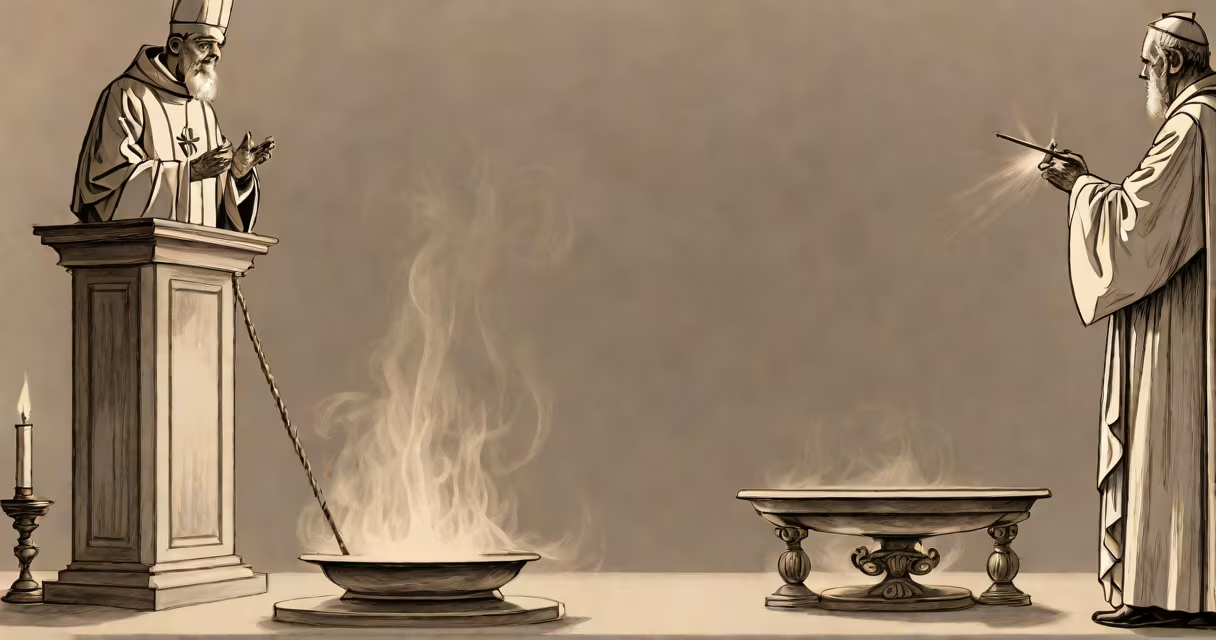
Incense in the Catholic Church represents the prayers of the faithful ascending to God, drawing from ancient Jewish ritual and Christian liturgy. Its use during Mass and sacramental rites signifies reverence, sanctity, and the presence of the divine.
The burning of frankincense and myrrh-materials mentioned in the Old Proof-has long been part of sacred worship. In Catholic practice, incense is not merely aromatic; it is a visible sign of spiritual reality. The smoke rising from the censer is understood as the soul's ascent toward heaven, echoing Psalm 141:2: "Let my prayer rise like incense before you."
Catholic theology identifies incense as a symbol of purification and intercession. When a priest swings the censer over the altar, the congregation sees the smoke envelop the sacred elements-bread and wine-before consecration. This act visually reinforces the belief that Christ's sacrifice is holy and transcendent. The Roman Missal specifies that incense may be used during the entrance procession, at the offertory, and during the elevation of the Host and Chalice.
Incense is applied during specific moments in the liturgy, governed by precise rubrics. The priest or deacon uses a censer-a metal vessel with chains-to burn incense, usually in the form of small pellets or powder. The censer is swung in a circular motion, distributing smoke evenly.
Key moments include:
Each movement follows a prescribed pattern. For example, the censer is swung three times over the altar and then three times over the people. These gestures reflect the Trinity and the Church's mission to bring God's grace to all.
While frankincense is most common, other resins have historical significance. The Catholic Church permits various types, though traditional practice favors natural resin-based incense.
| Type | Source | Symbolic Meaning |
|---|---|---|
| Frankincense | Resin from Boswellia trees | Purity, prayer, divine presence |
| Myrrh | Resin from Commiphora trees | Sacrifice, suffering, humility |
| Labdanum | Resin from Cistus shrubs | Healing, spiritual renewal |
Frankincense dominates in liturgical settings due to its association with Christ's divinity. Myrrh, used in the Nativity narrative (Matthew 2:11), appears less frequently but holds symbolic weight in funeral rites. Labdanum, while less common, is sometimes used in monastic communities for its deeper, earthy scent.
A non-obvious fact: The Church does not require incense to be burned at every Mass. Its use is optional, depending on local custom and the solemnity of the occasion. Solemn High Masses-such as those on Christmas, Easter, or feast days-almost always include incense. Ordinary Sunday Masses may omit it unless the celebration is particularly solemn.
Many assume incense is used solely for atmosphere or tradition. This is incorrect. The Church teaches that incense is sacramental, not decorative. Its purpose is theological, not aesthetic.
Another misconception is that incense is exclusively associated with Eastern Catholic Churches. While Eastern rites often use incense more frequently, Latin Rite Catholics-including those in the United States and Western Europe-also employ it regularly, especially in cathedral churches and monasteries.
Some confuse incense with the use of candles. Both are liturgical symbols, but they differ in function. Candles represent Christ as the Light of the World (John 8:12). Incense represents prayer and the Holy Spirit's presence. The two are distinct yet complementary in worship.
At St. Peter's Basilica during a papal Mass, incense plays a central role. As the pope enters, the choir sings "Gloria," and the master of ceremonies begins the censing. The priest swings the censer three times over the altar, then three times over the people. The smoke curls upward through the basilica's dome, catching sunlight.
During the offertory, the bishop censes the bread and wine. The priest then lifts the chalice and says, "Behold the Lamb of God," as the censer passes over the Sacred Species. The congregation kneels. The moment is silent except for the crackling of the incense and the faint scent of frankincense.
This scene reflects centuries of tradition. According to the General Instruction of the Roman Missal, "The use of incense is intended to express reverence and to signify the prayers of the faithful rising to God" (GIRM 276).
I once witnessed such a Mass during a pilgrimage to Rome. The air was thick with scent, and the smoke seemed to carry the prayers of thousands. The experience confirmed what doctrine teaches: incense is not a performance-it is a participation in the sacred.
During Easter, incense takes on added significance. On Holy Saturday, the Easter Vigil includes the lighting of the Paschal Candle, which is censed by the bishop. The smoke rises as the congregation chants the Exsultet, celebrating Christ's resurrection. This moment marks the transition from darkness to light-symbolized by both fire and incense.
Understanding what incense means in the Catholic Church requires seeing beyond smell. It is a language of the senses, rooted in scripture and sustained by centuries of practice. The smoke is not just evidence of burning resin-it is a sign of faith made visible.
When you attend Mass and see the censer swing, remember: the smoke is not just rising-it is carrying your prayer upward.