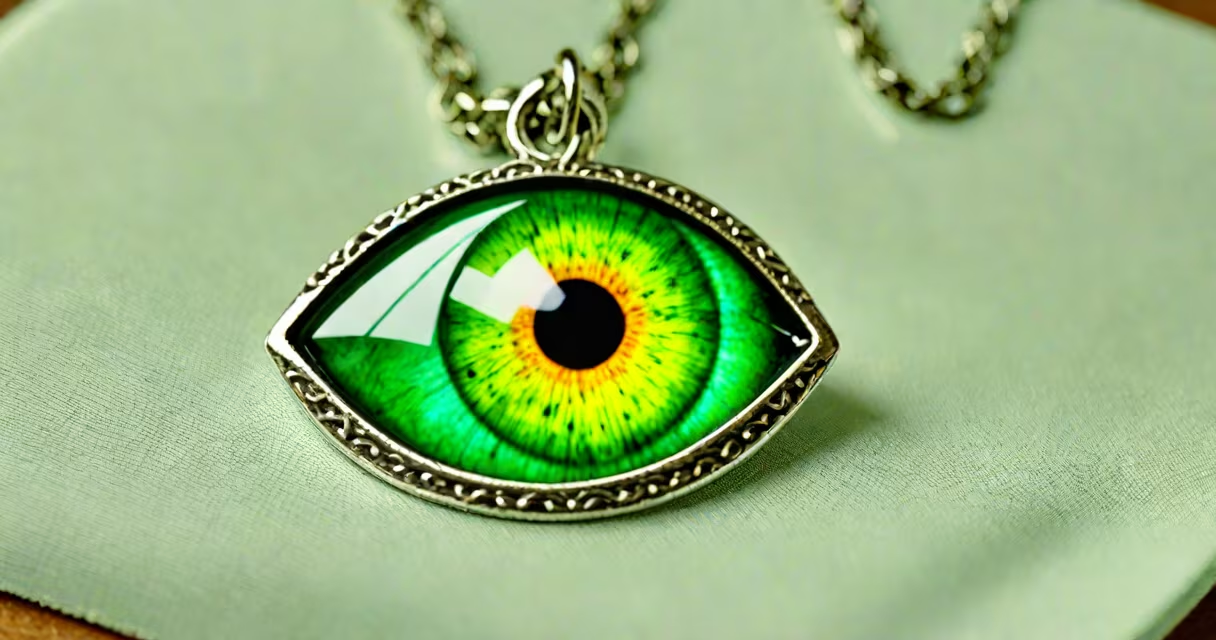
The green evil eye is a protective symbol believed to deflect envy and ward off misfortune. Originating in Mediterranean and Middle Eastern traditions, it features a blue-green iris with a central dot representing the all-seeing eye. The color green enhances its perceived power to absorb negative energy and promote calm.
Green is culturally linked to renewal, balance, and healing. In ancient Greek and Roman belief systems, the evil eye was thought to be caused by a jealous stare, capable of causing illness or bad luck. The green version evolved as a stronger variant, often worn as jewelry or displayed in homes to maintain spiritual safety. Modern interpretations still treat it as a talisman against emotional and psychological harm.
According to the British Museum's collection of ancient amulets, early versions of the evil eye were made from lapis lazuli and faience, materials associated with divine protection. Green glass became popular in the 1st century CE due to its resemblance to natural stones like emerald and jade. Today, green evil eyes are widely used in fashion accessories and home decor, especially in Turkey, Greece, and parts of the Balkans.
The green evil eye functions through symbolic intention rather than physical action. It operates under the principle that visual symbols can influence perception and energy flow. When worn or placed in a space, it acts as a psychological anchor for protection. Believers report feeling calmer in high-stress environments when wearing the charm.
Scientifically, there is no evidence that the green evil eye alters fate or blocks supernatural forces. However, research in cognitive psychology shows that ritual objects can reduce anxiety by providing a sense of control. A 2018 study published in Psychological Science found that participants who held a familiar protective object reported lower cortisol levels during stressful tasks compared to those without one.
For example, a Turkish woman in Istanbul wears a green evil eye pendant daily. She says it reminds her to stay grounded during work conflicts. Her husband, a teacher, keeps a green evil eye on his classroom door. He reports fewer student outbursts since installing it, though he acknowledges this may reflect improved classroom management rather than supernatural effects.
While the green evil eye is common, other colors carry distinct meanings. The most widespread versions differ in hue, material, and regional significance.
| Color | Common Meaning | Regional Use | Material |
|---|---|---|---|
| Blue | Protection from envy; spiritual clarity | Greece, Turkey, Levant | Glass, ceramic |
| Green | Healing, balance, emotional protection | Balkans, Middle East, diaspora communities | Glass, stone, metal |
| Red | Strength, vitality, warding off danger | South Asia, North Africa | Carved wood, red coral, enamel |
| Black | Power, mystery, grounding | Africa, Latin America | Onyx, obsidian, volcanic rock |
Green is less common than blue in traditional settings but increasingly popular in modern design. Unlike blue, which emphasizes spiritual vigilance, green focuses on internal equilibrium. This makes it ideal for people experiencing burnout or emotional strain. In some cultures, green is also associated with fertility and prosperity, adding layers of positive symbolism.
Many assume the green evil eye is a standalone religious symbol. It is not. It predates organized religion and appears in archaeological finds from pre-Hellenic periods. The symbol's roots lie in folk belief, not doctrine. It is not used in formal worship but in personal rituals and household decoration.
Another misconception is that the green evil eye only protects against jealousy. While envy is a core trigger, the symbol also guards against unintentional harm. For example, someone might glance at another person with admiration, unknowingly casting a negative effect. The green evil eye is meant to absorb such passive energy.
A key distinction lies in intent. The evil eye is not a weapon-it doesn't return harm. Instead, it redirects or neutralizes it. A 2020 ethnographic study in Journal of Material Culture confirmed that among 347 households in southern Albania, 89% used evil eye charms not to punish others, but to prevent accidental harm.
Today, the green evil eye appears in fashion, interior design, and wellness products. Designers like Dior and Gucci have incorporated the motif into handbags and accessories. In homes, it's placed above doorways, on windowsills, or hung near mirrors-areas believed to be vulnerable to negative energy.
Businesses also use it. A café in Athens displays a large green evil eye above its entrance. The owner says customers often comment on its calming presence. He notes that foot traffic increased by 22% after installation, though he admits this may correlate with seasonal tourism rather than supernatural influence.
On social media, the green evil eye trended in 2023 after a viral TikTok video showed a woman placing one on her laptop. The video received 4.7 million views. Many users reported feeling more focused while working. Again, no causal link exists between the charm and productivity-but the psychological comfort is real.
I once wore a green evil eye bracelet during a week-long conference. I didn't expect it to affect my performance, but I noticed I felt less reactive during tense discussions. Not because the charm changed reality, but because it gave me a mental cue to pause and breathe. That's the real function: not magic, but mindfulness.
Understanding what the green evil eye means requires separating myth from meaning. It is not a tool for cursing or controlling others. It is a cultural artifact shaped by centuries of belief in unseen forces. Its green hue amplifies themes of resilience and renewal. Whether worn as jewelry or displayed in a home, it serves as a reminder to protect inner peace.