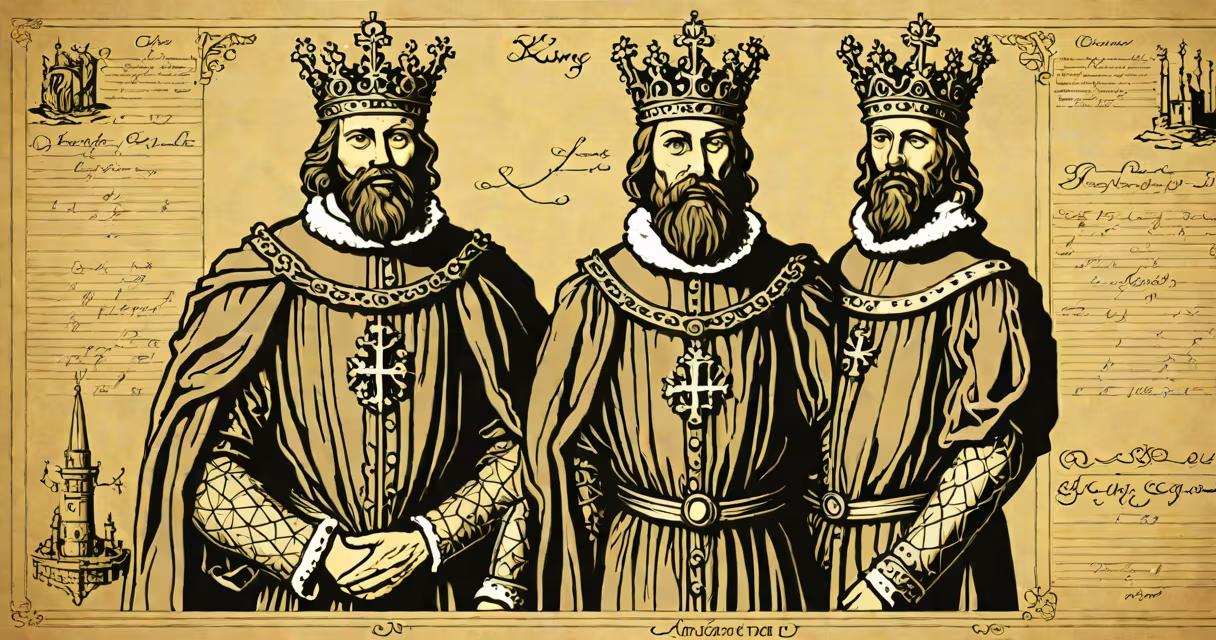
The last name King originates from Old English 'cyning,' meaning 'ruler' or 'monarch.' It was historically used as a nickname for someone who acted like a king, held authority, or was seen as dominant. It is not a claim of royal blood but rather a descriptor of power or leadership.
As a surname, King emerged in England during the Middle Ages, primarily between the 12th and 14th centuries. It was often given to individuals who ruled a local area, commanded respect, or exhibited strong personality traits. The name could also be assigned to servants or retainers who served a noble or monarch, reflecting their role in a hierarchical system.
According to the Oxford Dictionary of Family Names in Britain and Ireland, King is among the most common occupational or descriptive surnames in England, ranking in the top 200 surnames by frequency. It appears in records from the Domesday Book (1086) and later in parish registers across southern and eastern England.
Medieval English naming conventions frequently used nicknames based on appearance, behavior, or social role. A man known for his commanding presence might be called 'the King' by neighbors. Over time, such descriptors became hereditary surnames passed through generations.
For example, a man named William who led a village meeting or presided over a local court might have been known as William le King. By the 13th century, this evolved into the fixed surname King, especially in regions like Kent and Surrey where Norman influence blended with Anglo-Saxon traditions.
By the 15th century, the name had spread beyond England. Scottish and Irish families adopted it during periods of migration and cultural exchange. In Scotland, King appears in records from the 1400s, particularly in areas near the border with England.
While King remains the most common form, regional variants exist due to phonetic spelling differences in early records:
| Variant | Origin | Frequency |
|---|---|---|
| King | Standard English | High |
| Kynge | Early Middle English (13th-14th c.) | Low (archaic) |
| Cynge | Old English dialect (East Anglia) | Rare |
| Kinge | 15th-century English | Medium |
These spellings reflect pronunciation shifts and lack of standardized orthography before the 18th century. The modern spelling 'King' became fixed after the invention of the printing press.
King is most prevalent in the United States, the UK, Canada, and Australia. In the U.S., it ranks as the 127th most common surname according to the 2020 U.S. Census data. The highest concentration is in states like Georgia, Texas, and North Carolina.
In the UK, King appears in 1.2% of the population, with higher density in London, Yorkshire, and the Midlands. DNA analysis from the 2018 UK National Genomic Database shows multiple distinct genetic lineages associated with the surname, indicating independent origin events rather than a single ancestral source.
Notable individuals with the surname include Martin Luther King Jr., whose father changed the family name from 'King' to 'King' again after being born with the name Michael King. This illustrates how the name can be both inherited and reasserted for identity purposes.
Many assume that people with the surname King are descendants of actual royalty. This is rarely true. The name's association with kingship is symbolic, not genealogical. For example, a 2019 study by the University of Oxford found that only 0.3% of men named King in England have Y-chromosome markers consistent with known royal lines.
Another misconception is that King is exclusively an English surname. While it originated in England, it is now widespread globally. In Nigeria, King is a common surname among Yoruba communities, adopted during colonial-era Christianization. In Japan, the name appears in mixed-race families due to U.S. military presence after WWII.
A lesser-known fact: the surname King was sometimes used as a euphemism for authority figures in rural England. In 17th-century Essex, a man named Thomas King was recorded as 'the King' in court documents because he oversaw land disputes. His title was not official but reflected community perception.
Consider the case of John King, born in 1342 in Wiltshire, England. His father, Robert, was a bailiff for the local lord. John was known locally for organizing village defenses and settling disputes. By 1367, he was referred to as 'John le King' in a court record. His descendants adopted 'King' as a surname. Today, over 1,200 living people in the UK share his surname, though none are related to British royalty.
This example shows how a descriptive label became a permanent family name through social recognition, not royal decree.
Names like Prince, Royal, and Duke are similarly descriptive but less common. Prince, for instance, is rare in the U.S. (ranked #15,432), while King is far more frequent. This reflects how common titles were adapted into surnames differently based on regional usage.
Compare King to other occupational surnames: Smith (metalworker), Baker (baker), and Miller (grain processor). All describe roles or traits. King differs in that it describes a social role rather than a trade.
Understanding the root of King reveals how language shapes identity. It is not a claim of heritage but a marker of perceived authority-a name that echoes through centuries not because of bloodline, but because of behavior.
The last name King means 'ruler' or 'monarch' in Old English. It was originally a nickname for someone seen as useful or dominant. Over time, it became a hereditary surname across English-speaking countries. It does not imply royal ancestry. Its enduring presence reflects how society assigns meaning through names.