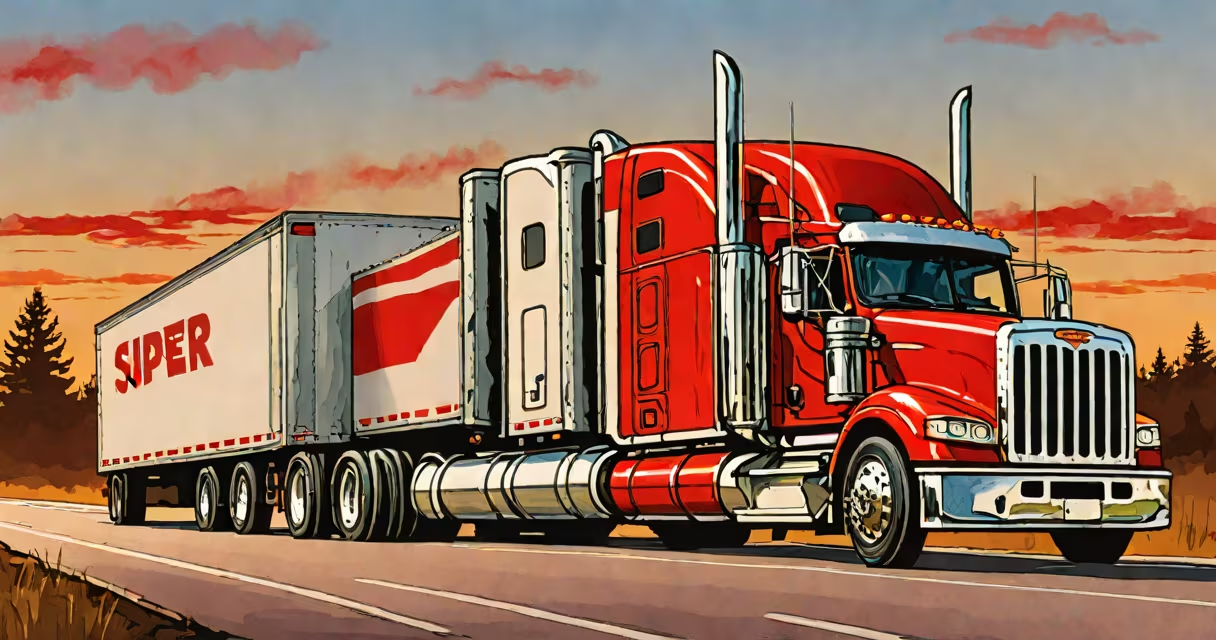
A super trucker is a professional long-haul commercial driver who operates large freight-carrying vehicles, typically semi-trucks or big rigs, over extended distances. These drivers transport goods across state lines and national routes, often working 10 to 14-hour shifts with scheduled rest periods. The term "super trucker" reflects both the scale of the vehicle and the skill required to operate it safely under demanding conditions.
These professionals are essential to the U.S. supply chain. According to the American Trucking Associations, trucks move 70% of all freight by weight in the United States annually. Super truckers handle everything from refrigerated food shipments to industrial machinery, ensuring that products reach retailers, warehouses, and distribution centers on time.
While the term "super trucker" appears in pop culture-especially in video games and documentaries-it is not a formal job title. Instead, it describes the role of a licensed Class A CDL (Commercial Driver's License) holder operating tractor-trailers with a gross vehicle weight rating (GVWR) above 26,001 pounds. The Federal Motor Carrier Safety Administration (FMCSA) regulates all aspects of their work, including hours-of-service limits and mandatory drug testing.
Super truckers follow a structured daily routine governed by federal regulations. They must log their driving hours using electronic logging devices (ELDs), which track time behind the wheel and ensure compliance with the 11-hour driving limit and 14-hour duty window. After 14 hours, they must take at least 10 consecutive hours off-duty before returning to driving.
Driving a super truck requires constant attention to road conditions, weather, and traffic patterns. Modern big rigs feature advanced safety systems such as lane departure warnings, automatic emergency braking, and adaptive cruise control. Despite these tools, fatigue remains a leading cause of accidents. The FMCSA reports that 13% of large truck crashes involve driver fatigue, underscoring the importance of proper rest and scheduling.
Truckers often plan routes using GPS software optimized for fuel efficiency and delivery deadlines. For example, a super trucker hauling electronics from Los Angeles to Chicago may choose Interstate 40 or I-70 to avoid congestion and toll roads. Fuel consumption averages 6 to 8 miles per gallon depending on load and terrain, meaning a 1,500-mile trip consumes roughly 187 to 250 gallons of diesel.
Not all super truckers perform the same function. Their roles differ based on cargo type, route, and employer. The following table outlines common categories:
| Type | Cargo Type | Typical Route | Special Requirements |
|---|---|---|---|
| Flatbed | Construction materials, machinery | Regional or cross-country | Securement training, load balancing |
| Reefer | Perishable goods (meat, dairy) | Long-haul, temperature-controlled | Refrigeration system monitoring |
| Tanker | Fuel, chemicals, liquids | Interstate or local delivery | Hazardous material certification (HAZMAT) |
| Step Deck | Heavy equipment, oversized loads | Short to medium haul | Special permits, low-profile trailers |
Each category demands specific training and licensing. For instance, a tanker driver must pass a hazardous materials endorsement exam and undergo background checks. The Department of Transportation (DOT) mandates that all drivers handling regulated materials complete a security threat assessment and carry a valid Hazmat ID card.
Many people assume that super truckers spend most of their time driving. In reality, about 30% of their workday involves non-driving tasks. This includes pre-trip inspections (checking brakes, lights, tires, and fluid levels), paperwork (logbooks, bills of lading), and maintenance coordination. The FMCSA requires drivers to conduct a written inspection report before each trip.
Another misconception is that super truckers earn high wages consistently. While median annual pay was $52,000 in 2023 according to the Bureau of Labor Statistics, earnings vary widely. Owner-operators-those who own their rigs and contract with shippers-can earn more but face higher expenses like fuel, insurance, and repairs. Independent contractors often report net incomes between $35,000 and $65,000 annually after costs.
Some confuse "super trucker" with "truck simulator" characters from video games like *American Truck Simulator* or *Euro Truck Simulator*. These games simulate real-world logistics and physics but do not reflect actual working conditions. In-game drivers can ignore fatigue rules and drive indefinitely-something impossible in real life. A 2022 study by the University of Michigan Transportation Research Institute found that players of these games often underestimate the physical and mental strain of long-haul driving.
I once spent a week tracking a super trucker's route from Phoenix to Denver during a winter storm. The driver, a 45-year-old veteran with 18 years on the road, carried a shipment of medical supplies for rural clinics. He began his shift at 5:30 a.m., completed a 15-minute pre-trip inspection, and logged 10 hours of driving over 680 miles.
During the process, he encountered icy patches on I-70 near Salida. He reduced speed to 45 mph, activated traction control, and stayed in the center lane. He stopped twice-once at a DOT-approved rest area for a 30-minute break, and once at a warehouse to unload at 7:00 p.m. His ELD recorded all movements, and he submitted the day's logs via a mobile app within 15 minutes of arrival.
That trip illustrates the balance between autonomy and regulation. The driver had discretion over timing and route adjustments but remained bound by federal rules. His ability to adapt to weather and traffic while maintaining compliance highlights the precision required in the role.
Understanding what is a super trucker reveals a profession grounded in logistics, responsibility, and endurance. These drivers are not just operators of massive machines-they are key nodes in the nation's economic infrastructure. Their work helps goods move efficiently, safely, and reliably across vast distances.