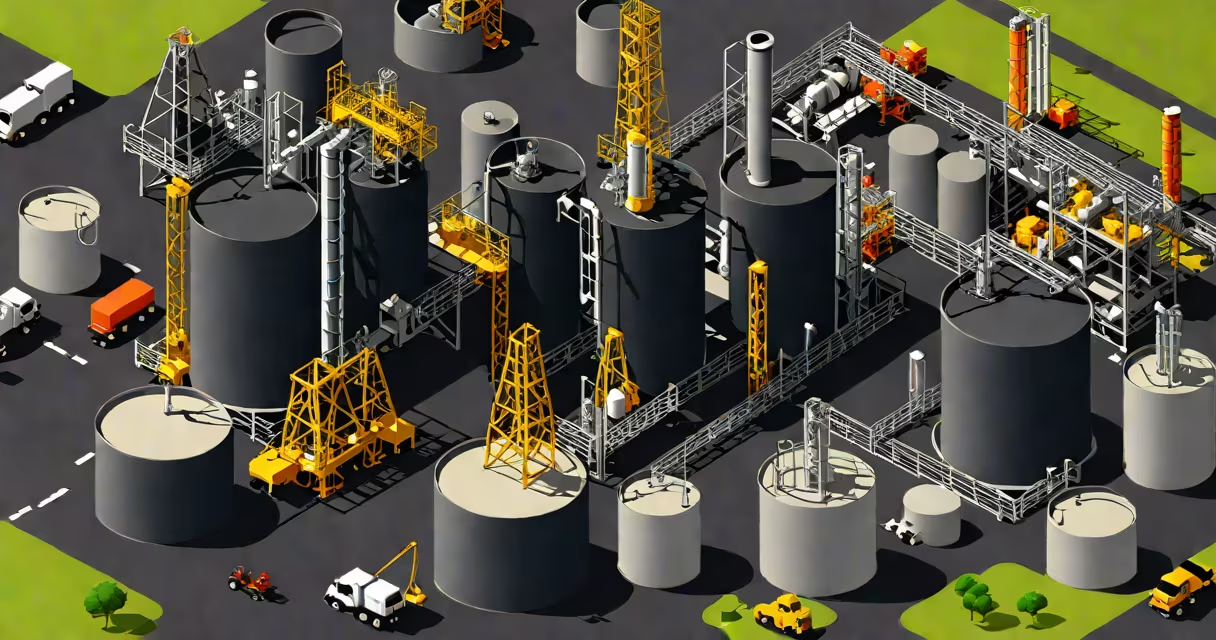
Petroleum coke, or petcoke, is a high-carbon residue produced during the refining of crude oil, primarily used as a fuel in power plants and industrial processes, and as a raw material in aluminum and steel manufacturing. It forms when heavy oil fractions undergo thermal cracking in a delayed coker unit.
Refineries produce petcoke during the coking process, which separates heavy hydrocarbons from crude oil. The resulting solid residue contains over 80% carbon by weight and has a heating value comparable to coal-typically between 26,000 and 30,000 BTU per pound. This makes it valuable as a low-cost energy source in high-heat environments.
According to the U.S. Energy Information Administration (EIA), global petcoke output reached approximately 150 million metric tons annually in 2022, with Canada and the United States accounting for nearly half of worldwide production. The majority of this material is consumed domestically in industrial sectors rather than exported.
The coking process occurs in a delayed coker unit, where vacuum residue from crude distillation is heated to around 480°C (900°F) in a furnace. The hot feed then enters a large, insulated reactor called a coke drum, where it decomposes into lighter gases and a solid carbon residue-the petcoke.
After cooling, the drum is opened and the coke is removed via a water jet cutter. The resulting material is classified by quality based on sulfur content, ash level, and particle size. Low-sulfur petcoke (below 1%) is preferred for high-temperature applications, while high-sulfur varieties are often burned as fuel.
One refinery in Alberta, Canada, reported producing about 1.2 million tons of petcoke annually from its 200,000-barrel-per-day facility. The plant uses a continuous coker system that runs 24/7, generating petcoke with consistent carbon content and minimal variability in combustion performance.
Petcoke's high energy density and low cost make it ideal for use in industries requiring intense heat. Its most common applications include:
A key distinction often missed is that not all petcoke is suitable for high-value uses. The EIA notes that only about 30% of global petcoke output meets the purity standards required for battery-grade graphite. The rest is limited to fuel applications due to higher impurities.
Petcoke is categorized by physical form and chemical composition. The two main types are:
| Type | Carbon Content | Sulfur Level | Common Use |
|---|---|---|---|
| Calcined | 85-90% | 0.5-1.5% | Aluminum anodes, graphite electrodes |
| Green (uncalcined) | 80-85% | 1.5-5.0% | Fuel, cement kilns, power plants |
Green petcoke is unprocessed and retains volatile organic compounds. It must be calcined-heated to 1,300°C-to stabilize its structure before use in electrode manufacturing. Calcining reduces volume by up to 15% and removes moisture and sulfur.
One notable example is a graphite plant in China that processes 200,000 tons of green petcoke annually. After calcination, the material is mixed with pitch binder and pressed into electrodes. These electrodes are later used in electric arc furnaces for steel production.
Many assume petcoke is interchangeable with coal or charcoal. This is incorrect. While petcoke has similar heating values, its combustion profile differs. Petcoke burns hotter and faster than coal, producing more NOx and SOx emissions unless scrubbed.
Another misconception is that petcoke is a waste product with no value. In reality, it generates significant revenue. In 2022, the global market for petcoke was valued at $28 billion, driven by demand from aluminum and steel producers. Refineries sell petcoke at prices ranging from $50 to $120 per ton, depending on sulfur content and destination.
I once visited a coking unit in Louisiana where operators explained that petcoke is not simply "leftover." The unit aims to maximize yield from heavy crude, and petcoke is a primary product, not a byproduct. The refinery sells 90% of its annual output to nearby industrial facilities within 200 miles.
Because petcoke contains high levels of sulfur and trace metals like vanadium and nickel, its combustion releases pollutants regulated under the Clean Air Act. Facilities using petcoke must install flue gas desulfurization systems to meet emission limits.
Petcoke stockpiles pose environmental risks. When exposed to rain, leachates containing polycyclic aromatic hydrocarbons (PAHs) can contaminate soil and groundwater. The U.S. Environmental Protection Agency (EPA) classifies petcoke as a hazardous material when stored improperly.
One incident in 2019 involved a petcoke pile near the Great Lakes that leaked into a tributary stream. The EPA fined the operator $1.2 million for violating stormwater discharge permits. This highlights the importance of proper containment and monitoring.