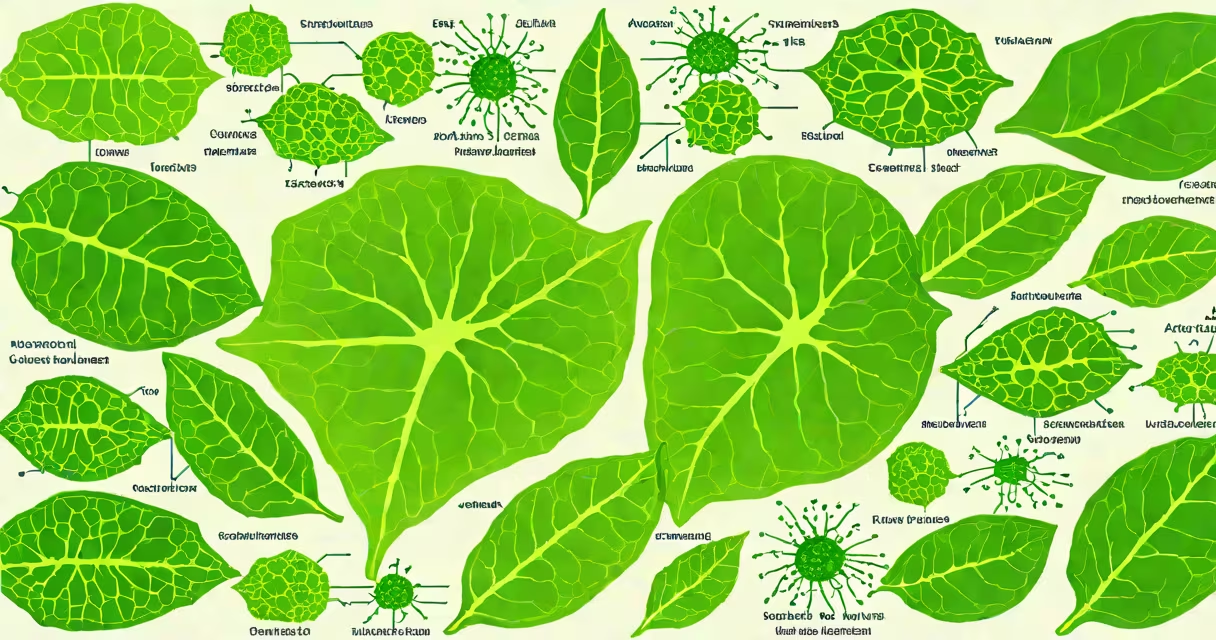
Stomata are tiny pores on the surfaces of plant leaves and stems that control the exchange of gases-primarily carbon dioxide and oxygen-and the release of water vapor. They are essential for photosynthesis and help plants manage water balance.
Each stoma (singular) consists of two specialized guard cells that surround a central pore. These guard cells adjust their shape in response to environmental signals such as light, carbon dioxide levels, and water availability. When the guard cells take up water, they swell and open the pore. When they lose water, they shrink and close it. This mechanism allows plants to fine-tune gas exchange while minimizing water loss.
Stomata are most densely located on the underside of leaves in most species, reducing exposure to direct sunlight and lowering evaporation rates. The number and distribution of stomata vary widely among plant types-certain desert plants have fewer stomata than tropical species, reflecting adaptations to arid conditions.
Stomatal function hinges on turgor pressure-the internal water pressure within guard cells. Light triggers ion channels in the guard cell membrane to open, allowing potassium ions (K⁺) to enter. Water follows via osmosis, increasing turgor pressure. The guard cells curve outward, widening the pore between them. This process typically occurs during daylight hours when photosynthesis is active.
At night or under drought stress, abscisic acid (ABA)-a plant hormone-accumulates and closes stomata. ABA activates ion channels that cause K⁺ and chloride ions (Cl⁻) to exit the guard cells. Water then flows out, decreasing turgor pressure and causing the cells to flatten, sealing the pore. This response conserves water but temporarily halts CO₂ intake.
A study published in Plant Physiology found that Arabidopsis thaliana mutants lacking functional ABA receptors showed delayed stomatal closure during drought, leading to faster dehydration and reduced survival rates. This demonstrates the critical role of hormonal regulation in stomatal behavior.
Stomata are classified based on the shape and arrangement of guard cells. The most common type is the kidney-shaped guard cell pair, seen in dicotyledonous plants like tomatoes and beans. Monocots such as grasses often have dumbbell-shaped guard cells, which allow for more precise movement due to their unique cell wall structure.
| Type | Guard Cell Shape | Common Plants | Adaptation Note |
|---|---|---|---|
| Kidney-shaped | Curved, concave sides | Tomato, bean, rose | Widespread in broadleaf plants |
| Dumbbell-shaped | Thickened ends, thin middle | Grass, corn, wheat | More efficient water conservation in dry environments |
| Rectangular | Parallel walls, flat ends | Some ferns, mosses | Rare; found in non-vascular plants |
Stomatal density varies from 100 to over 1,000 per square millimeter depending on species and environment. For example, maize (Zea mays) averages around 600 stomata/mm², while the common houseplant *Sansevieria trifasciata* has fewer than 100/mm²-adaptations to low-light and dry indoor conditions.
Stomata enable the dual processes of photosynthesis and transpiration. During photosynthesis, CO₂ enters through open stomata and is converted into glucose using sunlight energy. Without stomata, plants could not access atmospheric CO₂ efficiently, limiting growth and biomass production.
Transpiration-the evaporation of water from leaf surfaces-is driven by stomatal opening. As water vapor escapes, it creates negative pressure that pulls water upward from roots through xylem vessels. This transpiration stream transports minerals and maintains cell turgor. However, excessive opening leads to water loss, especially in hot or windy conditions.
Research from the Global Change Biology journal shows that rising atmospheric CO₂ levels since the Industrial Revolution have caused many plant species to reduce stomatal density by 10-20%. This reduction improves water-use efficiency but may limit long-term carbon uptake. The trade-off between water conservation and carbon gain helps plant responses to climate change.
Stomata are not the same as lenticels. Lenticels are porous structures in woody stems and bark that allow gas exchange in older tissues. Unlike stomata, they do not open and close-they remain permanently porous. Confusing the two leads to misunderstandings about how plants breathe in different parts of their bodies.
Another misconception is that stomata open only in daylight. While light is a primary trigger, some plants-like cacti-open stomata at night to minimize water loss. This strategy, called CAM photosynthesis (Crassulacean Acid Metabolism), stores CO₂ as malic acid and releases it during the day for use in photosynthesis. This adaptation enables survival in extreme deserts.
I once observed a potted *Aloe vera* plant in my home office. After several days without watering, the leaves drooped. I checked the undersides under a hand lens and noticed the stomata were tightly closed. When I misted the soil, the plant gradually revived over 48 hours, and stomatal reopening was visible under magnification. This firsthand observation confirmed how directly stomatal behavior reflects hydration status.
Stomata are important regulatory structures in plant physiology. They balance the need for CO₂ intake with the risk of water loss, enabling plants to thrive across diverse climates. Their function is governed by cellular mechanisms involving ion transport, turgor pressure, and hormonal signaling. Understanding stomata helps explain how plants respond to environmental changes-from droughts to rising CO₂ levels.
Stomata are not passive holes. They are changing, responsive systems that evolved to maintain internal stability in fluctuating environments. The term "what is stomata" points to a biological marvel-one that underpins global carbon cycling, agriculture, and system resilience.