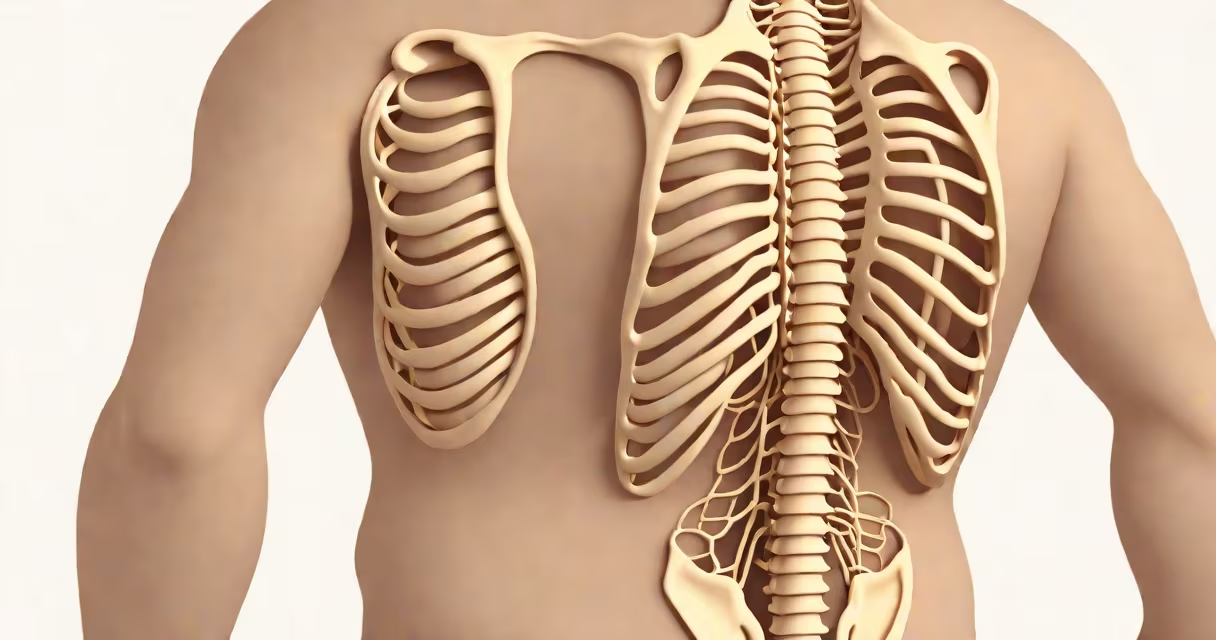
The organ on your back right side is most often the right kidney. It lies just beneath the lower ribs, tucked between the diaphragm above and the psoas muscle below, nestled against the posterior abdominal wall.
Each kidney sits retroperitoneally-behind the peritoneum, the lining of the abdominal cavity. The right kidney sits slightly lower than the left due to the liver's presence on the right side of the abdomen. This anatomical offset places the right kidney directly under the 12th rib and near the lumbar vertebrae L1-L3.
When people refer to "back pain on the right side," they're usually pointing to the region over the right kidney. This area is clinically known as the right flank. Pain here may stem from kidney stones, infection, trauma, or referred pain from nearby structures such as the spine or muscles.
The kidneys filter about 120-150 quarts of blood daily, removing waste products and excess fluid. They maintain electrolyte balance, regulate blood pressure via renin release, and produce erythropoietin to stimulate red blood cell production.
Each kidney weighs approximately 120-150 grams and measures about 11 cm long, 6 cm wide, and 3 cm thick-roughly the size of a large fist. The right kidney is slightly smaller than the left due to space constraints from the liver.
Urine forms in nephrons, the functional units of the kidney. Blood enters through the renal artery, passes through capillaries in the cortex, and exits via the renal vein. Waste products travel through the ureter to the bladder.
Pain in the right back side is frequently caused by kidney-related issues. The most common is nephrolithiasis-kidney stones. These form when minerals crystallize in the urine, often causing sharp, colicky pain that radiates from the flank to the groin.
According to the National Institute of Diabetes and Digestive and Kidney Diseases (NIDDK), about 1 in 11 Americans will develop a kidney stone in their lifetime. Stones larger than 5 mm have a 50% chance of passing spontaneously, but those over 6 mm often require medical intervention.
Pyelonephritis, a kidney infection, can cause persistent dull ache in the right flank, fever, chills, and nausea. Left untreated, it may lead to sepsis. Diagnosis involves urinalysis showing white blood cells and bacteria, plus imaging like ultrasound or CT scan.
People often mistake right back pain for liver problems. The liver sits on the right side of the abdomen but lies anteriorly, beneath the diaphragm and ribs-not in the back. Liver pain is typically felt in the upper right quadrant, not the flank.
Another frequent error is attributing pain to the spine. Lumbar facet joint syndrome or herniated discs can mimic kidney pain. However, spinal pain tends to worsen with movement, bending, or sitting, while kidney pain often remains constant and may intensify when lying down.
A key distinction: kidney pain is deep and dull, localized to the flank. Spinal pain is often sharp, radiating along nerve pathways. Imaging is essential to differentiate-ultrasound detects kidney stones and hydronephrosis (swelling from blocked urine flow), while MRI or CT identifies spinal pathology.
In 2022, a 34-year-old woman presented with severe right flank pain lasting 12 hours. She reported nausea but no fever. Physical exam revealed tenderness at the costovertebral angle (CVA)-the spot where the 12th rib meets the spine on the right side.
An ultrasound showed a 7-mm stone in the right distal ureter with mild hydronephrosis. She was treated with hydration, NSAIDs, and tamsulosin to relax the ureter. The stone passed within 48 hours. No surgical intervention was needed.
This case illustrates how CVA tenderness, combined with imaging, confirms kidney origin. Without proper evaluation, the diagnosis could have been misattributed to musculoskeletal strain or gallbladder disease.
Not all pain in the right back side comes from the kidney. The following table outlines common sources:
| Source | Location | Pain Quality | Diagnostic Clue |
|---|---|---|---|
| Kidney (e.g., stones) | Flank, under 12th rib | Dull, colicky, radiates to groin | CVA tenderness, hematuria, obstruction on ultrasound |
| Lumbar spine (disc, facet) | Lower back, may radiate | Sharp, movement-dependent | Pain increases with bending, sitting; normal urinalysis |
| Muscle strain | Overlying muscles | Ache, worsens with activity | Localized tenderness, no systemic symptoms |
| Liver (rare) | Upper right quadrant | Dull, may be associated with jaundice | Elevated liver enzymes, palpable mass |
One non-obvious fact: the right kidney is more accessible to ultrasound than the left because the liver acts as a window. Sound waves pass easily through the liver, allowing clear visualization of the right kidney. The left kidney is harder to image due to gas in the intestines and the spleen blocking the path.
Consult a healthcare provider if pain persists beyond 24 hours, especially with fever, vomiting, blood in urine, or inability to urinate. These signs suggest complications like obstruction or infection.
I've seen patients delay care for days, assuming it was muscle strain. One man ignored right flank pain for five days. He later developed sepsis from an undetected kidney abscess. Early imaging prevented a life-threatening outcome.
If you suspect kidney involvement, a urinalysis and non-contrast CT scan are standard. CT detects stones with 95% accuracy, according to the American College of Radiology.
The right kidney connects to the urinary system via the right ureter, which runs down the retroperitoneal space and enters the bladder at the trigone. The renal arteries branch from the abdominal aorta, and the renal veins drain into the inferior vena cava.
Understanding the precise location of the right kidney helps distinguish true renal pain from other sources. If you feel pain in your back right side, don't assume it's muscular. Get evaluated to rule out stones, infection, or structural issues.
Knowing what organ is on your back right side-typically the right kidney-helps you recognize warning signs early. Prompt diagnosis prevents complications and guides effective treatment.