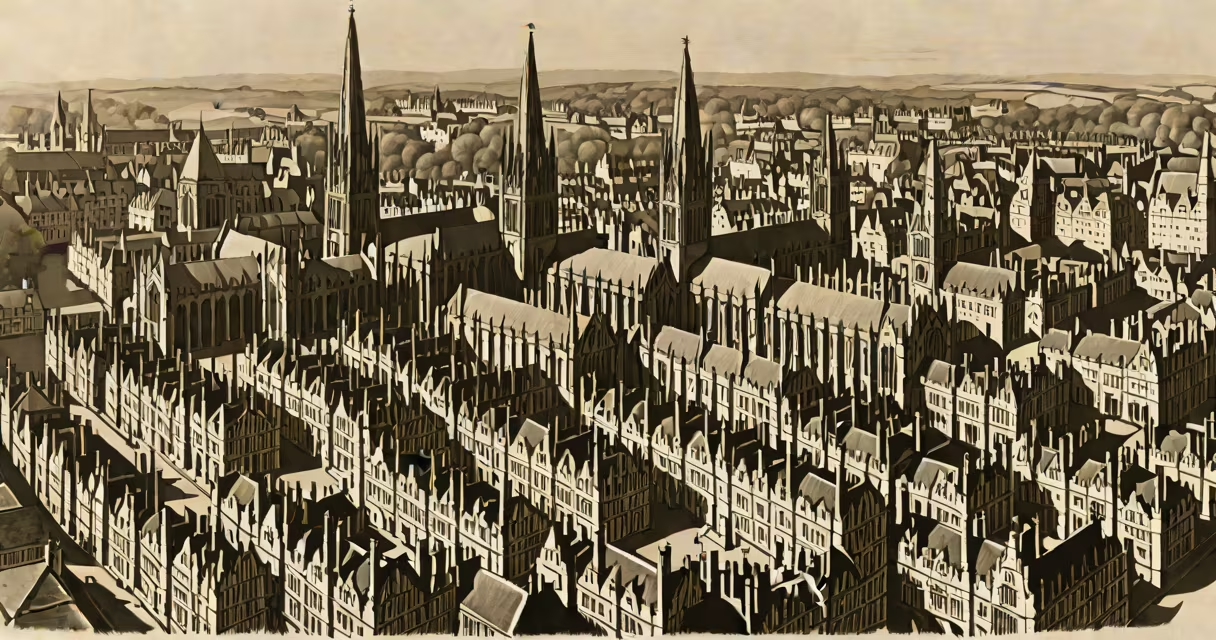
Oxford University was established in the late 11th century, around 1096, making it the oldest university in the English-speaking world. The date is approximate due to the absence of a single founding charter; its formation emerged from a migration of scholars from the University of Paris and local teaching groups in Oxford.
The earliest records of formal instruction in Oxford appear in letters from 1096, when King William II granted privileges to students studying in the town. By 1100, Oxford had developed a structured academic community. The university did not receive a royal charter until 1248, when Henry III confirmed its status. This charter granted legal recognition and authority to award degrees, marking the transition from informal study circles to a formal institution.
Founding dates for medieval universities are often debated because they evolved gradually. Oxford did not begin as a single building or centralized administration. Instead, it grew from clusters of masters and students living in hostels and churches. The city's proximity to London and its role as a religious center helped attract scholars from across Europe.
Oxford's early structure mirrored other European academic centers. Students lived in halls-private accommodations managed by masters-and attended lectures held in churches or borrowed rooms. There were no permanent campuses. The university operated through a network of independent colleges, each with its own governance and funding.
By the 13th century, Oxford had gained international reputation. Scholars like Robert Grosseteste and Roger Bacon taught there, contributing to advances in logic, natural philosophy, and mathematics. The university's curriculum centered on theology, law, medicine, and arts-subjects aligned with Church doctrine and imperial needs.
Colleges were the core units of Oxford's organization. The first college, Merton College, was founded in 1264. Others followed: Balliol (1263), Christ Church (1525), and Trinity (1555). Each college functioned as a residential and educational community, pooling resources to support teaching and student life.
Oxford is not a single entity but a federation of 38 colleges and over 100 departments. Each college manages its own admissions, finances, and internal affairs. The central university handles degree examinations, faculty appointments, and research oversight.
| Type | Description | Example |
|---|---|---|
| College | Residential and administrative unit; selects students and provides tutoring. | Trinity College |
| Department | Faculty group responsible for teaching and research in a subject area. | Department of Physics |
| University | Central governing body; oversees exams, degree awards, and institutional policy. | Oxford University Senate |
A common misunderstanding is that Oxford was founded in 1096 as a single institution. That year marks the beginning of organized study, but the university evolved over centuries. The term "founded" applies differently than in modern institutions with clear start dates and charters.
Many assume Oxford was established in 1096 with a formal charter. No such document exists from that year. The first official charter came in 1248. The confusion arises because 1096 is cited in historical texts as the year when scholars began gathering in Oxford to teach and learn.
Another misconception is that Oxford was created by royal decree. While kings and popes supported its growth, the university formed organically. The move of scholars from Paris to Oxford in the 1090s was driven by political instability and conflict in France, not royal planning.
A lesser-known fact: Oxford's name derives from the Old English word *Oxenford*, meaning "ford where oxen cross." The River Cherwell and the Thames tributaries formed natural crossing points. The settlement grew around this location, which became a hub for trade and learning.
Merton College, established in 1264, illustrates how Oxford expanded beyond informal gatherings. Founded by Walter de Merton, a former Lord Chancellor, it was the first college to have a constitution and a fixed endowment. It received its charter from Pope Urban IV in 1265.
At its founding, Merton had 12 fellows and a library of 15 books. By 1300, it housed 40 students and owned land in Oxfordshire. Its statutes governed conduct, attendance, and scholarship standards-models later adopted by other colleges.
This example shows that Oxford's development was incremental. The university did not emerge overnight. Each college added layers of structure, governance, and academic tradition over time.
I visited Oxford in 2019 during a summer course. Walking through the Bodleian Library's entrance, I saw a 13th-century manuscript page displayed behind glass. The Latin text described a theological debate from 1220. The physical presence of such materials reinforced how deeply Oxford's history is embedded in its buildings and collections.
Later, I sat in a tutorial room at St. John's College. A tutor discussed Chaucer's *Canterbury Tales* using a 14th-century edition. The continuity of teaching methods-from oral debate to close reading-was tangible. These moments underscored that Oxford's foundation wasn't a single event but a living process spanning nearly 900 years.
The Oxford University Archives confirm that the earliest known record of a student being expelled from Oxford dates to 1209. This indicates a functioning academic system existed by then. The British Library holds a 1248 charter issued by Henry III, which formally recognized Oxford as a university.
According to the Oxford University website, the university's origins are traced to "a group of scholars who moved from Paris to Oxford in the late 11th century." The British History Online entry states that the university's formal status was confirmed in 1248, aligning with the royal charter.
When was Oxford University founded? The answer is not a single year. The university began forming around 1096, received formal recognition in 1248, and evolved continuously. The term "founded" applies to the emergence of scholarly activity, not a ceremonial opening.
Understanding this timeline prevents misrepresentations. Oxford is not a modern institution with a launch date. It is a living archive of intellectual tradition. The question "when was Oxford University founded" requires context: the initial gathering of scholars in 1096, the royal charter in 1248, and the ongoing evolution of its structure.