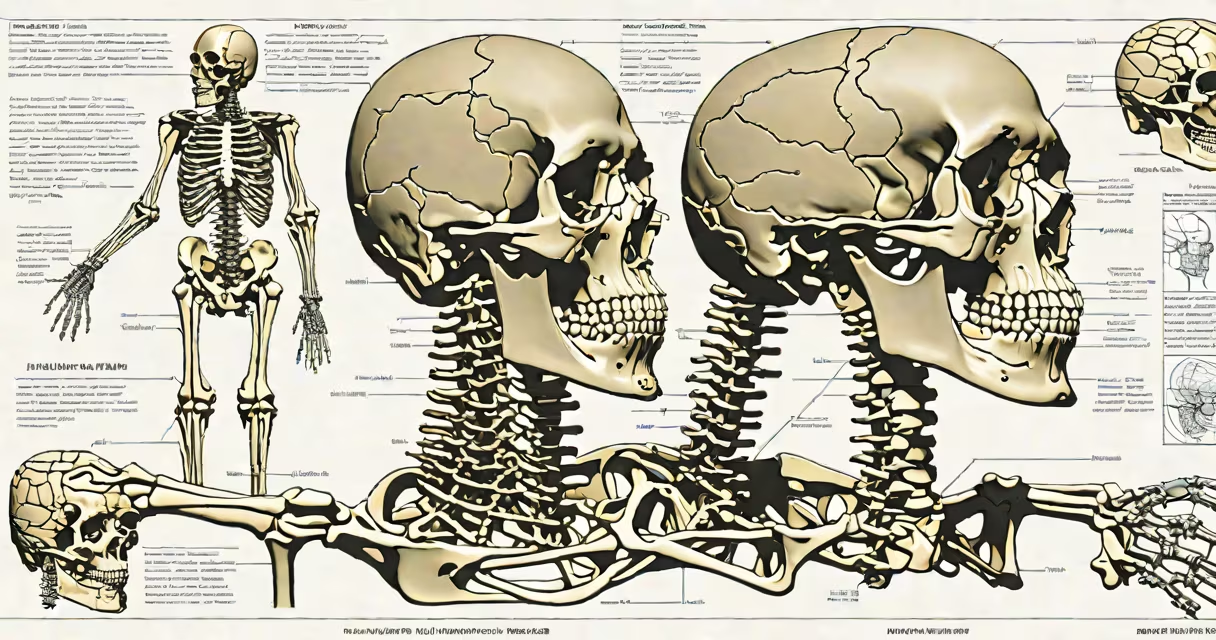
The 80 bones of the axial skeleton make up the central core of the human body, forming the skull, vertebral column, and thoracic cage. These bones protect important organs like the brain and spinal cord, provide structural support, and serve as attachment points for muscles involved in posture and movement.
This group includes 8 cranial bones, 14 facial bones, 26 vertebrae (including the sacrum and coccyx), 24 ribs, and 1 sternum. Together, they create a rigid structure that anchors the head, supports the trunk, and maintains balance during standing and walking.
These bones do not include the limbs or limb girdles. The appendicular skeleton-the arms, legs, shoulders, and pelvis-contains the remaining 126 bones. The axial skeleton's role is foundational: it stabilizes the body's center and shields internal systems from trauma.
The axial skeleton acts as a mechanical scaffold. Its bones resist compressive forces and transmit loads from the upper body to the lower spine and pelvis. For example, when standing upright, the weight of the head and torso is transferred through the cervical, thoracic, and lumbar vertebrae to the pelvic girdle.
Each segment contributes to stability and motion. The atlas (C1) and axis (C2) vertebrae allow head rotation and nodding. The intervertebral discs between vertebrae absorb shock and enable limited flexion and extension. The rib cage expands and contracts during breathing, driven by diaphragm and intercostal muscle action.
Without this structure, the brain would lack protection, the spine would collapse under load, and respiration would fail. The axial skeleton enables survival in upright posture-a key adaptation in human evolution.
The axial skeleton divides into three main regions: the skull, vertebral column, and thoracic cage. Each contains specific bones with defined roles.
| Region | Bone Type | Count | Function |
|---|---|---|---|
| Skull | Cranial & facial bones | 22 | Protects brain, houses sensory organs |
| Vertebral Column | Individual vertebrae | 26 | Supports head, protects spinal cord |
| Thoracic Cage | Ribs and sternum | 25 | Protects heart and lungs, aids respiration |
Adding these gives 22 + 26 + 25 = 73 bones. But the count reaches 80 because the skull includes 8 cranial bones (frontal, parietal ×2, temporal ×2, occipital, sphenoid, ethmoid) and 14 facial bones (maxilla, mandible, zygomatic, nasal, lacrimal, palatine, inferior nasal conchae, vomer). The vertebral column includes 7 cervical, 12 thoracic, 5 lumbar, 5 fused sacral (sacrum), and 4 fused coccygeal bones. The thoracic cage comprises 12 pairs of ribs (24 total) and one sternum.
A common error is counting the sacrum and coccyx as single bones. They are formed from fused vertebrae-sacrum from five, coccyx from four. Each fusion reduces the total number of individual bones but preserves function. This fusion increases strength and stability in weight-bearing positions.
Many assume the axial skeleton includes the hyoid bone. It is part of the axial skeleton but is not attached to other bones-it floats in the neck. The hyoid supports the tongue and larynx and is included in the 80-bone count.
Another misconception is that all ribs are equal. True: there are 12 pairs, but first seven are true ribs (attached directly to the sternum), next three are false ribs (joined via cartilage), and last two are floating ribs (no anterior attachment). This variation affects biomechanics and clinical diagnosis.
Some sources incorrectly list 79 bones due to omitting the hyoid. The standard anatomical count from Gray's Anatomy and the National Library of Medicine confirms 80 bones in the adult axial skeleton. This number accounts for all elements, including the hyoid and fused segments.
In a clinical setting, knowing the 80 bones of the axial skeleton is essential for diagnosing fractures and planning surgeries. For instance, a patient with a fall may have a fractured C6 vertebra. Radiologists use the known anatomy-specifically the 26 vertebrae-to locate the injury precisely.
During a routine physical exam, a doctor checks the rib cage for symmetry. Uneven expansion during inhalation may indicate a rib fracture or lung pathology. The 24 ribs and sternum form a closed box; any asymmetry suggests structural compromise.
I once observed a cadaver dissection where a student miscounted the ribs. He assumed all 12 pairs were visible. But upon careful removal of the sternum and costal cartilages, we confirmed all 24 ribs were present-two were hidden beneath the diaphragm in the posterior view. This reinforced that visual access doesn't equal anatomical completeness.
The axial skeleton contrasts sharply with the appendicular skeleton. While the axial skeleton focuses on protection and central support, the appendicular skeleton emphasizes mobility and manipulation. The shoulder girdle (scapula and clavicle) and pelvic girdle (hip bones) connect limbs to the axial frame.
For clarity, the axial skeleton includes the skull, spine, and ribcage-but not the bones of the limbs. The femur, humerus, radius, ulna, metacarpals, phalanges, and tarsals belong to the appendicular system. Together, both systems total 206 bones in the adult human body.
Understanding the division helps in medical education and imaging interpretation. A CT scan of the chest highlights the 24 ribs and sternum-part of the axial skeleton-while MRI of the knee focuses on the tibia, fibula, patella, and femur-appendicular bones.