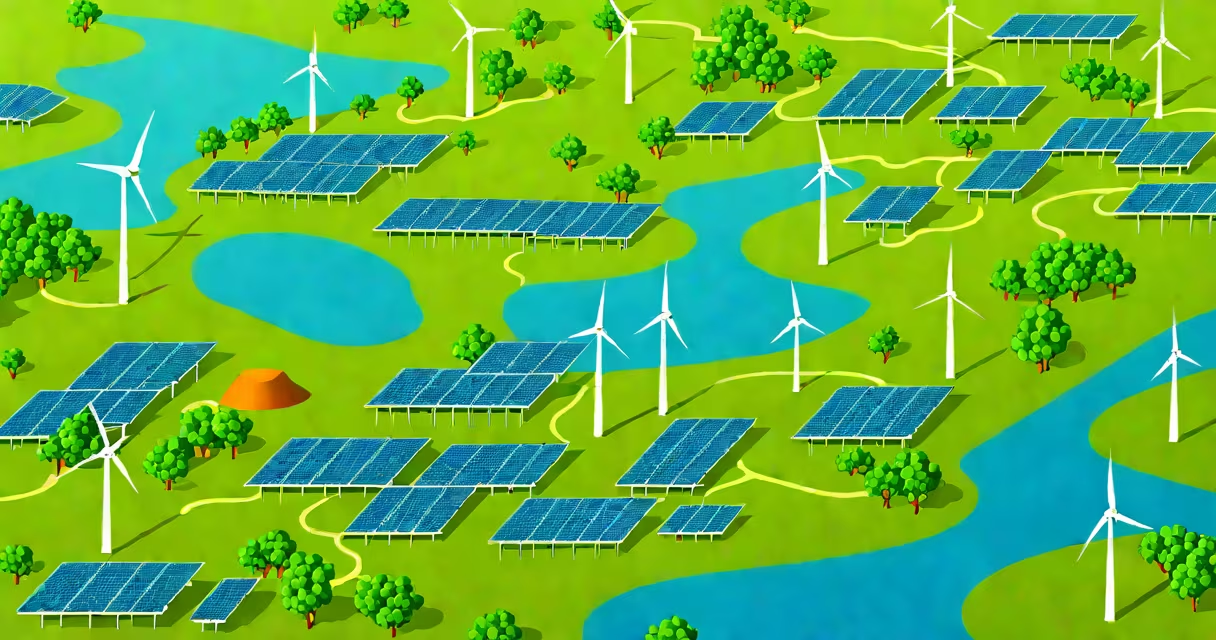
All renewable energy sources generate electricity or heat from natural processes that replenish faster than they are consumed. These include solar, wind, hydroelectric, geothermal, and biomass energy. They differ from fossil fuels by producing little to no greenhouse gas emissions during operation.
Solar power captures sunlight using photovoltaic cells or mirrors focused on receivers. When sunlight hits a solar panel, electrons move, creating direct current (DC) electricity. This DC is converted to alternating current (AC) via an inverter for home or grid use. A typical residential rooftop system generates 5 to 10 kilowatts (kW) and can offset 60-80% of household electricity use annually.
Wind energy uses turbines to convert kinetic energy from wind into electrical power. Modern turbines stand 80 to 120 meters tall with blades spanning over 60 meters. A single turbine can produce 2 to 3 megawatts (MW) of power. Offshore wind farms in Denmark and Germany average 300 MW capacity per site, supplying tens of thousands of homes.
Hydroelectric power relies on flowing water to spin turbines. Dams store water in reservoirs and release it through penstocks to drive generators. The largest facility, China's Three Gorges Dam, has 34 turbines generating 22.5 GW-enough to power 18 million homes. Run-of-river systems, which don't require large dams, produce smaller outputs but reduce ecological disruption.
Geothermal energy taps heat from beneath Earth's surface. Wells drilled 1 to 3 kilometers deep access hot rock or steam to drive turbines. Iceland runs 30% of its electricity and 90% of its heating from geothermal sources. Enhanced geothermal systems (EGS) use injected water to fracture dry rock, expanding viable sites beyond volcanic zones.
Biomass energy burns organic materials-wood, crop residues, or waste-to create heat or electricity. A 100 MW biomass plant in Sweden burns forestry waste, reducing landfill use while providing baseload power. However, combustion releases carbon dioxide, requiring careful lifecycle analysis to ensure net-zero impact.
| Source | Primary Input | Typical Output Capacity | Environmental Consideration |
|---|---|---|---|
| Solar | Direct sunlight | 1-10 kW (residential), 100+ MW (utility-scale) | Low land use, minimal water consumption |
| Wind | Wind speed | 2-3 MW per turbine, 300+ MW per offshore farm | Avian mortality risk, visual impact |
| Hydroelectric | Flowing water | 100 MW-22.5 GW (Three Gorges) | Dam displacement, altered river ecosystems |
| Geothermal | Subsurface heat | 5-50 MW per plant | Low emissions, high site specificity |
| Biomass | Organic matter | 10-100 MW per facility | Carbon neutrality debated; air quality concerns |
Renewables are often confused with "clean" energy, but not all renewable sources are low-emission throughout their lifecycle. For example, biomass combustion emits CO₂ during burning, though proponents argue it's balanced by regrowth. Solar panel manufacturing involves mining rare metals and energy-intensive processes, contributing about 40-50 grams of CO₂ per kWh over 25 years-far less than coal's 1,000 g/kWh.
A common misconception is that all renewable energy sources are equally scalable. Solar and wind have seen rapid deployment due to falling costs-solar PV prices dropped 89% between 2010 and 2020, according to the International Renewable Energy Agency (IRENA). Geothermal and biomass face higher upfront barriers: geothermal requires precise geological surveys, and biomass needs consistent feedstock supply chains.
I once installed a 6-kW solar range on my garage roof. After calculating local irradiance (average 4.8 peak sun hours/day), I projected 8,700 kWh/year output. Over five years, the system saved $5,200 in utility bills and reduced my household's carbon footprint by 5.3 tons annually-equivalent to planting 125 trees.
While all renewable energy sources share the trait of being naturally replenished, their implementation varies widely. Solar and wind scale rapidly due to modular design and decreasing component costs. Hydroelectric and geothermal depend on geographic suitability and long lead times for infrastructure. Biomass balances energy yield against land-use trade-offs and emissions management.