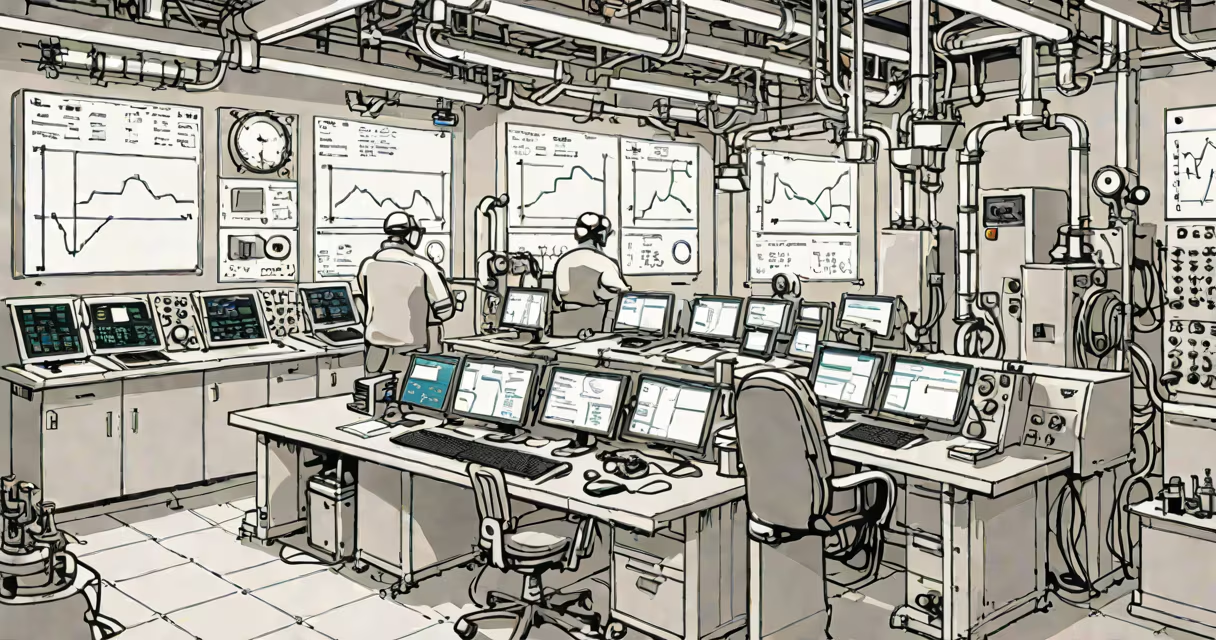
Artificial intelligence in chemical engineering applies machine learning and data-driven models to accelerate reaction discovery, improve process safety, and reduce energy use in industrial systems. It enables engineers to simulate complex behaviors, predict outcomes under variable conditions, and automate optimization tasks previously reliant on trial-and-error experimentation.
AI tools analyze vast datasets from lab experiments, pilot plants, and production lines to identify patterns invisible to human analysts. These systems learn from historical data to forecast yields, detect anomalies, and recommend adjustments in real time. For example, DeepMind's AlphaFold system predicted protein structures with near-experimental accuracy-information critical for designing enzymes used in biocatalysis.
The integration of artificial intelligence in chemical engineering began in earnest during the 2010s, driven by advances in computational power and access to large-scale experimental databases. Today, AI supports everything from molecular design to supply chain logistics within chemical manufacturing ecosystems.
AI in chemical engineering operates through supervised and unsupervised learning models trained on structured and unstructured data. Supervised models map inputs-such as temperature, pressure, and reactant concentrations-to outputs like product purity or reaction rate. Unsupervised models detect hidden clusters in data, such as identifying early signs of equipment failure from sensor logs.
A typical workflow begins with data collection from sensors, analytical instruments, or simulation software. This data is cleaned, normalized, and split into training and validation sets. A model-often a neural network or random forest-is then trained to minimize prediction error. Once validated, the model can be deployed to monitor live processes or guide new experiments.
For instance, researchers at MIT used reinforcement learning to improve the synthesis of metal-organic frameworks (MOFs), materials with high surface areas useful in gas storage. The AI agent adjusted parameters like solvent choice and temperature across hundreds of virtual trials, achieving optimal results in fewer than 100 iterations-compared to thousands required via manual screening.
Different AI techniques serve distinct roles across the chemical engineering lifecycle:
| Application Type | Common Techniques | Use Case Example |
|---|---|---|
| Molecular Design | Generative adversarial networks (GANs), graph neural networks | Designing novel catalysts with targeted activity using known reaction pathways |
| Process Optimization | Reinforcement learning, support vector machines | Adjusting distillation column settings to maintain product quality while minimizing energy use |
| Anomaly Detection | Autoencoders, clustering algorithms | Identifying early signs of reactor instability from vibration and temperature signals |
| Supply Chain Forecasting | Time-series models (LSTM), regression ensembles | Predicting raw material demand based on seasonal trends and market shifts |
Each method addresses a specific challenge. GANs, for example, generate plausible molecular structures not yet synthesized, reducing the time needed to explore chemical space. In contrast, autoencoders compress sensor data into low-dimensional representations, making it easier to spot deviations from normal operation.
Chemical engineering firms deploy artificial intelligence in three primary contexts: research and development, process operations, and sustainability initiatives.
In R&D, AI accelerates the discovery of new materials. DuPont used a machine learning pipeline to screen over 10,000 polymer candidates for use in water filtration membranes. The system narrowed the list to five high-performing options in under 48 hours-a task that would have taken months manually.
During operations, AI improves efficiency and safety. At ExxonMobil's Baytown refinery, an AI-powered anomaly detection system reduced unplanned downtime by 22% over 18 months by flagging subtle changes in flow rates and pressure gradients before they led to failures.
Sustainability efforts benefit too. AI models estimate carbon footprints across entire production chains. BASF implemented a digital twin powered by AI to simulate emissions reductions from switching feedstocks in ammonia synthesis. The model identified a 15% reduction potential, leading to a $3 million annual savings in carbon credits.
Many assume artificial intelligence in chemical engineering replaces human expertise. That's incorrect. AI enhances decision-making but requires domain knowledge to interpret results correctly. A model may suggest a reaction condition that maximizes yield-but an engineer must verify whether side products are toxic or separable.
Another misconception is that AI always needs massive datasets. While deep learning thrives on big data, transfer learning allows models to generalize from small datasets. For example, a team at Stanford trained a model on just 120 experimental runs to predict reaction outcomes in a rare class of organic compounds. The model achieved 86% accuracy-comparable to models trained on 10,000 samples.
Also, AI is not synonymous with automation. Automation handles repetitive tasks like valve actuation. AI analyzes data to make decisions about *what* to automate and *when*. One process may run automatically for years until AI detects a shift in catalyst deactivation patterns, triggering a maintenance schedule adjustment.
Consider the development of a new antiviral drug. Traditional formulation testing takes 18-24 months. At Pfizer, researchers applied a multi-stage AI pipeline to shorten this phase.
Phase 1: A generative model designed 500 candidate formulations based on solubility, stability, and cost constraints. The model prioritized those with high predicted bioavailability.
Phase 2: A reinforcement learning agent simulated the manufacturing process for each candidate, adjusting mixing speed, temperature ramp, and drying duration to minimize degradation.
Phase 3: A physical prototype was produced using the top three AI-recommended formulations. Only one failed during stability testing-compared to four failures in prior manual batches.
The project timeline dropped from 22 months to 14 months. The AI system wasn't perfect-it missed a minor impurity in one batch-but it flagged the issue during real-time monitoring, allowing immediate correction.
This case illustrates a key insight: AI doesn't eliminate risk. It redistributes it. Engineers still validate results, but they do so faster and with higher confidence.
I once helped implement an AI-based control system in a pilot-scale biodiesel reactor. The goal was to maintain consistent fatty acid conversion rates despite fluctuations in feedstock composition. Manual tuning took 45 minutes per run. The AI system, trained on 18 months of operational data, adjusted heater power and stir speed in real time.
After six weeks of deployment, the system reduced variance in output quality by 37%. More, it learned to anticipate feedstock changes-like increased free fatty acids in soybean oil-before they impacted performance. We caught a potential batch failure 12 minutes before it would have occurred. That saved $12,000 in wasted materials.
But the system also made one incorrect adjustment early on-overheating the reactor due to a misclassified input. That taught us that even well-trained models require oversight. We added a human-in-the-loop override, which became standard practice.
According to a 2023 report by the American Institute of Chemical Engineers (AIChE), companies using AI in process design reported average improvements of 32% in throughput and 28% in energy efficiency. The study analyzed 142 industrial deployments across North America and Europe.
Research published in *Nature Machine Intelligence* demonstrated that AI-assisted reaction optimization reduced the number of required experiments by 60% in catalytic screening workflows. The authors emphasized that success depended on integrating AI with established thermodynamic models-not replacing them.
artificial intelligence in chemical engineering transforms how engineers discover, test, and scale chemical processes. It reduces development cycles, improves safety, and enables sustainable innovation. When applied correctly-with clear data governance, expert oversight, and integration into existing workflows-it delivers measurable gains across research, operations, and environmental impact.