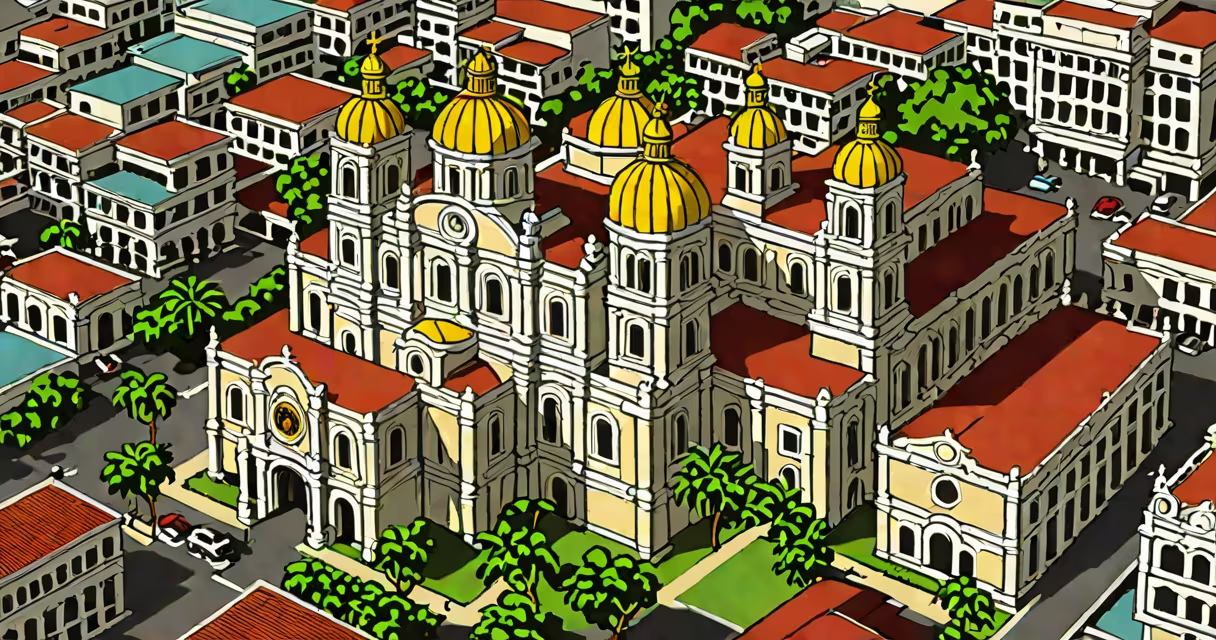
The Basilica Minore del Santo Niño is a Roman Catholic church in Cebu City, Philippines, established in 1521 by Portuguese explorer Ferdinand Magellan. It is the oldest church in the country and houses the venerated image of the Santo Niño, a statue of the Child Jesus. The structure was rebuilt multiple times due to war and natural disasters, with the current façade dating to 1735.
Located on the island of Cebu, the basilica sits within the historic district near the original landing site of Magellan. It serves as both a place of worship and a national shrine. The church's current designation as a minor basilica was granted by Pope Paul VI in 1965, affirming its historical and spiritual significance. Its architecture blends Spanish colonial design with local materials and craftsmanship, featuring thick stone walls, a tiled roof, and a central nave with side chapels.
Inside, the main altar displays the Santo Niño statue, carved from wood and believed to have been given by Magellan to Rajah Humabon. The image is adorned with gold robes and jewels during annual festivals. The church hosts daily Masses, processions, and the Sinulog Festival in January, drawing over 1 million attendees. Pilgrims often visit to pray for healing, protection, and blessings.
The basilica operates as a functioning parish under the Archdiocese of Cebu. Liturgical services follow the Roman Rite, with Mass celebrated in Filipino, English, and Latin. The Santo Niño is central to devotional practices. On feast days, especially January 14 (the feast of the Santo Niño), thousands gather for the procession of the image through the streets of Cebu City.
Pilgrims enter through the main gate, walk past the ornate wrought-iron gates, and pass the marble floor inscribed with the names of donors and benefactors. Inside, they may light candles, offer prayers, or touch the glass-enclosed altar containing the statue. The church maintains a strict schedule: Mass begins at 5:30 a.m., and the last service ends at 8:00 p.m. on weekdays. Weekends see increased attendance, especially during Holy Week.
A key ritual is the "Pasyón" recitation, a dramatic reading of the Passion of Christ in Cebuano, performed annually during Lent. This tradition dates to the 18th century and is conducted in the church's courtyard. The event draws families, students, and tourists who come to witness the emotional storytelling and communal participation.
The basilica's construction uses locally quarried limestone, coral stone, and volcanic rock. The façade features a double bell tower with arched windows and a central rose window. The interior columns are made of solid stone, with capitals carved in Baroque style. The ceiling is painted with religious scenes, including the Annunciation and the Last Supper, completed in 1912.
Notable elements include:
The church's acoustics were designed to amplify choral music. During Mass, the choir sings Gregorian chant and Filipino hymns. The sound travels evenly throughout the nave due to the vaulted ceiling and stone walls. The church also has a small museum displaying artifacts from the 16th century, including fragments of Magellan's ship's hull and early Christian manuscripts.
The basilica is used primarily for religious ceremonies, pilgrimages, and cultural events. It is a designated National Historical Landmark by the Philippine government and a UNESCO World Heritage Site candidate. The site attracts over 2 million visitors yearly, including domestic tourists, international pilgrims, and academic researchers.
Its role extends beyond worship. The basilica hosts interfaith dialogues, youth retreats, and educational programs on Philippine history. The Diocesan Office of Culture and Heritage organizes guided tours in seven languages. Visitors pay a 20-peso entry fee, with proceeds supporting restoration projects.
During the 2020 pandemic, the church adapted by live-streaming Masses and offering virtual confessions. The online attendance peaked at 150,000 viewers during Holy Saturday. This shift demonstrated the institution's ability to maintain community engagement despite physical restrictions.
Many assume the Santo Niño statue is made of ivory or silver. It is actually carved from narra wood and covered in layers of paint and gold leaf. The image's face is said to have been modeled after a child from Cebu, though no records confirm this.
Another misconception is that the church was destroyed during World War II. While the original structure was damaged in 1942, the current building was reconstructed between 1946 and 1950 using salvaged stones and plans from the 1735 version. The reconstruction was led by architect Antonio L. Pineda, whose blueprints are preserved in the National Archives of the Philippines.
A lesser-known fact: the basilica's foundation stones contain embedded coins from the 16th century. Archaeologists discovered them during a 2018 excavation beneath the sanctuary floor. The coins, minted in Malacca and Lisbon, suggest early trade links between Cebu and Southeast Asia and Europe.
Minor basilicas like the Basilica Minore del Santo Niño are part of a global hierarchy recognized by the Vatican. They differ from major basilicas (like St. Peter's in Rome) in rank but share ceremonial privileges. There are 16 minor basilicas in the Philippines, with four located in Cebu.
| Site Type | Number in Philippines | Key Feature | Example |
|---|---|---|---|
| Minor Basilica | 16 | Special papal blessing rights | Basilica Minore del Santo Niño |
| Major Basilica | 1 | Seat of a patriarch or cardinal | San Agustin Church (Manila) |
| National Shrine | 12 | Designated by the Episcopal Conference | Our Lady of Peñafrancia (Naga) |
| Historical Church | Over 100 | Pre-1900 construction | San Juan de Letran Church (Manila) |
Unlike other churches, minor basilicas receive a special papal decree granting them the right to display the papal cross and use the title "minor basilica." This status is not automatic-it requires a formal petition and approval from the Dicastery for Divine Worship and the Discipline of the Sacraments.
I visited the basilica in 2019 during the Sinulog Festival. The crowd was dense, with people holding candles and chanting in unison. I stood near the entrance and watched the image being carried through the streets. The air smelled of incense and wet pavement. The energy was intense-not just religious, but communal. That moment confirmed what scholars call "embodied faith": belief expressed through movement, sound, and shared space.
The Basilica Minore del Santo Niño is not just a building. It is a living archive of Philippine Christianity. Its foundations were laid in 1521, and its mission continues today. The image of the Santo Niño remains central to Catholic identity in Cebu and across the archipelago. For many Filipinos, visiting the basilica is not optional-it is a rite of passage.
Understanding the basilica minore del santo nino requires recognizing its layered identity: a historical monument, a spiritual center, and a cultural symbol. It is not merely a church. It is proof of endurance, faith, and continuity. The image of the Child Jesus, carried through centuries of conflict and change, still stands at the heart of Cebu.
For those seeking deeper context on climate patterns affecting the region, el niño's impact on Philippine weather and agriculture offers a contrasting yet complementary perspective on long-term environmental shifts.