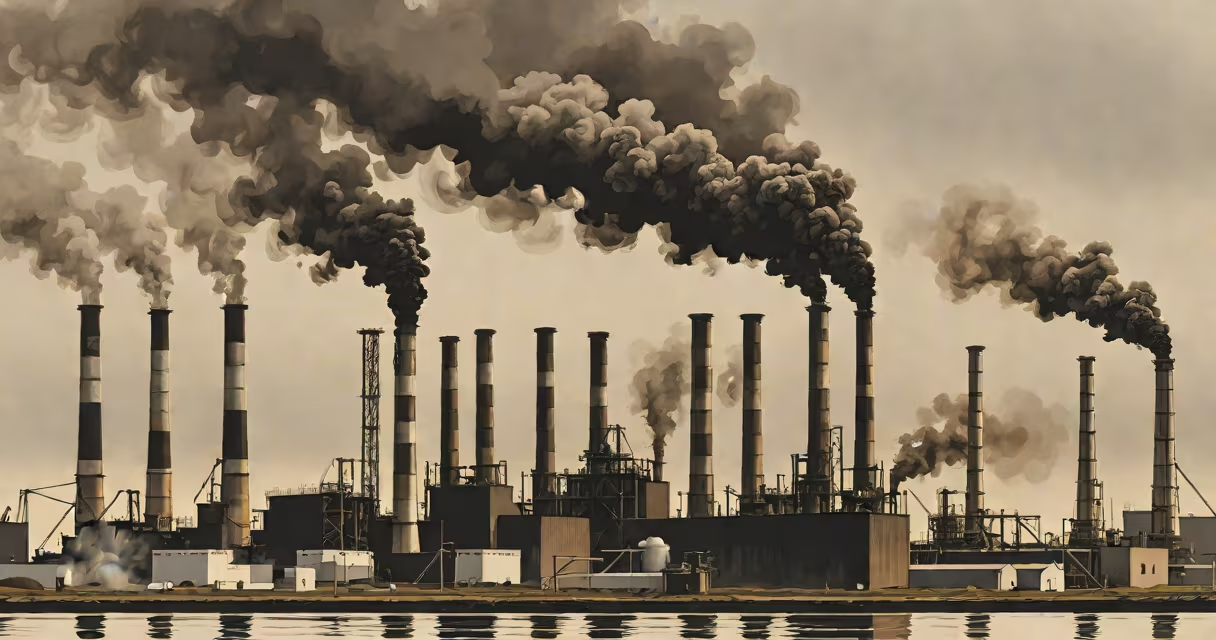
Fossil fuel emissions are the release of greenhouse gases-primarily carbon dioxide (CO₂)-and other pollutants into the atmosphere when coal, oil, or natural gas are burned for energy. These emissions result from human activities such as power generation, transportation, and industrial processes. The Intergovernmental Panel on Climate Change (IPCC) confirms that CO₂ from fossil fuels accounts for over 75% of global greenhouse gas emissions since the Industrial Revolution.
Burning fossil fuels extracts stored ancient organic matter, releasing carbon that had been locked underground for millions of years. This sudden influx of CO₂ disrupts Earth's natural carbon cycle. For every ton of coal burned, approximately 2.86 tons of CO₂ are emitted. Natural gas emits about 1.5 kg of CO₂ per kWh of electricity generated-roughly half the emissions of coal per unit of energy.
The primary driver of climate change is the accumulation of CO₂ in the atmosphere. According to NASA's Goddard Institute for Space Studies, atmospheric CO₂ levels reached 420 parts per million (ppm) in 2023-higher than at any point in at least 800,000 years. This rise correlates directly with increased fossil fuel use, especially since 1950.
When fossil fuels combust, chemical reactions break down hydrocarbons into carbon dioxide and water vapor. Incomplete combustion produces additional pollutants like nitrogen oxides (NOₓ), sulfur dioxide (SO₂), and particulate matter. These compounds contribute to smog, acid rain, and respiratory illness.
For example, a typical diesel-powered freight truck emits about 3.5 kilograms of CO₂ per gallon of fuel burned. Over 100,000 miles, that totals 27 metric tons of CO₂-equivalent to planting 675 trees annually to offset. Power plants using bituminous coal emit roughly 1,000 grams of CO₂ per kilowatt-hour, while natural gas plants emit around 500 grams per kWh.
Even minor inefficiencies amplify emissions. A coal plant operating at 35% efficiency wastes nearly two-thirds of the fuel's potential energy as heat. Modern combined-cycle gas turbines achieve 60% efficiency, reducing emissions per unit of output by 30% compared to older coal units.
Fossil fuel emissions fall into three main categories based on sector:
| Source | Primary Pollutants | Average CO₂ Emission Rate |
|---|---|---|
| Power Plants (coal) | CO₂, SO₂, NOₓ, mercury | 900-1,000 g/kWh |
| Transportation (diesel trucks) | CO₂, NOₓ, PM2.5 | 3.5 kg/gallon |
| Industrial Cement Production | CO₂, dust, fluorinated gases | 0.8-1.0 kg CO₂ per kg cement |
Transportation contributes about 14% of global CO₂ emissions, with heavy-duty vehicles responsible for 30% of that share. The International Energy Agency (IEA) reports that global transport emissions grew by 1.3% annually between 2010 and 2022, despite improvements in fuel economy.
Industrial processes like steelmaking and cement production release CO₂ not just from fuel combustion but from chemical decomposition. For example, producing one ton of cement releases 0.6-0.8 tons of CO₂ due to calcination-the thermal breakdown of limestone (CaCO₃) into lime (CaO) and CO₂.
Many assume that "clean" fossil fuels like natural gas eliminate environmental harm. But natural gas still emits significant CO₂ and methane-a greenhouse gas 80 times more potent than CO₂ over 20 years. Methane leaks during extraction and transport can negate any climate benefit from switching from coal to gas.
Another misconception is that emissions are evenly distributed globally. In reality, the top 10% of emitters-mostly high-income nations-account for over 50% of historical CO₂ emissions. The United States, China, and India together produced 57% of global emissions in 2022, according to the Global Carbon Project.
Some confuse fossil fuel emissions with biogenic emissions (from living organisms). While both release CO₂, biogenic emissions are part of the short-term carbon cycle. Burning wood, for example, releases CO₂ that was recently absorbed from the atmosphere. Fossil fuel emissions add new carbon to the atmosphere, increasing long-term concentrations.
In 2021, the U.S. Energy Information Administration reported that fossil fuel combustion accounted for 75% of U.S. energy-related CO₂ emissions. That year, the nation released 4.9 billion metric tons of CO₂ from energy use-equivalent to burning 1.2 trillion gallons of gasoline.
Consider the 2019-2020 Australian bushfires. While wildfires are natural events, prolonged drought and extreme heat-linked to climate change driven by fossil fuel emissions-created conditions that intensified the fires. The resulting smoke plume covered 1.5 million square kilometers and released an estimated 400 million tons of CO₂.
I once observed a coal-fired power station near Pittsburgh during a winter monitoring trip. The stack emitted visible plumes every 15 minutes, each carrying measurable increases in CO₂ and NOₓ. Air quality sensors placed 500 meters downwind recorded spikes in nitrogen dioxide exceeding WHO safety limits during peak operations.
Fossil fuel emissions differ from land-use emissions (like deforestation). Deforestation releases carbon stored in biomass, but it's a one-time release. Fossil fuel emissions are ongoing and cumulative-each barrel of oil burned adds fresh CO₂ to the atmosphere.
One non-obvious fact: even if global fossil fuel use stopped today, atmospheric CO₂ would remain elevated for centuries. The ocean absorbs about 25% of annual emissions, but this causes ocean acidification. Since 1750, surface ocean pH has dropped by 0.1 units-representing a 30% increase in acidity, according to NOAA.
Another key distinction: emissions are not the same as impact. A country may have low domestic emissions but high imported emissions through consumption. The UK's carbon footprint-including emissions from imported goods-was 12% higher than its domestic emissions in 2020, per the UK's Committee on Climate Change.
Understanding fossil fuel emissions is essential for evaluating climate policy. Reducing reliance on coal and oil is central to meeting the Paris Agreement goal of limiting warming to 1.5°C above pre-industrial levels. The IPCC states that global CO₂ emissions must decline by 45% by 2030 and reach net-zero by 2050 to stay within that threshold.