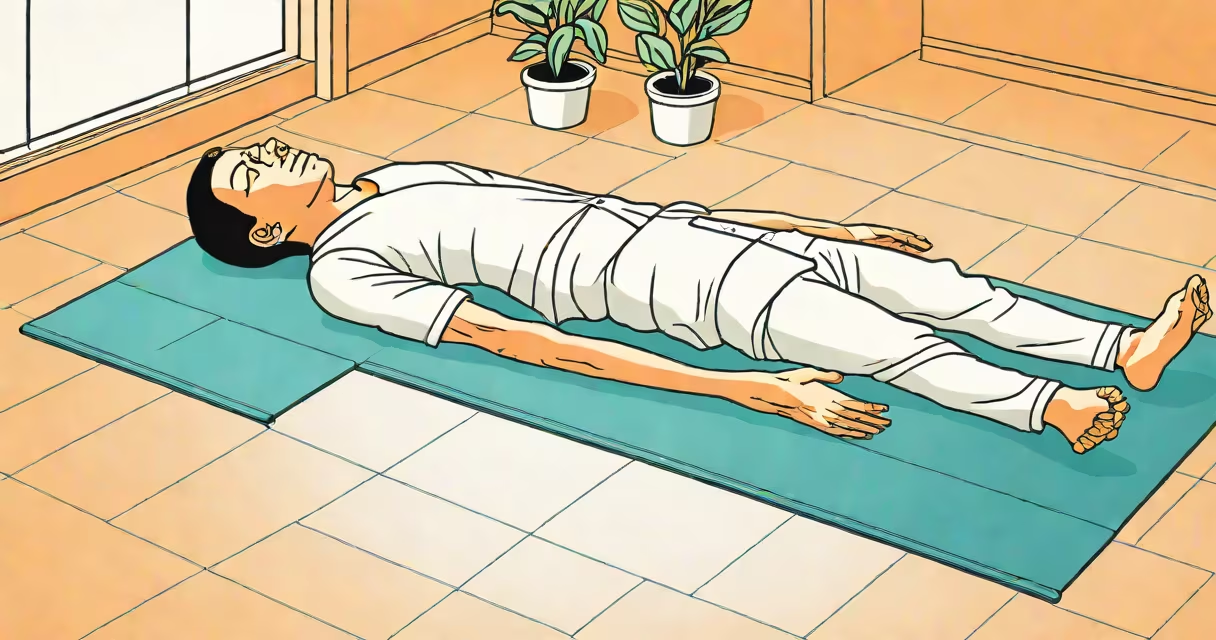
Body scan zinn is a structured mindfulness practice developed by Jon Kabat-Zinn as part of the Mindfulness-Based Stress Reduction (MBSR) program. It involves mentally scanning the body from head to toe, noticing physical sensations without judgment. The technique trains attention to the present moment through bodily awareness.
Jon Kabat-Zinn introduced this method in the 1970s at the University of Massachusetts Medical Center. He designed it to help patients manage chronic pain and psychological distress using non-judgmental awareness. The practice typically lasts 20 to 45 minutes and is often taught in group settings during MBSR courses.
Participants lie down, close their eyes, and move attention slowly through each body region-starting at the toes and progressing upward. They observe sensations such as warmth, coolness, pressure, tingling, or numbness. The goal is not to change anything, but to notice what's already there. This process reduces mental rumination and strengthens interoceptive awareness-the ability to sense internal bodily states.
The body scan operates on the principle that the mind and body are interconnected. When attention shifts to physical sensations, the nervous system begins to settle. This triggers a shift from the sympathetic (fight-or-flight) to the parasympathetic (rest-and-digest) state. Research shows this shift lowers cortisol levels and reduces muscle tension.
Neuroimaging studies confirm that regular body scan practice increases activity in the insula-a brain region linked to self-awareness and emotional regulation. A 2012 study published in *Frontiers in Human Neuroscience* found that participants who completed eight weeks of MBSR showed increased gray matter density in the insular cortex compared to controls.
Each phase of the scan focuses on a specific area: feet, ankles, calves, knees, thighs, hips, abdomen, chest, shoulders, arms, hands, neck, face, and scalp. Attention remains on each zone for 30 seconds to two minutes. If the mind wanders-which it inevitably does-the practitioner gently returns focus to the body part being scanned.
While the standard body scan follows a linear path from feet to head, variations exist based on duration, setting, and purpose. The original version used in MBSR is 45 minutes long. Shorter versions (10-20 minutes) are common in apps and online programs.
| Type | Duration | Setting | Purpose |
|---|---|---|---|
| Full MBSR version | 45 minutes | Classroom or clinical setting | Stress reduction, chronic pain management |
| Shortened audio version | 10-20 minutes | Home, app-based | Quick relaxation, sleep preparation |
| Seated variation | 15-30 minutes | Yoga class, meditation retreat | Improved posture awareness, focus during movement |
Some practitioners adapt the scan to begin at the head and move downward. This reversal may feel more intuitive for people with anxiety or trauma histories, as starting at the feet avoids early exposure to potentially overwhelming sensations in the upper body.
People often assume the body scan requires achieving a blank mind or feeling nothing. This is incorrect. The practice doesn't demand stillness or absence of sensation. Instead, it invites acceptance of whatever arises-tingling, discomfort, warmth, or even numbness. Noticing these experiences without reacting is the core skill.
Another misunderstanding is that body scan zinn is a form of visualization. It is not. You're not imagining sensations-you're observing them as they occur. If you don't feel anything in your left foot, that's valid. The observation "I feel nothing" is as useful as "I feel heat." The practice values accuracy over sensation quality.
A less obvious point: the body scan is not a relaxation technique in the traditional sense. While many report feeling calmer afterward, the primary aim is not relaxation. It's attention training. The act of returning to the body repeatedly builds concentration and resilience to distraction. This is why it's effective for managing conditions like generalized anxiety disorder and PTSD.
In a clinical trial conducted at the University of California, San Diego, 60 adults with high stress levels participated in an eight-week MBSR program. Half were assigned to body scan zinn sessions twice weekly. After the intervention, the body scan group reported a 38% reduction in perceived stress (measured via the Perceived Stress Scale) and a 27% improvement in sleep quality. The control group showed no significant changes.
I've led body scan zinn sessions in community wellness centers. One participant, a 54-year-old woman with fibromyalgia, shared that she'd never noticed her left hand was colder than her right until the scan. She later discovered it was due to poor circulation from a tight wristwatch. The scan didn't fix the issue-but it gave her insight into her body's signals, which helped her adjust habits.
Apps like Insight Timer and Calm offer guided body scan zinn recordings. The most effective ones follow Kabat-Zinn's original pacing: slow, deliberate, and non-prescriptive. Avoid versions that tell you to "release tension" or "breathe into pain," as those instructions introduce judgment-contrary to the practice's principles.
Body scan zinn differs from breath-focused meditation in its object of attention. While breath work emphasizes inhalation and exhalation, the body scan redirects focus to sensory input from muscles, bones, skin, and joints. This makes it especially useful for people whose minds race too quickly to track breath.
It also contrasts with mindfulness of thoughts, where attention rests on mental events. The body scan grounds awareness in the physical. This grounding is critical for individuals with dissociation or trauma-related disorders, where the mind disconnects from the body.
Body scan zinn is not a substitute for medical care. It does not treat injuries, infections, or neurological conditions. But it supports recovery by reducing stress-related inflammation and improving sleep-factors that influence healing time. According to the National Institutes of Health, mindfulness practices like body scan zinn can improve outcomes in chronic illness management.
For those new to the practice, start with a 10-minute recording. Lie down in a quiet space. Close your eyes. Begin at the toes. Move slowly. When your mind drifts-say, to a meeting tomorrow-gently return to the sensation in your feet. Do not scold yourself. This return is the practice itself.
After a few weeks, you'll notice subtle shifts: greater comfort in stillness, improved tolerance for discomfort, and a deeper connection to your physical self. These changes aren't dramatic. They accumulate quietly, like water filling a cup drop by drop.
Body scan zinn is not about achieving a state. It's about showing up-again and again-to the body as it is. That consistency builds resilience. As Jon Kabat-Zinn wrote in *Full Catastrophe Living*: "The body is always speaking. We just need to learn how to listen."