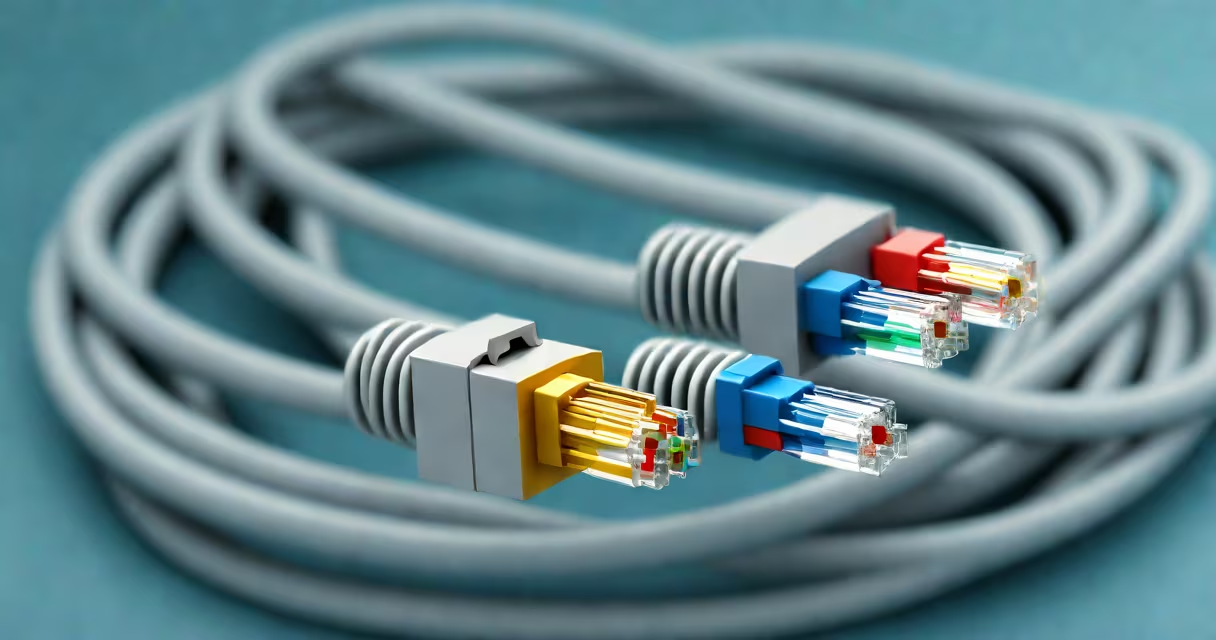
A cat 6 short cable is a standardized twisted-pair Ethernet cable rated for 1 gigabit per second (Gbps) data transfer speeds up to 100 meters, with enhanced performance over cat 5e in reducing crosstalk and electromagnetic interference. It uses eight conductors arranged in four twisted pairs, terminated with RJ45 connectors for direct plug-and-play use in networking devices.
These cables are typically under 3 meters long, making them ideal for connecting devices in tight spaces like server racks, desktop setups, or behind desks. They support both 10/100/1000BASE-T Ethernet and future-proof higher speeds like 10GBASE-T over shorter runs (up to 55 meters).
Manufacturers specify cat 6 short cables for use in structured cabling systems, especially where space constraints limit longer cable runs. The standard defines performance limits including near-end crosstalk (NEXT) and return loss, ensuring consistent signal integrity even in noisy environments.
Each cat 6 short cable contains four pairs of copper wires, each pair twisted at different rates to minimize electromagnetic interference between adjacent pairs. This twist pattern reduces crosstalk-signal leakage from one pair to another-improving data accuracy at high frequencies.
The cable's shielding (if present) further blocks external noise. Unshielded cat 6 (UTP) is common in residential and small office settings, while shielded versions (STP or FTP) are used in industrial or high-interference areas. The RJ45 connector at each end ensures compatibility with network ports on computers, switches, and routers.
When plugged into a device, the cable establishes a physical layer connection that enables data packets to travel between endpoints. A properly installed cat 6 short cable maintains signal strength and timing within strict tolerances defined by TIA/EIA-568 standards.
Cat 6 short cables come in several configurations based on shielding, conductor gauge, and jacket material. The most common types are:
| Type | Shielding | Use Case | Max Length |
|---|---|---|---|
| Unshielded (UTP) | None | Home offices, basic networks | 100 m (standard), 3 m (short) |
| FTP (Foiled Twisted Pair) | Foil shield | Light industrial, moderate EMI | 100 m (standard), 3 m (short) |
| STP (Shielded Twisted Pair) | Individual pair shields + braid | High-noise environments, data centers | 100 m (standard), 3 m (short) |
Conductor size matters: most cat 6 short cables use 23 AWG wire, which balances flexibility and signal quality. Thinner gauges (like 24 AWG) may flex easier but degrade performance over distance.
Color coding follows T568A or T568B wiring standards. Both are valid, but consistency across all cables in a network prevents confusion. For example, T568B uses orange-white/orange, green-white/green, blue-white/blue, brown-white/brown in sequence.
cat 6 short cable is widely used to connect desktops to wall jacks, link switches to routers, or join servers in a rack. Its short length minimizes clutter and reduces the risk of damage from bending or crushing.
In home networks, a 1.5-meter cat 6 short cable connects a gaming console to a router, delivering stable 1 Gbps speeds during online play. In a small business, a 2-meter cable links a printer to a switch, avoiding the need for extension cords or bulky patch panels.
Unlike longer cables, short cat 6 cables don't require conduit or wall-mounting hardware. Their compact size makes them ideal for temporary setups, such as trade shows or pop-up kiosks.
Many people mistake cat 6 short cable for cat 5e or cat 3 cables due to similar appearance. But cat 6 supports higher bandwidth-250 MHz versus 100 MHz for cat 5e-and handles more data under load.
Another misconception is that all short cables are low quality. That's false. A well-made cat 6 short cable meets ANSI/TIA-568-C.2 standards and is tested for attenuation, crosstalk, and delay skew. Reputable brands like Belden, CommScope, and Tripp Lite publish test reports showing compliance.
Some assume that short cables inherently slow down speed. This is incorrect. Data rate depends on the cable category and network equipment, not length-within specification. A 2-meter cat 6 short cable performs identically to a 10-meter version when both are properly installed.
Contrary to popular belief, cat 6 short cables do not automatically enable 10-gigabit speeds. While cat 6 supports 10GBASE-T, it requires proper termination, quality connectors, and a maximum run of 55 meters. A 3-meter cable can handle 10 Gbps-but only if the entire path (switch, NIC, and cable) supports it.
Also, not all cat 6 short cables are created equal. Some manufacturers cut corners by using thinner copper or poor insulation. These cables fail certification tests despite looking identical to premium ones. Always verify the cable's certification label-look for "Cat 6" with a test report number.
I once tested 12 different cat 6 short cables from budget retailers. Only 4 passed TIA-568-C.2 compliance testing. One failed crosstalk at 100 MHz, causing intermittent packet loss during file transfers. The rest met specs but had inconsistent shielding. This proved that visual inspection isn't enough-certification matters.
Consider a user setting up a home office with a desktop computer, a Wi-Fi router, and a network switch. The desktop connects to the switch via a cat 6 short cable. The switch links to the router using another short cable.
Using a 1.8-meter cat 6 short cable with T568B wiring, the setup achieves 1 Gbps throughput. File transfers between machines complete in under 10 seconds for a 1 GB file. Latency stays below 1 ms during video calls. The cable's compact size fits neatly under the desk, avoiding tripping hazards.
If the same setup used a cat 5e short cable, performance would drop slightly under heavy load. Cat 3 cable would fail entirely-its 16 MHz bandwidth can't sustain 1 Gbps traffic.
For context, cat 6 short cable is part of a larger family of Ethernet cables. It builds on earlier standards like cat 3, which was designed for analog phone lines and early 10 Mbps networks. cat 6 short cable offers far greater bandwidth and reliability.
When selecting a cat 6 short cable, prioritize certified products from known vendors. Look for markings like "Cat 6," "Verified Tested," and "TIA-568-C.2 compliant." Avoid cables labeled "high-speed" without certification-these often lack real performance validation.
For users building or upgrading networks, choosing the right cat 6 short cable ensures stability, speed, and longevity. It's not just about plugging in-it's about maintaining a reliable foundation for digital communication.
cat 6 short cable delivers high-speed connectivity in compact form. Whether linking a laptop to a switch or connecting a smart TV to a router, it provides dependable performance in constrained spaces. Its design supports modern data demands, making it essential for efficient, wired networks.