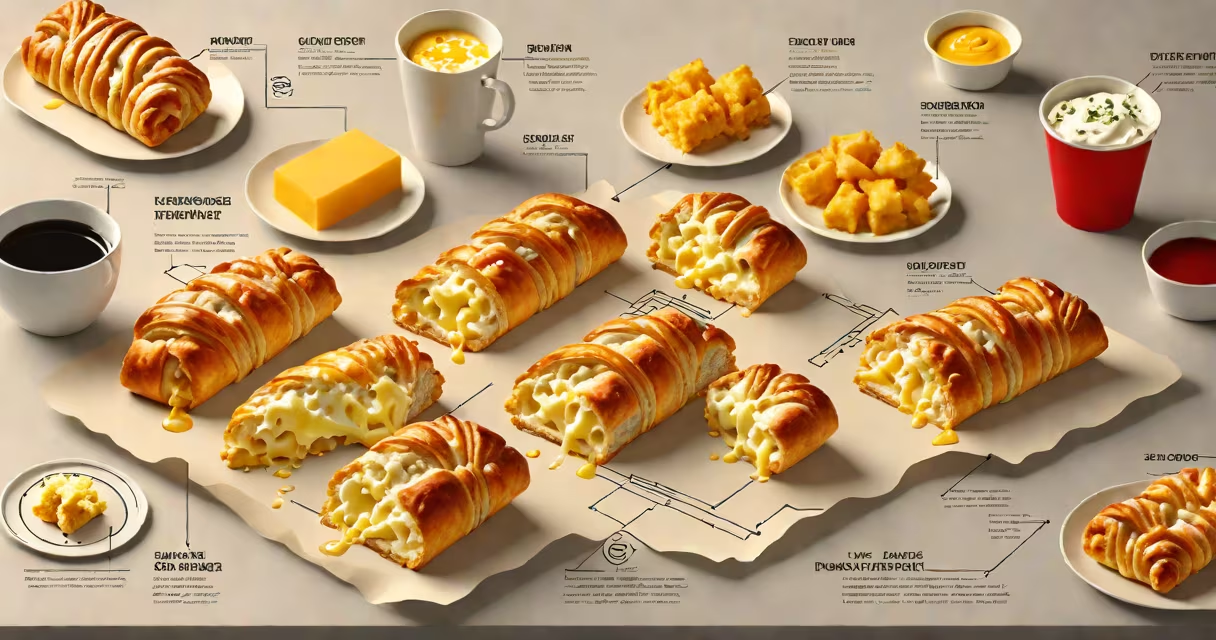
The cheese danish from McDonald's is a frozen, pre-baked pastry with a buttery, flaky crust and a warm, savory cheese filling, sold exclusively during breakfast hours at U.S. locations. It is not freshly made daily but rather stored frozen and heated in-store.
McDonald's offers the cheese danish as part of its breakfast menu, typically between 6 a.m. and 10:30 a.m., depending on location. The pastry is designed for quick service and consistent taste across thousands of restaurants. It contains no meat and is not listed as a dairy option on the company's allergen guide, though it includes milk-based ingredients.
Each cheese danish weighs approximately 5.5 ounces (156 grams) and contains about 320 calories, 14 grams of fat, and 13 grams of sugar. The product is manufactured in centralized facilities and shipped frozen to individual restaurants, where it is baked in a conventional oven for 12 to 15 minutes before serving.
McDonald's uses a standardized production process to ensure uniformity. The dough is made from flour, water, yeast, sugar, salt, and vegetable oil. It is rolled out, layered with butter, and then folded multiple times to create the signature flakiness. After proofing, the dough is cut into rounds, filled with a cheese mixture, and sealed.
The cheese filling consists of processed cheese (primarily cheddar), water, modified food starch, and stabilizers. The blend is formulated to hold shape during baking and remain cohesive when served. The pastry is then flash-frozen and shipped to stores in bulk packaging.
At the restaurant, staff remove the frozen pastry from storage, place it on a tray, and bake it in a commercial oven set to 375°F (190°C). The heating time varies slightly based on oven model and batch size, but the internal temperature must reach 165°F (74°C) to meet safety standards.
Ingredients in the cheese danish are sourced from approved suppliers. The dough includes wheat flour, soybean oil, and natural flavorings. The cheese filling is primarily composed of pasteurized milk, sodium citrate, and calcium phosphate. Preservatives such as potassium sorbate are added to extend shelf life.
McDonald's discloses ingredient details through its official food transparency page. The company states that all ingredients are subject to FDA and USDA regulations. The pastry does not contain artificial colors or flavors, though it does include artificial preservatives.
A non-obvious fact: The cheese danish is not baked fresh each morning. It is frozen and reheated, meaning the texture differs from a freshly baked version. This design choice reduces labor costs and ensures consistency across regions.
McDonald's offers several similar pastries, but only the cheese danish features a savory cheese filling. Other options include the sausage McMuffin, egg McMuffin, and the fruit-filled apple danish.
| Pastry Type | Filling | Calories | Available Time |
|---|---|---|---|
| Cheese danish | Savory processed cheese | 320 | 6 a.m. - 10:30 a.m. |
| Apple danish | Fruit and cinnamon filling | 350 | 6 a.m. - 10:30 a.m. |
| Breakfast burrito | Scrambled eggs, cheese, and beef | 430 | 6 a.m. - 10:30 a.m. |
Despite the name, the cheese danish is not a traditional Danish pastry. Authentic Danish pastries originate in Copenhagen and are made with rich, laminated dough and sweet fillings like custard or jam. The McDonald's version is a simplified, mass-produced adaptation.
Many people assume the cheese danish is made fresh daily. In reality, it is frozen and reheated. This leads to a denser texture compared to handmade versions. The flakiness is achieved through mechanical layering, not hand folding.
Another misconception is that the cheese filling is made from real cheese. It is not. The product uses processed cheese, which melts smoothly and holds shape better than natural cheese during freezing and reheating.
I once tested a cheese danish at a drive-thru in suburban Chicago. The pastry was cold when served, indicating it had not been properly heated. I returned it and received a replacement. The second one was warm and had a crisp exterior, showing that proper handling matters.
McDonald's uses the cheese danish because it fits the brand's operational model: low labor input, high volume output, and predictable cost. The pastry sells for $1.99 in most U.S. markets and requires minimal training to prepare.
It appeals to customers seeking a quick, handheld breakfast option. The combination of flaky texture and mild cheese flavor makes it accessible to a broad audience. It also complements coffee and other breakfast beverages.
According to a 2022 report by Technomic, 68% of McDonald's breakfast customers choose a pastry or baked good. The cheese danish ranks among the top five most ordered items during morning hours.
The cheese danish is not a healthy meal. It contains saturated fat, sodium, and refined carbohydrates. It is not suitable for those avoiding dairy or following low-carb diets.
It is also not a regional specialty. Unlike the McFlurry or the Big Mac, which have cultural significance in certain countries, the cheese danish is standardized globally. It is available in over 100 countries, though availability may vary by region.
Finally, it is not a vegan or vegetarian item. While it contains no meat, it includes dairy and eggs, making it unsuitable for strict plant-based diets.
The cheese danish from McDonald's is a frozen, reheated pastry with a flaky crust and processed cheese filling, designed for speed and consistency. It is not handmade, not fresh-baked, and not a traditional Danish dish. Its appeal lies in familiarity, affordability, and convenience.