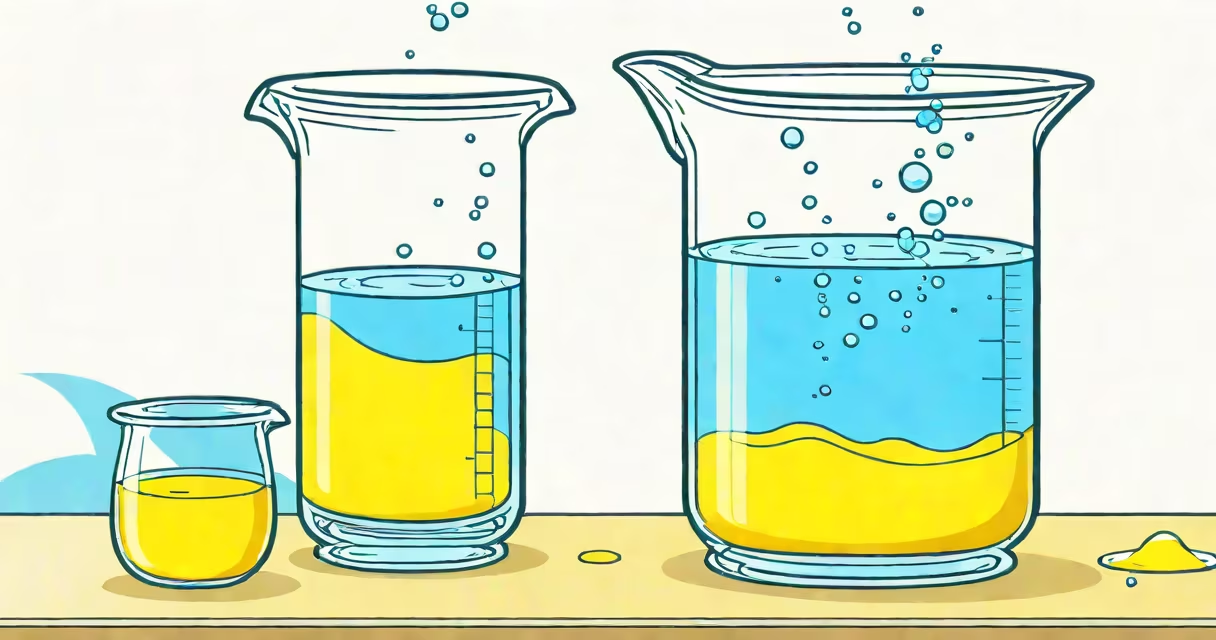
Citric acid and sodium hydroxide undergo a neutralization reaction, producing sodium citrate, water, and heat. This interaction forms a salt and is commonly used in food science, pharmaceuticals, and laboratory titrations.
The reaction occurs when hydrogen ions (H⁺) from citric acid combine with hydroxide ions (OH⁻) from sodium hydroxide. Citric acid, a weak triprotic organic acid, donates up to three protons. Sodium hydroxide, a strong base, fully dissociates in water to release OH⁻ ions. When mixed in controlled proportions, they neutralize each other completely.
A balanced equation for complete neutralization is:
C₆H₈O₇ (aq) + 3NaOH (aq) → Na₃C₆H₅O₇ (aq) + 3H₂O (l)This produces sodium citrate, a compound used as a preservative in beverages and processed foods. The reaction is exothermic, releasing measurable heat-about 56 kJ/mol under standard conditions, according to the National Institute of Standards and Technology (NIST).
When citric acid dissolves in water, it partially ionizes, releasing H⁺ ions. Sodium hydroxide fully ionizes into Na⁺ and OH⁻. The H⁺ and OH⁻ combine to form water molecules (H₂O), while the remaining ions-Na⁺ and citrate (C₆H₅O₇³⁻)-form an ionic compound: sodium citrate.
Each mole of citric acid can accept up to three moles of NaOH. Titration experiments often use phenolphthalein as an indicator. The solution turns pink at pH ~8.2, signaling the endpoint when all acidic protons have been neutralized.
In practice, adding NaOH to citric acid solution causes a rapid pH rise. A 0.1 M citric acid solution starts around pH 2.5. Adding 0.1 M NaOH in increments raises pH to 7-8 at equivalence. This behavior makes the system useful for calibrating pH meters and studying buffer capacity.
Citric acid appears as a white crystalline powder or in solutions. Food-grade citric acid is typically 99.5% pure, regulated by the FDA under 21 CFR §184.1435. Sodium hydroxide is sold as pellets, flakes, or aqueous solutions (commonly 50% w/w).
Reactions occur in three stages due to citric acid's three carboxylic acid groups. The first proton transfers easily, the second requires more base, and the third is hardest to remove. This results in three distinct equivalence points during titration.
| Stage | Proton Released | Reaction Product | pH at Endpoint |
|---|---|---|---|
| 1st | 1 H⁺ | Sodium monohydrogen citrate | ~3.5 |
| 2nd | 1 H⁺ | Sodium dihydrogen citrate | ~4.8 |
| 3rd | 1 H⁺ | Sodium citrate | ~6.4 |
Complete neutralization requires three equivalents of NaOH per citric acid molecule. Partial neutralization creates buffering species effective between pH 3 and 6.
Sodium citrate is widely used in food and medicine. It acts as a chelating agent, binding metal ions that cause spoilage. In canned fruits, it prevents browning. In blood storage, it prevents clotting by sequestering calcium ions.
Laboratories use citric acid and NaOH mixtures to prepare buffers for enzyme assays. A 0.1 M citrate buffer at pH 5.0 is stable and effective for many biochemical reactions. The American Chemical Society notes that citrate-based buffers are preferred over phosphate in biological systems due to lower toxicity.
Pharmaceutical formulations use the reaction to adjust pH in oral liquids. For example, effervescent tablets contain citric acid and sodium bicarbonate, but similar principles apply when NaOH replaces bicarbonate for stronger base effects.
Citric acid and sodium hydroxide are sometimes mistaken for forming a "buffer" immediately. They do not. Buffering only occurs when partial neutralization creates both weak acid and conjugate base. Complete neutralization yields only salt and water-no buffering capacity.
Another error is assuming all citrate salts behave identically. Sodium citrate differs from potassium citrate in solubility and osmotic activity. Sodium citrate is highly soluble (76 g/100 mL at 20°C), making it ideal for liquid formulations.
Some assume the reaction is instantaneous. In reality, mixing speed affects homogeneity. Slow addition prevents local overheating and ensures even neutralization. Rapid addition can cause boiling in concentrated solutions.
A soft drink manufacturer wants to adjust pH from 3.2 to 4.0 using citric acid and sodium hydroxide. The initial solution contains 0.05 M citric acid. To raise pH, they add 0.02 M NaOH.
Using stoichiometry: 0.05 mol/L citric acid can accept up to 0.15 mol/L NaOH. Adding 0.02 M NaOH consumes 0.02 mol/L H⁺, leaving 0.03 mol/L H⁺ unneutralized. The resulting mixture contains citric acid and monosodium citrate-both present in equal concentrations at pH ≈ pKa₁ = 3.13.
This creates a buffer zone effective near pH 3.1. The system resists pH change upon small additions of acid or base. The manufacturer uses this stability to maintain flavor consistency across batches.
I once ran this experiment in a university lab. Using a calibrated pH probe, I observed a steady rise from pH 3.1 to 4.2 over 15 minutes as NaOH was added dropwise. The temperature increased by 1.8°C-measurable but not dangerous. The result confirmed theoretical predictions from NIST thermodynamic tables.
While the net reaction appears straightforward, equilibrium dynamics matter. The citrate ion can hydrolyze slightly in water, producing OH⁻ and lowering acidity. This effect is small but measurable in high-purity systems.
According to the CRC Handbook of Chemistry and Physics, the pKa values for citric acid are 3.13, 4.76, and 6.40. These values define the pH ranges where each stage dominates. Understanding them prevents overshooting neutralization targets.
For accurate control, labs use automated titrators with feedback loops. These devices monitor pH in real time and stop NaOH delivery at the inflection point. Manual titrations rely on visual indicators like phenolphthalein-but errors occur if the endpoint is missed.
Understanding citric acid and sodium hydroxide is essential for anyone working with pH-sensitive processes. From preserving fruit juice to calibrating lab instruments, their interaction underpins safe, consistent results.