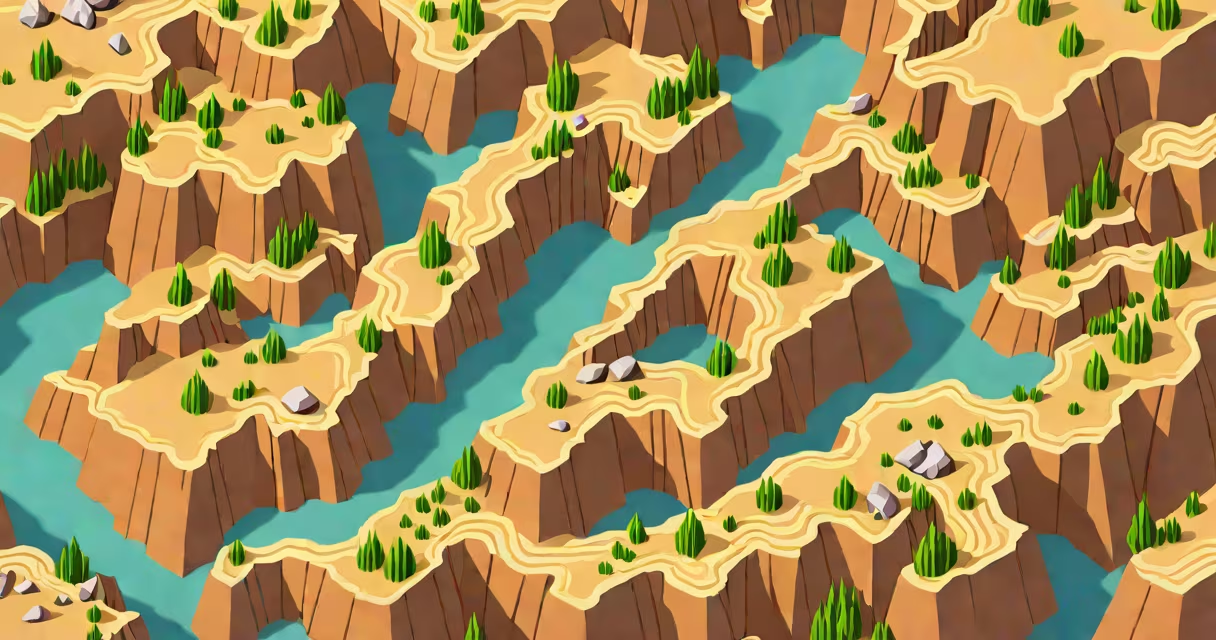
Clastic sedimentary rocks form from fragments of pre-existing rocks transported by water, wind, or ice and deposited as sediment. These fragments undergo compaction and cementation over time to become solid rock. The term "clastic" refers to the broken nature of the particles, distinguishing them from chemical or organic sedimentary rocks.
These rocks originate through mechanical weathering, which breaks down bedrock into smaller pieces. The resulting debris-ranging from clay-sized particles to large boulders-is moved by natural agents like rivers, glaciers, or wind. Once deposited, layers accumulate and are buried under new material. Over thousands to millions of years, pressure squeezes the grains together, and minerals precipitate from groundwater to bind them into a cohesive rock. This process is called lithification.
Geologists classify clastic sedimentary rocks based on grain size. Sandstone contains grains between 0.0625 mm and 2 mm. Shale forms from clay-sized particles (<0.0625 mm) and typically splits into thin layers. Conglomerate consists of rounded pebbles and gravel bound in finer matrix. Grain size reflects energy levels during transport-high-energy environments like fast-flowing rivers produce coarser deposits, while low-energy settings like lakes or deep oceans preserve fine-grained sediments.
Formation begins with erosion and weathering. Physical processes such as freeze-thaw cycles fracture rock, while chemical weathering dissolves minerals. The resulting fragments are eroded and carried away. Transport distance affects grain roundness and sorting-longer travel results in smoother, more uniformly sized grains.
Deposition occurs when energy drops. A river slows entering a lake, dropping its load. Wind loses power when hitting a dune field. Glaciers melt, releasing sediment. The location determines the rock type: deltas create sandstone; deep marine basins yield shale; mountain fronts host conglomerates.
Lithification completes the transformation. As layers pile up, pore spaces shrink under weight. Water trapped in pores becomes supersaturated with calcite, quartz, or iron oxide. These minerals crystallize around grains, acting as glue. After millions of years, loose sediment becomes solid rock. This process is irreversible-once lithified, the rock cannot return to sediment unless reburied and re-weathered.
The following table outlines major clastic sedimentary rock types based on grain size and composition:
| Rock Type | Grain Size Range | Common Environment | Key Features |
|---|---|---|---|
| Shale | <0.0625 mm | Deep marine, lakes, floodplains | Splits into thin sheets; often dark due to organic content |
| Siltstone | 0.0039-0.0625 mm | Slow-moving rivers, glacial outwash | Fine texture; feels gritty when rubbed |
| Sandstone | 0.0625-2 mm | Rivers, beaches, deserts | Visible grains; often light-colored due to quartz dominance |
| Arkose | 0.0625-2 mm | Mountainous regions with rapid uplift | Rich in feldspar; indicates near-source deposition |
| Granulestone | 2-4 mm | High-energy streams, alluvial fans | Coarse grains; limited cementation |
| Conglomerate | >2 mm | Fast rivers, glacial outwash | Round pebbles in finer matrix; shows high-energy origin |
Each rock type reveals clues about past landscapes. For example, a layer of cross-bedded sandstone in a desert region suggests ancient dunes. Shale rich in pyrite indicates stagnant water with low oxygen-ideal for preserving fossils.
Clastic sedimentary rocks are often confused with chemical sedimentary rocks. While both form from accumulated material, clastic rocks derive from physical fragments, whereas chemical ones grow from dissolved ions. For instance, rock salt forms when seawater evaporates and crystals precipitate-no broken rock involved.
A key distinction lies in provenance. Clastic rocks reflect their source. Quartz-rich sandstones suggest long transport and weathering; feldspar-rich rocks indicate recent uplift and minimal erosion. This allows geologists to trace sediment movement across continents.
Another misconception is that all clastic rocks contain visible grains. Shale appears homogeneous but is actually composed of microscopic clay flakes. Its layered structure-called laminations-forms under quiet conditions. Without magnification, it's easy to mistake shale for a uniform mass.
In 2018, NASA's Curiosity rover identified layered sedimentary rocks on Mars' Mount Sharp. Analysis showed alternating bands of fine-grained and coarse-grained material consistent with fluvial (river-related) deposition. The presence of cross-bedding and ripple marks confirmed that water once flowed across the area. These findings support the existence of ancient lakes and rivers on Mars-conditions favorable for microbial life.
On Earth, the Navajo Sandstone in southern Utah is a classic example. Formed 190 million years ago during the Jurassic period, it preserves massive dune fields. The rock's high quartz content and cross-bedding patterns reveal it was shaped by wind in a vast desert. Today, it forms dramatic cliffs in Zion National Park.
I once examined a core sample from a well drilled in the Gulf of Mexico. The layer sequence included alternating sandstone and shale. The sandstone intervals were sharply bounded and contained fossilized burrows-evidence of ancient tidal channels. The shale layers had high organic content, indicating periods of low energy and abundant plant material. This combination helped identify potential hydrocarbon reservoirs.
These rocks record Earth's history. Their textures, compositions, and layering provide evidence of past climates, sea levels, and tectonic activity. They also serve as reservoirs for oil and gas. More than half of the world's oil reserves are trapped in porous sandstone formations.
According to the U.S. Geological Survey, sedimentary basins containing clastic rocks hold approximately 70% of known petroleum resources. The Bureau of Ocean Energy Management notes that offshore drilling operations rely heavily on seismic imaging of clastic sequences to locate subsurface traps.
For students and professionals alike, recognizing clastic sedimentary rocks is foundational. It enables interpretation of geological maps, prediction of resource locations, and reconstruction of paleoenvironments. Understanding the difference between a conglomerate formed by a flash flood versus one shaped by glacial meltwater can alter interpretations of regional geology.
When studying clastic sedimentary rocks, remember: they are not just rock-they are records. Each grain tells a story of where it came from, how far it traveled, and what environment it settled in. Their layered structure captures time itself.