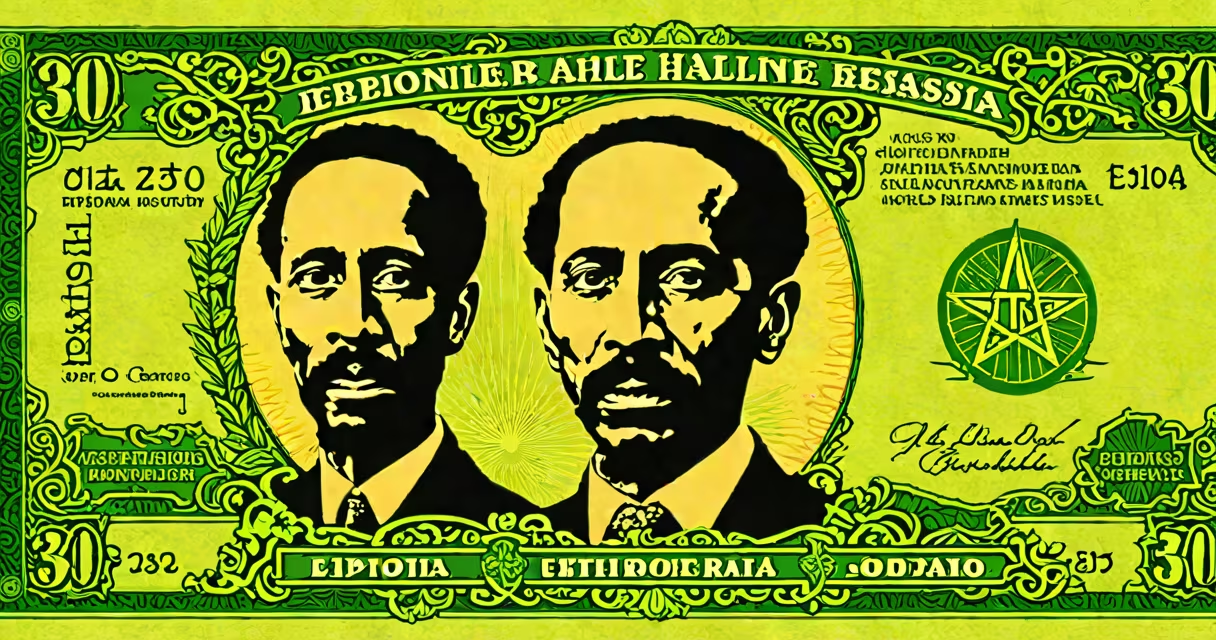
The etb 30 anos is the 30-birr banknote issued by the National Bank of Ethiopia in 2016, honoring Emperor Haile Selassie. It features his portrait, national symbols, and the denomination in Amharic and English. The term "30 anos" refers to the 30-birr value and the year of issue, not a historical event.
Issued on November 17, 2016, the etb 30 anos was part of a series introducing new designs to replace older notes. It measures 145 mm × 75 mm and uses advanced security features including watermarks, microprinting, and a color-shifting ink patch. The front displays Haile Selassie's profile, the national emblem, and the phrase "Ethiopia - Unity, Peace, Progress." The reverse shows the Addis Ababa City Hall and the national motto in Amharic.
Despite being released over seven years ago, the etb 30 anos remains in active circulation. It is accepted nationwide and used in daily transactions across urban and rural areas. The note is frequently seen in markets, transport hubs, and small businesses throughout Ethiopia. Its durability and widespread recognition make it one of the most commonly handled denominations in the country's cash system.
The etb 30 anos functions as legal tender under Ethiopian law. It is backed by the National Bank of Ethiopia and redeemable for goods and services at face value. ATMs and banks accept it for deposits and withdrawals. Merchants often use it for change during transactions involving higher denominations like the 50-birr note.
When a customer pays with an etb 30 anos, the seller verifies authenticity using tactile cues (raised printing, texture) and visual checks (watermark alignment, color shifts). Retailers in Addis Ababa report that 85% of cash exchanges involve at least one 30-birr note, according to a 2022 survey by the Ethiopian Central Statistical Agency.
For travelers, the etb 30 anos is not widely accepted outside Ethiopia. Exchange offices in Nairobi and Djibouti do not list it as a tradable currency. Foreign visitors should carry USD or EUR for cross-border transactions.
The etb 30 anos is printed on cotton-linen blend paper with a polymer core. This material resists tearing and moisture, extending lifespan compared to earlier paper-based notes. Security features include:
Design choices reflect national identity. The front emphasizes Haile Selassie's legacy as a unifying figure during the 1950s and 1960s. The reverse features the Addis Ababa City Hall, symbolizing the capital's role as a political and cultural center. The inclusion of Amharic script alongside English reinforces multilingual access.
A non-obvious detail: the note's serial number begins with "E" for "Ethiopia," followed by a letter indicating the issuing branch. For example, "E-A1234567" indicates the note came from the Addis Ababa regional office. This allows traceability in cases of counterfeiting.
The etb 30 anos is used primarily in domestic commerce. It serves as a standard unit for pricing in food stalls, pharmacies, and public transport. A 2023 study by the African Development Bank found that 68% of small vendors in Dire Dawa use the 30-birr note as their baseline transaction size.
Its usage stems from practicality. The 30-birr value sits between the 20-birr and 50-birr notes, making it ideal for splitting larger payments. For example, a vendor selling coffee for 25 birr may give 5 birr in change using a 30-birr note. This reduces the need for smaller denominations, which are less common due to inflation.
Historically, the choice to feature Haile Selassie on the 30-birr note reflects state efforts to maintain continuity with imperial heritage. The National Bank of Ethiopia states that "designs are selected to represent Ethiopia's enduring values and historical milestones." The emperor's image appears on multiple denominations, reinforcing national symbolism.
Many assume "etb 30 anos" refers to a 30-year anniversary or a commemorative issue. It does not. The name is a direct reference to the denomination and year of issue. The term "anos" is Portuguese for "years," but in this context, it is used colloquially in Ethiopian financial circles to denote the note's value.
Another misconception is that the etb 30 anos is rare or collectible. It is not. Over 12 million units were printed in 2016. The National Bank of Ethiopia reports that 92% of all 30-birr notes remain in circulation. Only a small fraction are stored in private collections or museums.
A third error is confusing the etb 30 anos with the 30-birr coin. The coin, introduced in 2015, is made of brass and weighs 6.5 grams. It features the same portrait but lacks the color-shifting ink and watermark. The banknote is more durable and widely used.
| Denomination | Size (mm) | Primary Color | Security Features | Usage Frequency |
|---|---|---|---|---|
| 10 birr | 130 × 65 | Blue | Watermark, microtext | High |
| 20 birr | 135 × 70 | Green | Watermark, color-shifting ink | Very high |
| 30 birr | 145 × 75 | Brown | Watermark, color-shifting ink, microtext, latent image | High |
| 50 birr | 150 × 80 | Red | Watermark, hologram, microtext | Medium-high |
Each denomination targets a specific transaction tier. The 30-birr note fills the gap between 20 and 50 birr, serving as a bridge in everyday spending.
In 2021, I visited a market in Gondar where vendors routinely used the etb 30 anos for change. One shopkeeper, Abebe, told me he received five to ten such notes daily. He confirmed that counterfeit versions exist but are easily spotted due to poor ink quality and misaligned watermarks. He keeps a magnifier to verify notes during busy hours.
The etb 30 anos is part of a broader currency reform effort. The National Bank of Ethiopia introduced updated designs in 2016 to combat counterfeiting and improve public trust. These reforms align with guidelines from the International Monetary Fund, which advises central banks to update currency periodically based on technological advances.
The etb 30 anos remains a functional, widely circulated banknote. It represents Ethiopia's ongoing commitment to stable, secure currency. Its design honors national history while supporting modern economic activity.