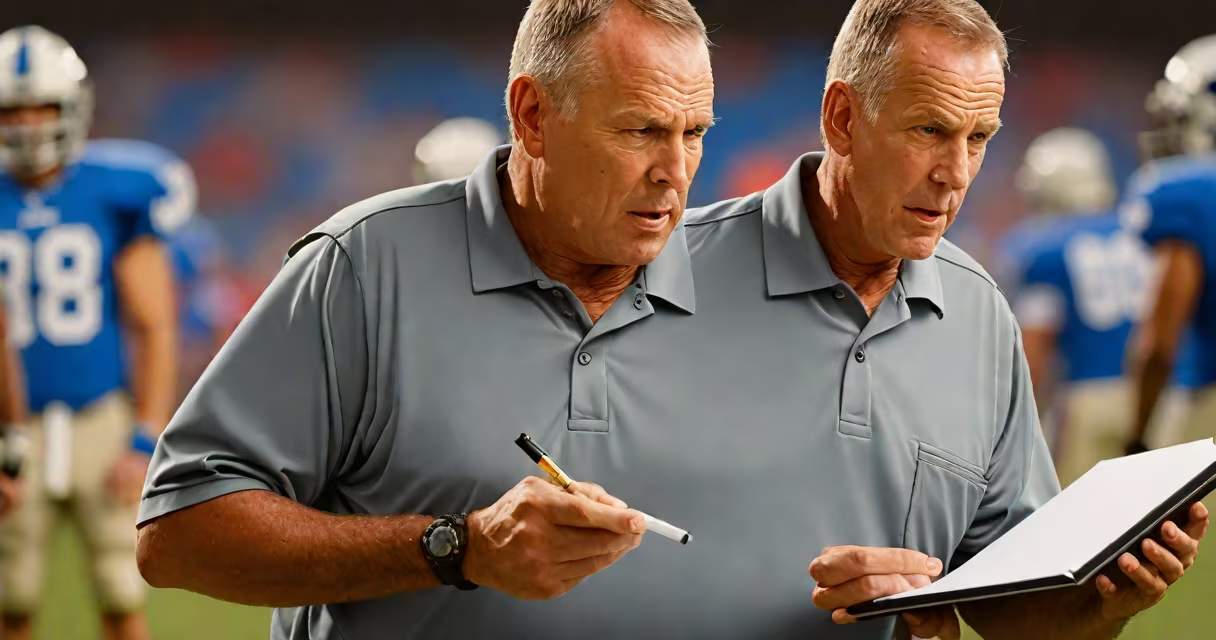
A football coach is a person who directs a team's preparation, tactics, and player development during games and practices. The role includes designing plays, managing player roles, and making real-time decisions under pressure. Coaches are responsible for both short-term outcomes and long-term athlete growth.
Coaches operate at multiple levels-high school, college, professional leagues like the NFL, and international competitions. Their authority stems from expertise in the sport's rules, physical conditioning, and psychological motivation. A head coach holds ultimate decision-making power, while assistants focus on specific areas such as offense, defense, or special teams.
The term "football coach" applies to both American football and association football (soccer), though the structure and responsibilities differ between the two. In American football, coaches often specialize in positions or playbooks. In soccer, the head coach typically oversees all aspects of team performance, including tactical setup and player rotation.
Football coaching begins with planning. Coaches analyze opponents' tendencies using film, statistics, and scouting reports. They then design offensive and defensive schemes tailored to their players' strengths. For example, a coach may assign a quarterback a series of quick passes if the team lacks a dominant running back.
During practice, coaches break down movements into drills. A defensive coordinator might run a 3-on-3 pass coverage drill to improve timing between cornerbacks and safeties. These sessions build muscle memory and coordination. Coaches observe form, correct errors, and adjust based on progress.
Game-day decisions are high-stakes. A coach must choose whether to go for it on fourth down, call a timeout, or substitute a player. These choices rely on real-time data, situational awareness, and risk assessment. A well-known example occurred in Super Bowl XLVII, when the Baltimore Ravens' coach John Harbaugh opted to run the ball on fourth-and-goal, resulting in a touchdown and a key momentum shift.
Football teams employ several specialized coaching roles. The hierarchy varies by level, but most follow a similar structure:
| Role | Primary Responsibility | Example |
|---|---|---|
| Head Coach | Team strategy, staff management, public representation | Bill Belichick (New England Patriots) |
| Offensive Coordinator | Designing offensive plays, managing quarterback and skill position groups | Josh McDaniels (Denver Broncos) |
| Defensive Coordinator | Organizing defensive schemes, calling plays during games | Jim Schwartz (Detroit Lions) |
| Special Teams Coach | Managing kickoffs, punts, field goals, and returns | Rich Bisaccia (Green Bay Packers) |
| Position Coaches | Training players in specific roles (e.g., wide receivers, linebackers) | David Culley (wide receivers coach, Houston Texans) |
At the high school level, one person may hold multiple roles. A single coach might serve as head coach, offensive coordinator, and defensive coordinator. This reflects limited staffing but demands broad expertise.
Many assume a football coach's job is purely motivational. While communication matters, the role is rooted in analysis, execution, and adaptation. Coaches spend hours reviewing footage-sometimes 100+ hours per week during season prep.
Another myth is that coaches make all decisions. In reality, many teams have advisory boards or front office personnel who influence roster moves and contracts. A coach may recommend a player's release, but the general manager makes the final call.
Some confuse a football coach with a player. Coaches do not participate in games unless they are part of a dual-role system, such as a player-coach in lower-tier leagues. Even then, participation is rare and regulated.
In 2016, the New England Patriots faced the Atlanta Falcons in Super Bowl LI. Down 28-3 at halftime, head coach Bill Belichick did not panic. Instead, he adjusted the defensive scheme, increased blitz frequency, and trusted quarterback Tom Brady's ability to manage pressure. The Falcons' offense stalled in the second half due to consistent pressure, allowing the Patriots to score 31 unanswered points.
This comeback was not luck-it was strategic. Belichick had studied Atlanta's offensive patterns for weeks. He identified a weakness in their left tackle's footwork and designed a stunt play that exploited it. During the game, he called four different blitz packages in the final quarter, disrupting the Falcons' timing.
Belichick's actions illustrate that coaching is not about shouting or emotion. It's about pattern recognition, data use, and disciplined execution. His win rate over 18 seasons with the Patriots was 67%, one of the highest in NFL history.
Football coaching is distinct from sports psychology, athletic training, and team management. A sports psychologist focuses on mental resilience and team cohesion. An athletic trainer handles injury prevention and recovery. A team manager deals with logistics, travel, and contracts.
For example, when a player struggles with confidence, the coach may assign extra reps. The sports psychologist might conduct one-on-one sessions to rebuild self-image. The trainer ensures the player is physically ready. All three support the team, but only the coach shapes game plans and leads the group.
Understanding this difference prevents misattribution of results. A loss isn't always due to poor coaching. External factors-player injuries, weather, officiating-can affect outcomes independently.
I once attended a youth football camp where a coach emphasized repetition over praise. Over three days, players ran the same route 40 times. The coach didn't explain why until Day 3, when he said, "You're not learning the route-you're learning your body's response." That moment clarified how coaching builds instinctive behavior through deliberate practice.
That experience showed me that coaching isn't about inspiration-it's about precision. The best coaches don't just tell players what to do. They create conditions where doing it becomes automatic.
The football coach meaning centers on leadership, strategy, and player development. Coaches shape team culture, adapt to challenges, and drive performance through structured preparation. Their influence extends beyond the field, affecting player careers and organizational success.
Understanding this role helps fans, athletes, and aspiring coaches recognize the depth behind the sideline presence. Whether in high school or the pros, the football coach meaning remains consistent: responsibility, analysis, and action.