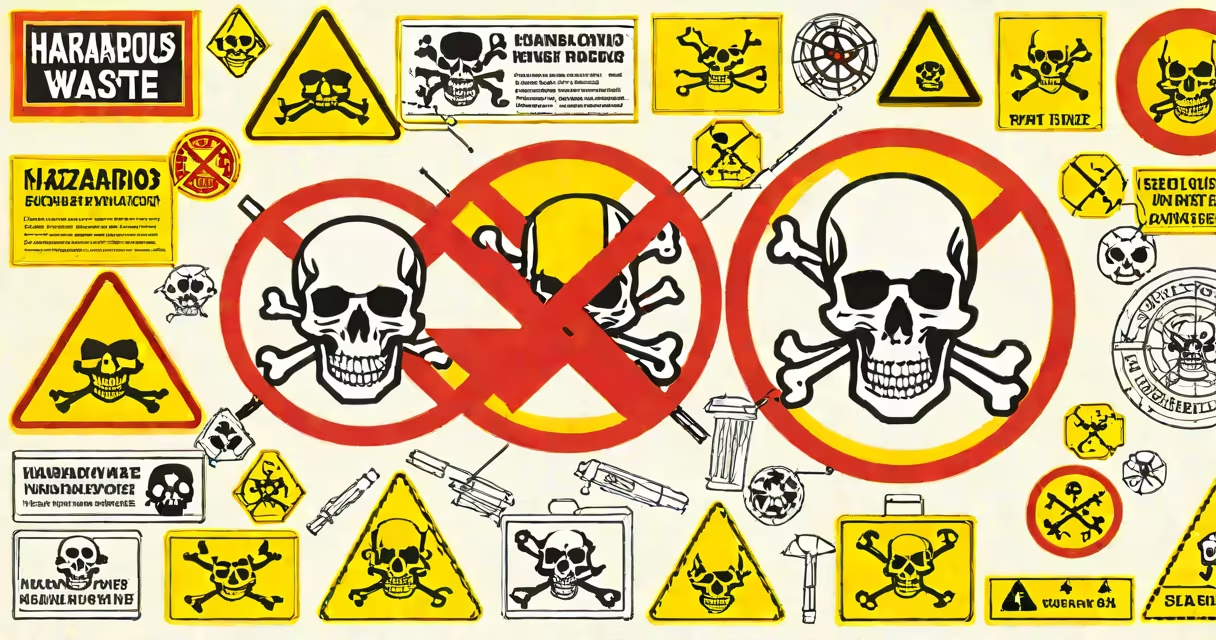
Hazardous waste signage is a standardized label required by U.S. federal law to identify containers holding regulated hazardous waste. These signs use specific colors, symbols, and wording to warn personnel and emergency responders of potential health and environmental risks.
The U.S. Environmental Protection Agency (EPA) mandates that containers holding hazardous waste must display a label stating "Hazardous Waste" and include the accumulation start date. This requirement applies to all facilities generating, storing, or transporting such waste under the Resource Conservation and Recovery Act (RCRA).
OSHA's Hazard Communication Standard (HCS) further specifies that labels must include pictograms, signal words, hazard statements, and precautionary statements. The combination ensures consistent understanding across industries, reducing exposure risks during handling, storage, and disposal.
Hazardous waste signage functions as a visual warning system. It uses universally recognized symbols and color coding to convey danger quickly, even without reading. Red borders and black symbols indicate immediate risk. Yellow backgrounds with black text signal caution or warning levels.
Each sign includes the word "Hazardous Waste" in bold capital letters. A secondary field lists the start date of waste accumulation-this is critical because waste cannot be stored longer than 90 days without a permit. After 90 days, the container must be moved to a designated storage area with additional controls.
For example, a lab producing solvents like acetone or methanol must place a hazardous waste sign on every container within 24 hours of waste generation. Failure to do so violates EPA rules and can result in fines up to $75,000 per violation.
There are two primary types of hazardous waste signage: temporary and permanent. Temporary signs are used on containers during short-term storage. Permanent signs are affixed to walls or bins in long-term storage areas.
| Type | Use Case | Size & Visibility | Regulatory Reference |
|---|---|---|---|
| Temporary | On-site containers, 90-day limit | Minimum 4 inches wide, visible from 3 feet away | EPA 40 CFR §265.171 |
| Permanent | Storage rooms, transfer areas | Minimum 6 inches wide, mounted at eye level | OSHA 29 CFR §1910.1200(g) |
Signs must include the following elements:
A common mistake is using generic "Caution" signs instead of proper hazard-specific labels. For instance, a container of spent battery acid requires a corrosive pictogram and the word "Corrosive" in the hazard statement. Using a standard caution sign fails to meet RCRA requirements.
Hazardous waste signage is mandatory in industrial facilities, laboratories, healthcare centers, auto repair shops, and waste treatment plants. Any location generating more than 100 kg of hazardous waste per month must comply.
In practice, a university chemistry lab generates waste from expired reagents. When a bottle of hydrochloric acid is emptied, the container is rinsed and placed in a labeled bin. The bin must have a hazardous waste sign showing the start date and hazard symbols. Without it, the institution risks inspection penalties.
Another example: a printing facility using ink containing volatile organic compounds (VOCs). Waste ink cartridges are collected in sealed drums. Each drum must carry a sign indicating "Hazardous Waste - Flammable Liquid," with the accumulation start date. This prevents accidental mixing with other materials and ensures safe transport to a licensed disposal site.
Many assume that any red-and-yellow sign qualifies as hazardous waste signage. That's incorrect. Only signs meeting EPA and OSHA specifications are compliant. A sign printed on paper with hand-drawn symbols does not satisfy legal requirements.
Another misconception is that signage is optional for small quantities. The EPA defines hazardous waste based on toxicity, reactivity, ignitability, or corrosivity-not volume. Even a single liter of lead-acid battery fluid counts as hazardous waste and must be labeled.
Some facilities reuse containers without relabeling. This is illegal. Once a container is emptied, it must be cleaned and re-labeled if reused for new waste. Reusing unmarked containers increases contamination risk and violates RCRA Section 265.171(a)(2).
I once observed a warehouse in Ohio fail an EPA audit due to missing hazardous waste signage. Over 30 plastic drums stored flammable solvents were unlabeled. The inspector cited violations under 40 CFR §265.171 and issued a $42,000 penalty. The facility had to halt operations until all containers were properly labeled. This incident underscores that compliance isn't optional-it's enforced.
Hazardous waste signage differs from general safety signage. General signs warn about physical dangers like "Wet Floor" or "High Voltage." Hazardous waste signs specifically address chemical and biological threats.
It also differs from shipping labels used under the Department of Transportation (DOT) rules. DOT labels apply during transport and include UN numbers and hazard classes. Hazardous waste signage focuses on storage and internal handling.
The term "hazardous waste" does not apply to household cleaners or office supplies. Only materials classified under RCRA as hazardous-such as pesticides, solvents, or heavy metals-are subject to this labeling.
Always use pre-printed, durable signage made from vinyl or laminated paper. Avoid handwritten labels. They degrade quickly and may be misread.
Train staff to check signs daily. If a container exceeds 90 days of storage, move it to a permitted area and update the label. Use a logbook to track accumulation dates.
When disposing of waste, ensure the final transporter verifies the label before pickup. A mismatch between the label and manifest can delay disposal and trigger regulatory scrutiny.
Proper hazardous waste signage protects people, property, and the environment. It's not just a formality-it's a legal obligation backed by enforcement. When applied correctly, it reduces risk, supports compliance, and saves money through prevention.