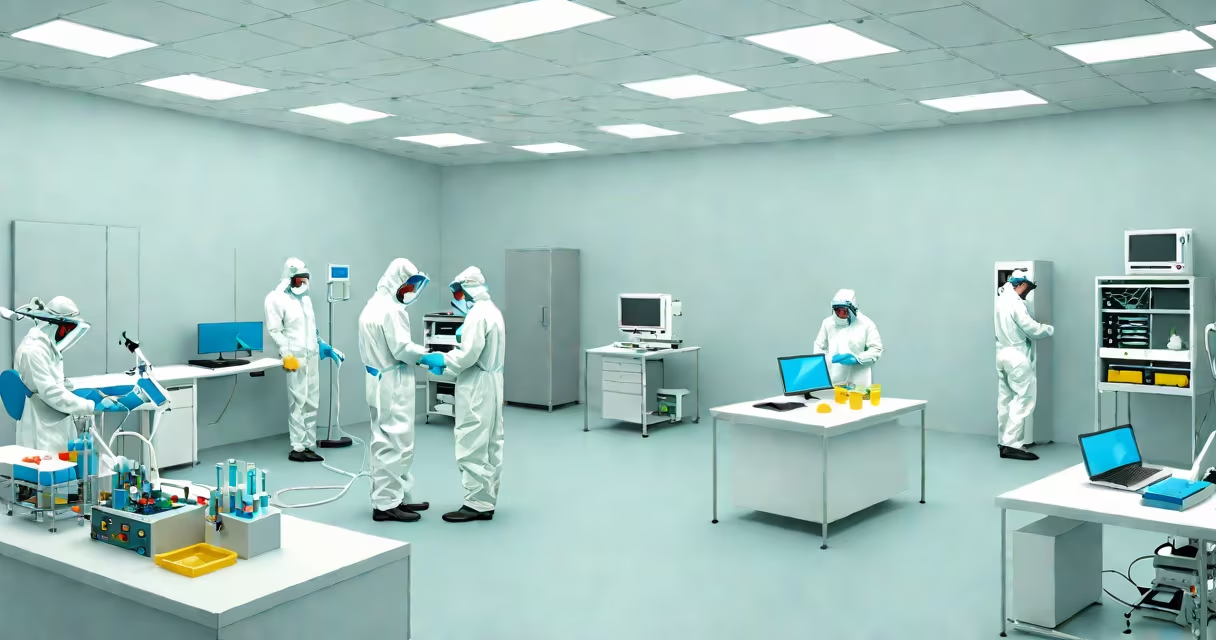
An ISO Class 7 cleanroom is a controlled environment where airborne particle concentration is limited to no more than 352,000 particles per cubic meter that are 0.5 micrometers or larger. This standard ensures minimal contamination during sensitive processes such as semiconductor fabrication and sterile drug production.
ISO Class 7 is part of the international ISO 14644-1 standard, which defines cleanroom performance based on particle counts. The classification uses a logarithmic scale: lower numbers indicate cleaner environments. ISO Class 7 sits between ISO Class 6 (cleaner) and ISO Class 8 (less clean), making it suitable for high-precision work requiring moderate control.
These rooms maintain airflow through HEPA filters, typically at 20-40 air changes per hour. Temperature and humidity are tightly regulated-usually between 20-24°C and 45-60% RH-to prevent condensation and material degradation. Personnel wear full-body suits, gloves, and masks to reduce particulate shedding.
ISO Class 7 cleanrooms rely on laminar or turbulent airflow systems to remove contaminants. Laminar flow, common in critical zones, moves air in parallel lines at uniform velocity, minimizing turbulence. Turbulent flow, used in larger areas, mixes air to dilute particles but requires higher filtration efficiency.
Air enters through ceiling-mounted HEPA filters and exits via floor grilles. Pressure differentials ensure air flows from cleaner to less clean zones-typically 10-15 Pascals higher inside the room than outside. This prevents unfiltered air from infiltrating.
Particle counters measure concentrations every 15 minutes during operations. If levels exceed thresholds, alarms trigger and the system logs deviations. Regulatory bodies require audit trails for compliance with FDA 21 CFR Part 11 and EU GMP Annex 1.
ISO Class 7 environments are categorized by function:
| Type | Use Case | Typical Particle Count (≥0.5µm) | Example Industry |
|---|---|---|---|
| Primary Cleanroom | Direct product contact | ≤352,000 | Pharmaceuticals, biologics |
| Secondary Support Area | Preparation, packaging | ≤352,000 | Medical device assembly |
| Controlled Access Zone | Personnel entry/exit | ≤352,000 | Electronics manufacturing |
These spaces often serve as buffer zones between ISO Class 8 and ISO Class 5 areas. For example, in vaccine production, ISO Class 7 rooms handle vial filling under controlled conditions before transferring to ISO Class 5 clean benches for final sealing.
Manufacturers use ISO Class 7 for tasks like tablet coating, syringe filling, and wafer handling. The U.S. Food and Drug Administration (FDA) mandates ISO Class 7 or better for sterile injectables under current Good Manufacturing Practice (cGMP).
Many assume ISO Class 7 is equivalent to the older Federal Standard 209E Class 10,000. While both allow up to 10,000 particles per cubic foot larger than 0.5 microns, the measurement units differ. ISO Class 7 allows 352,000 particles per cubic meter-about 10,000 per cubic foot-but the metric system is now the global standard.
Another misconception is that ISO Class 7 rooms don't require daily monitoring. In reality, the ISO 14644-1 standard requires continuous particle monitoring and periodic validation. A 2022 study by NIST found that 14% of facilities labeled as ISO Class 7 failed initial certification due to improper filter installation or airflow imbalance.
Some confuse ISO Class 7 with clean zones in labs without formal classification. A lab bench with a biosafety cabinet may appear clean but lacks certified airflow patterns and particle counting. Only a validated cleanroom with documented air exchange rates and filter integrity tests qualifies as ISO Class 7.
In 2021, a contract manufacturer in Massachusetts upgraded its packaging line for a new monoclonal antibody drug. The facility had previously operated in a Class 100,000 area (equivalent to ISO Class 8). To meet FDA requirements for sterile fill, they constructed a new ISO Class 7 cleanroom with dual HEPA filtration and pressure cascading.
The project included:
After certification, the facility reduced microbial contamination incidents by 83% compared to the previous setup. The upgrade required $210,000 in capital investment and six weeks of downtime.
While ISO 14644-1 defines cleanroom classes numerically, ANSI/ASHRAE 1952-2020 uses a different system based on air changes per hour and filter efficiency. For example, an ANSI Class 10,000 space corresponds roughly to ISO Class 7, but the criteria differ. ANSI focuses on system design and operational parameters rather than particle counts.
When selecting a cleanroom, engineers must reconcile both standards. A facility designed to ANSI Class 10,000 may not meet ISO Class 7 if particle counts exceed limits. Conversely, an ISO-compliant room may fail ANSI if airflow distribution doesn't meet minimum velocity thresholds.
I once oversaw the retrofit of a medical device cleanroom where the team relied solely on ANSI metrics. After switching to ISO 14644-1 validation, we discovered 17% of test points exceeded allowable particle levels. Correcting the filter layout and adjusting fan speeds brought the space into compliance.
An ISO Class 7 cleanroom is a strictly regulated environment with defined particle limits, airflow controls, and monitoring protocols. It supports high-integrity manufacturing in life sciences and advanced electronics. Understanding the difference between ISO and legacy standards like ANSI ensures accurate facility design and regulatory compliance. Always verify certification through independent testing, not just labeling.