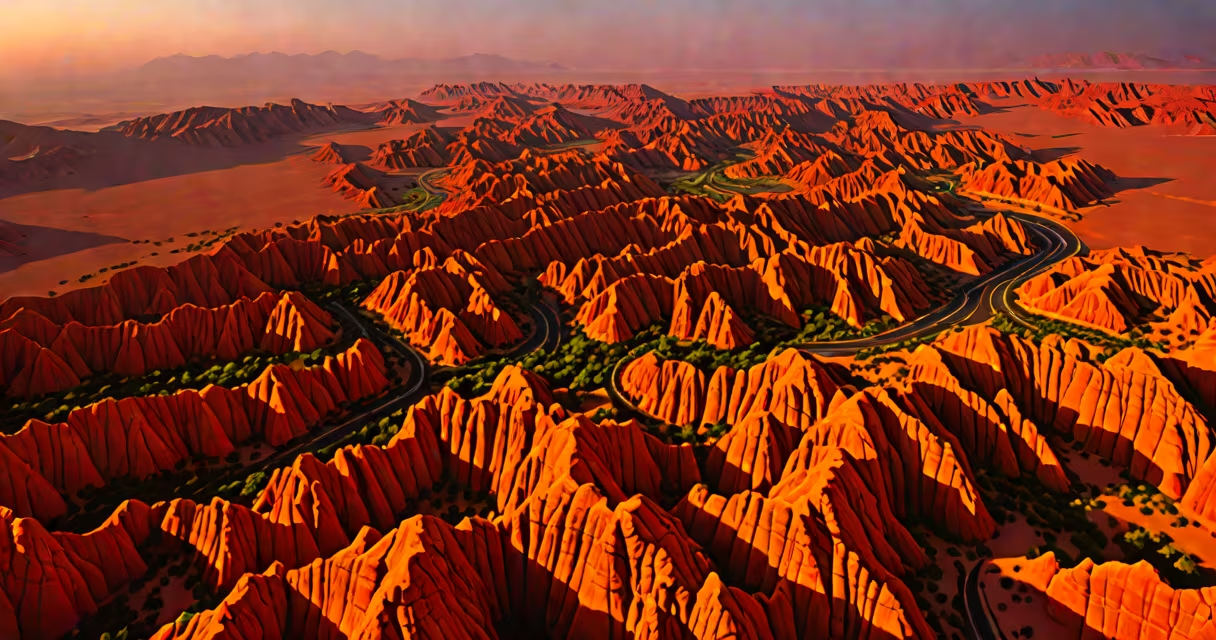
Things to do in Gansu center on ancient Silk Road heritage, dramatic desert landscapes, and millennia-old Buddhist cave art. The province spans arid highlands, mountain ranges, and river valleys in northwest China, offering access to UNESCO World Heritage Sites, remote monasteries, and geological wonders rarely seen by tourists.
Gansu lies along the historic Silk Road corridor, connecting China to Central Asia and the Middle East. Its terrain includes the Gobi Desert, the Qilian Mountains, and the Yellow River basin. This geography shaped centuries of trade, migration, and religious exchange. Today, visitors explore remnants of that past through archaeological sites, temple complexes, and natural formations formed over millions of years.
Major destinations include Dunhuang's Mogao Caves, Zhangye's Danxia Landforms, and the ancient city of Jiayuguan. These sites attract travelers seeking history, culture, and untouched scenery. Unlike tourist-heavy destinations in eastern China, Gansu offers quieter, more immersive experiences with fewer crowds and deeper historical context.
Most activities in Gansu revolve around guided exploration due to remote locations and complex logistics. Travelers typically book multi-day tours from Lanzhou, the provincial capital, or fly into Dunhuang. Transportation options include private vehicles, shared minivans, and local buses, though roads in rural areas can be unpaved and winding.
Entry to major sites often requires advance booking. The Mogao Caves, for example, limit daily visits to 6,000 people and require timed tickets. Visitors must check in via ID and follow strict photography rules. Some temples, such as the Labrang Monastery in Xiahe County, restrict entry to certain hours and prohibit loud behavior or flash photography.
Local guides provide essential context. At the Mogao Caves, trained docents explain the evolution of Buddhist iconography across Tang Dynasty murals. In the Hexi Corridor, guides detail how caravans transported silk, spices, and manuscripts between Chang'an and Samarkand. Without this guidance, much of the cultural significance remains invisible.
The following table outlines the main categories of things to do in Gansu, their typical duration, and key features:
| Type | Duration | Key Features | Best For |
|---|---|---|---|
| Buddhist Cave Temples | 2-4 hours | Mogao Caves (Dunhuang), Yungang-style carvings, Tang-era murals | Art history, religious studies |
| Natural Landscapes | Half-day to full day | Zhangye Danxia, Qilian Mountains, Heihe River Basin | Photography, geology, hiking |
| Historic Fortresses | 1-2 hours | Jiayuguan Pass, Yangguan Ruins, Ming Dynasty walls | History buffs, military architecture |
| Monastic Communities | Full day | Labrang Monastery (Xiahe), Kumbum Monastery (Qinghai border) | Cultural immersion, Tibetan Buddhism |
| Desert Trails | Multi-day | Hexi Corridor trekking, Dunhuang dunes, Shule River route | Adventure travel, off-grid exploration |
Each category reflects a different aspect of Gansu's identity. The Mogao Caves represent centuries of artistic and spiritual fusion, while Zhangye Danxia showcases Earth's slow sculpting through wind and water. The fortress ruins speak to imperial defense strategies, and the monasteries reveal how Tibetan Buddhism took root in frontier regions.
A lesser-known fact: the Mogao Caves were sealed for nearly 900 years before being rediscovered in 1900. A hidden chamber behind a wall contained over 50,000 manuscripts, scrolls, and textiles. Many of these artifacts are now housed in the British Museum and the Bibliothèque nationale de France. This event reshaped global understanding of early medieval trade and cross-cultural exchange.
Many assume Gansu is uniformly desert and barren. While parts of the province lie in the Gobi, other areas feature alpine meadows, fertile river valleys, and snow-capped peaks. The Qilian Mountains host permanent glaciers and seasonal lakes, supporting herding communities and rare species like the snow leopard.
Another misconception is that all things to do in Gansu involve extreme hardship. While remote locations demand preparation, infrastructure exists for most major sites. Dunhuang has international hotels, restaurants serving regional cuisine, and Wi-Fi in public spaces. Even Labrang Monastery offers guesthouses and translation services for foreign visitors.
Some confuse Gansu with Xinjiang or Inner Mongolia due to shared border regions and similar ethnic groups. But Gansu is distinct in language, religion, and administrative structure. The province is home to Han Chinese, Hui Muslims, Tibetan Buddhists, and Mongolian minorities-but its governance falls under Gansu's provincial government, not autonomous regional authority.
On a spring morning in Dunhuang, a traveler arrives at the Mogao Caves visitor center at 8:00 AM. After scanning a QR code linked to a pre-booked ticket, they board a shuttle bus to the site entrance. Inside, a guide leads them through nine caves selected for their artistic and historical significance.
In Cave 45, the guide points out a mural depicting the Bodhisattva Avalokiteshvara in a celestial court. The colors-lapis blue, cinnabar red, and gold leaf-remain vivid despite 1,300 years of exposure. The guide explains that the pigments came from Afghanistan and India, carried along the Silk Road. One panel shows a merchant offering a camel load of silk to a monk, illustrating trade dynamics during the Tang Dynasty.
After exiting, the visitor walks through a museum exhibit displaying fragments of the Dunhuang manuscripts. One scroll contains a 9th-century prayer in Uyghur, another a medical text translated from Persian. The visitor leaves with a printed map showing the original location of the sealed chamber discovered in 1900.
This visit takes about four hours. The cost is 180 yuan ($25 USD) for the full tour, including audio guide and museum access. No photography is allowed inside the caves, but exterior views are permitted with a tripod.
Things to do in Gansu extend beyond sightseeing-they offer layered encounters with history, ecology, and living cultures. The province's remoteness preserves authenticity, but it also demands planning. Travelers should prepare for variable weather, altitude changes, and limited mobile service.
For those drawn to deep history and unspoiled nature, Gansu delivers. The Mogao Caves reveal how ideas traveled across continents. The Danxia formations show how rock layers tell time. And the monasteries demonstrate how faith endures in harsh climates.