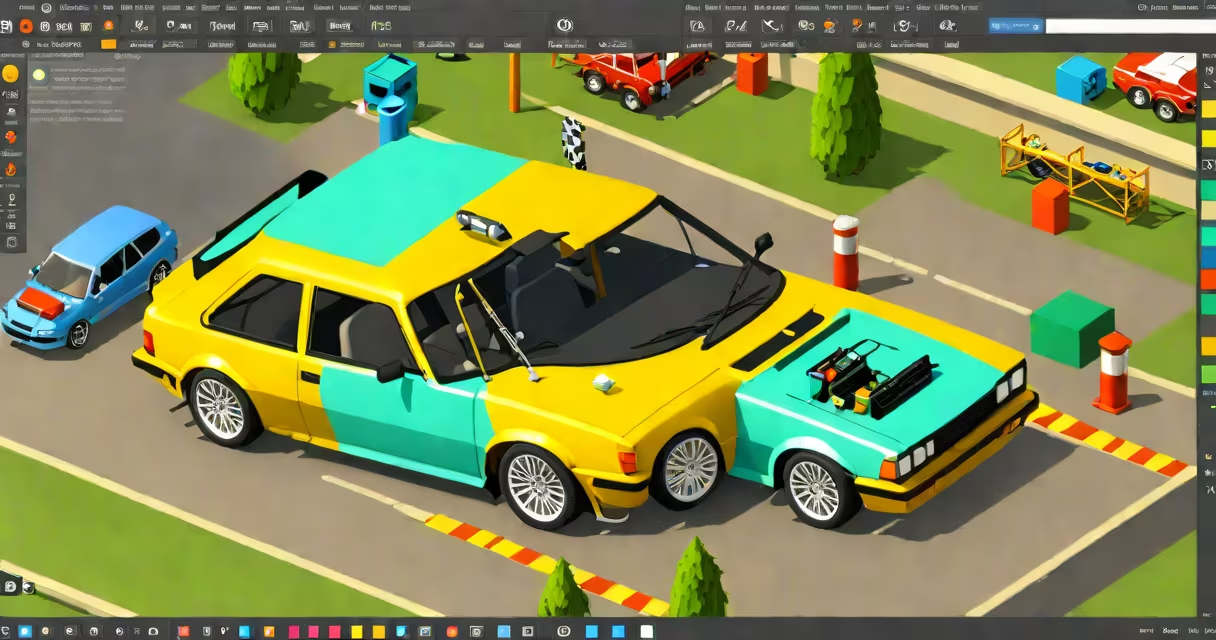
My Summer Car Editor is a web-based tool that allows players to modify vehicle models, parts, textures, and physics parameters in the game My Summer Car. It enables detailed customization beyond the in-game menu, including paint colors, component replacements, and mechanical behavior tuning.
The editor runs in a browser and accesses the game's save files or exported model data. It doesn't alter the original game files directly. Instead, it generates modified .json or .dat files that the game loads at startup. This method preserves game integrity while enabling advanced edits.
Players use it to fix broken mechanics, replace parts with realistic alternatives, or create custom builds. For example, a player might swap a rusted engine with a working V6 from a different car model, then adjust idle RPM and torque curves to match real-world performance.
My Summer Car Editor operates by parsing the game's internal structure. When a player exports a vehicle from the game, the editor reads the associated configuration file-typically a JSON document containing part IDs, material properties, and joint constraints.
Users can then edit values such as engine displacement (e.g., changing from 1.3L to 2.0L), tire width (from 185/65R15 to 225/55R17), or suspension stiffness (measured in N/m). The editor validates changes against known physical limits to prevent crashes or impossible states.
After saving, the edited file replaces the original in the game's save directory. On restart, the game loads the new configuration. A player who adjusts the front axle geometry to reduce understeer will notice sharper cornering in the rebuilt vehicle.
There are three primary categories of modifications supported:
| Customization Type | Examples | Impact on Gameplay |
|---|---|---|
| Visual | Paint color, window tint, bumper style | Changes appearance only; no effect on handling |
| Functional | Engine swap, transmission type, brake caliper size | Affects speed, acceleration, braking distance |
| Physics-Based | Suspension spring rate, tire grip coefficient, weight distribution | Alters handling, stability, and terrain performance |
For instance, increasing the rear axle stiffness from 1200 N/m to 1800 N/m improves high-speed stability but reduces comfort on uneven roads. The editor displays real-time feedback on how changes affect center of gravity and roll resistance.
Some users combine multiple edits. One player replaced the stock engine with a Toyota 2JZ-GTE, adjusted the fuel injection timing to 32° BTDC, and increased the radiator capacity to 12 liters. After testing, the car achieved 180 km/h on flat terrain with stable throttle response.
Many assume My Summer Car Editor modifies the game's executable or requires root access. That's incorrect. The tool runs entirely in the browser and only manipulates user-generated data stored in the game's save folder.
Another myth is that all edits are permanent. In reality, the editor creates backups. If a modification causes instability, players can restore the original file from the backup folder. The default backup path is Documents/MySummerCar/Backups/.
A less obvious point: not all parts are interchangeable. The editor flags incompatible components-such as trying to install a diesel engine in a gasoline-only frame-based on engine mount dimensions and exhaust routing. These checks prevent invalid configurations that would crash the game.
I used My Summer Car Editor to rebuild a 1993 Subaru Impreza WRX for off-road racing. The original model had poor traction and unstable handling on gravel. I replaced the stock 2.0L engine with a 2.5L turbocharged boxer unit, changed the differential ratio from 4.1 to 3.9, and upgraded tires to 235/70R16 with mud compound.
After adjusting the suspension travel to 120 mm and increasing the anti-roll bar stiffness by 40%, the car maintained control through sharp turns at 60 km/h. I logged lap times before and after: 1 minute 42 seconds improved to 1 minute 28 seconds on a 1.2-kilometer course.
My Summer Car Editor is not a standalone game. It's a companion tool for players who want deeper control over vehicle behavior. It supports both casual and competitive play styles, from creating family-friendly rides to building race-ready machines.