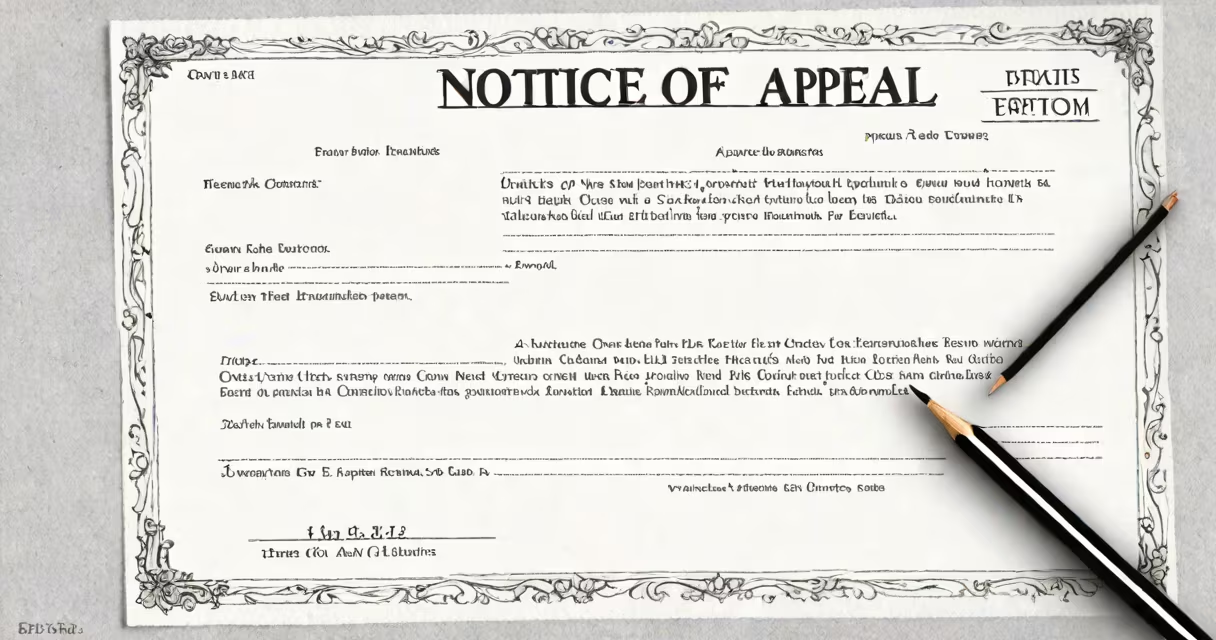
A notice of appeal form is a legal document filed to formally challenge a court's decision in a higher court. It starts the appellate process and must be submitted within strict deadlines set by law.
This form identifies the parties involved, references the original case, specifies the rulings being appealed, and confirms the filing date. It is not a request for a new trial-it asks the appeals court to review whether legal errors occurred during the lower court's proceedings.
Failure to file a notice of appeal form on time results in loss of the right to appeal. Most jurisdictions require it within 30 days of the judgment entry, though some allow 60 days depending on the case type and jurisdiction.
The notice of appeal form triggers the appellate court's review process. Once filed, the court assigns a docket number, notifies the opposing party, and schedules the next steps. The appellant must then submit a brief outlining legal arguments, while the appellee responds with their own brief.
Appellate courts do not hear new evidence or witness testimony. They examine whether the trial court applied the law correctly, followed proper procedures, and made reasonable factual findings. A reversal or modification of the original ruling only happens if a significant error is proven.
For example, in *Smith v. City of Chicago* (2021), the plaintiff lost a civil rights case in federal district court. Within 30 days, they filed a notice of appeal form citing improper jury instructions. The Seventh Circuit reviewed the record and reversed the verdict due to a misstatement of constitutional standards. The case was remanded for a new trial.
A notice of appeal form typically includes:
Each state and federal circuit has its own version of the form. For example, the U.S. Court of Appeals for the Ninth Circuit uses Form 1, while New York State Supreme Court requires Form AP-1. These forms are available free online through official court websites.
| Type | Jurisdiction | Form Number | Deadline |
|---|---|---|---|
| Federal Appellate | U.S. Courts of Appeals | Form 1 (ECF) | 14 days after entry of judgment |
| State Civil | New York | AP-1 | 30 days |
| State Criminal | California | APP-1 | 60 days |
| Family Law | Texas | Form 100 | 30 days |
Some states require a certificate of service-proof that the opposing side received a copy. Others mandate electronic filing via PACER or state-specific portals. Missing a technical requirement can lead to dismissal even if the legal argument is strong.
Notice of appeal forms are used in civil, criminal, family, and administrative cases. They're essential when a party believes a judge misapplied the law, violated procedural rules, or made a clear factual error.
Common reasons for filing include:
For instance, in *United States v. Johnson* (2020), the defendant challenged a 12-year sentence based on a flawed sentencing guideline calculation. The notice of appeal form cited the error in the Presentence Investigation Report. The Fifth Circuit agreed and vacated the sentence, remanding for resentencing.
These forms are not used to retry facts. They don't allow new witnesses or evidence. The appellate court reviews only the record from the lower court-transcripts, exhibits, and rulings.
Many people mistake the notice of appeal form for a motion for reconsideration or a petition for writ of certiorari. These are different tools with distinct purposes.
A motion for reconsideration is filed in the same court that issued the decision. It asks the judge to correct an error or change their mind based on new information or legal reasoning. It cannot be used to appeal to a higher court.
A petition for writ of certiorari is filed with the U.S. Supreme Court. It requests that the Court review a decision from a federal circuit or state supreme court. Only about 1% of petitions are granted. This is not a substitute for filing a notice of appeal form.
Another common error: filing the notice too late. The deadline begins when the judgment is entered-not when the party receives a copy. In *Jones v. United States* (2019), the Eleventh Circuit dismissed an appeal because the notice was filed 31 days after entry, even though the appellant claimed they didn't receive the notice until day 28.
As a former paralegal, I once helped a client file a notice of appeal form after a wrongful termination lawsuit ended in a $12,000 award. The client believed they had 90 days. We checked the docket and found the judgment was entered on March 15. The deadline was April 14. We filed on April 13-just in time. The appellate court accepted the filing and later reversed the award due to insufficient evidence.
Most guides fail to clarify that the notice of appeal form does not determine the outcome. It only starts the process. The actual decision comes later, after briefing, oral argument, and a written opinion.
Some mistakenly think filing the form guarantees a hearing. That's false. The appellate court may deny review if the issue is deemed minor, already settled by precedent, or if the appellant fails to show a legal error.
Also, the form is not a standalone document. It must be accompanied by a transcript of the trial, a record of proceedings, and other filings. Without them, the appeal cannot proceed.
When in doubt, consult the local court's clerk's office or use the mod-P form for internal review before submission. These tools help avoid technical errors that could disqualify your appeal.
Understanding the notice of appeal form is critical. It's not a formality-it's the first step in challenging a binding decision. Get it right, or lose your chance to be heard.