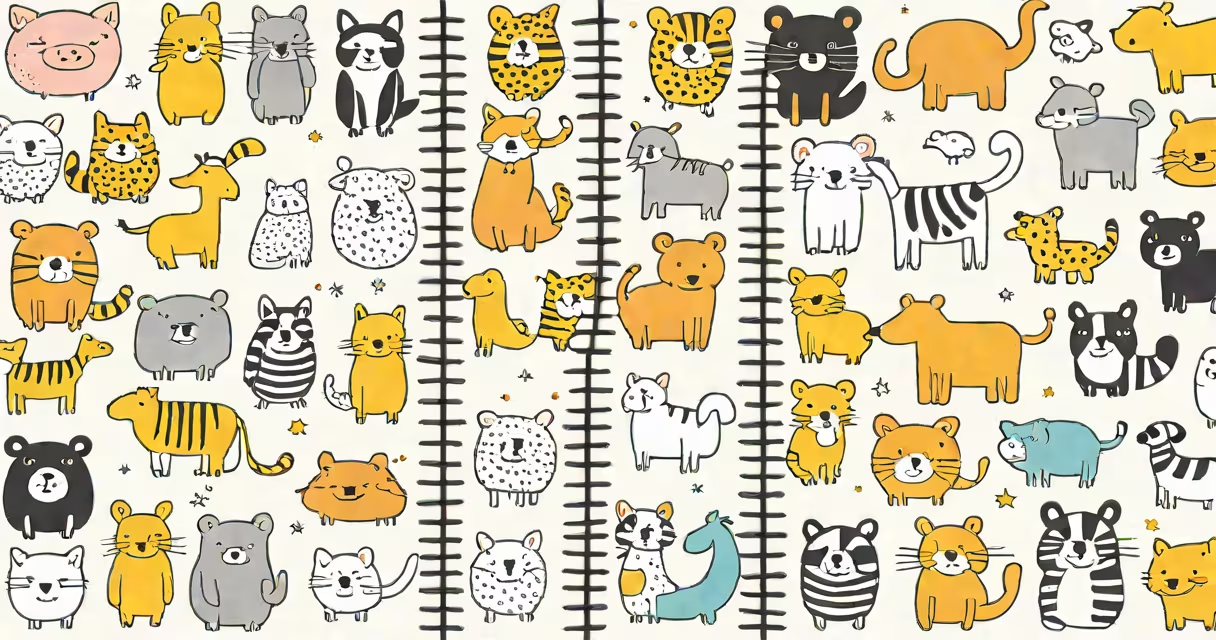
Simple cute drawings are minimalistic, hand-drawn illustrations that use basic shapes, soft outlines, and exaggerated features to convey charm and playfulness. They rely on clean lines and limited detail, making them accessible to beginners and effective for quick expression.
These drawings thrive on simplicity. A cat might be a circle for the head, two triangles for ears, and a few curved lines for a smile. The appeal lies in their immediacy-anyone can sketch one in under a minute. They're not about realism but emotional resonance. A wide-eyed face, a tiny bow, or a wobbly tail instantly communicates joy or curiosity.
They're widely used in journals, social media posts, greeting cards, and children's books. Their low barrier to entry makes them popular in art therapy and creative mindfulness exercises. According to the American Art Therapy Association, simple visual tasks like drawing cute characters reduce stress and improve focus.
They function through visual shorthand. Artists use symbolic forms-circles for heads, ovals for bodies-to communicate identity quickly. Exaggerated eyes, small noses, and rounded limbs create a sense of innocence and warmth. These traits trigger positive emotional responses linked to the "baby schema" phenomenon, where large eyes and small features activate caregiving instincts.
Line weight matters. Most simple cute drawings use consistent, light strokes. Thick lines disrupt the delicate balance. A single continuous line often defines the entire form, reducing complexity. This technique appears in Japanese *kawaii* art, where uniformity and softness dominate.
Color is optional. Many are drawn in black ink on white paper. When color is added, it's usually pastel or muted tones-pink, mint, baby blue. Bright colors can overwhelm the simplicity and distract from the emotional intent.
Simple cute drawings fall into distinct categories based on form and cultural origin:
| Type | Key Features | Common Uses |
|---|---|---|
| Animal-based | Round heads, oversized eyes, tiny limbs | Stickers, app icons, children's toys |
| Character faces | Smiling mouths, squinted eyes, blush marks | Emoticons, mood trackers, journaling |
| Object personification | Hearts for eyes, arms on teapots, hats on mushrooms | Illustrated stories, branding, gift tags |
| Seasonal themes | Snowflakes on hats, pumpkins with grins, hearts in spring flowers | Holiday cards, calendars, seasonal planners |
Each type uses consistent proportions. For example, a typical animal-based drawing has a head-to-body ratio of 1:1.5. Eyes are placed high on the face, often taking up half the head width. These ratios aren't arbitrary-they align with research from the University of California, San Diego, which found that viewers perceive drawings with these proportions as more likable and trustworthy.
Simple cute drawings appear everywhere. On Instagram, users share daily doodles of sleeping cats or happy cupcakes. In classrooms, teachers use them to explain math concepts-like drawing a smiling apple to represent "five apples." In mental health apps, they serve as mood check-ins: draw a sun for "good," a cloud for "meh," a frown for "bad."
They're especially effective in low-engagement contexts. A sticker with a sleepy fox requires no explanation. A heart-shaped cloud conveys affection instantly. This efficiency makes them ideal for communication across language barriers.
One overlooked advantage: they reduce cognitive load. A study published in *Frontiers in Psychology* (2021) showed that participants processed information faster when paired with simple cute drawings than with text-only messages. The brain prioritizes emotionally charged visuals, even when they're minimal.
People often assume simple cute drawings are childish or unskilled. That's incorrect. Their simplicity is intentional. A well-executed drawing of a smiling raccoon with perfectly spaced eyes and a tilted head takes deliberate control of line and space. It's not about lack of skill-it's about focused expression.
Another myth: they're only for kids. Not true. Adult artists use them in professional work. Designer Maki Nomiya creates entire fashion collections inspired by simple cute drawings. Her pieces appear in *Vogue Japan* and are worn by celebrities at award shows.
A third error: thinking they require special tools. You don't need a tablet or expensive pens. A pencil and scrap paper suffice. The key is confidence in line, not equipment. I drew my first simple cute rabbit during a lunch break using a Bic pen and a napkin. It wasn't perfect-but it made someone smile.
Begin with a circle. Add two dots for eyes and a small curve for a mouth. Sketch two short lines for legs and two triangles for ears. That's a basic bunny. Add a tiny bow or a wobble in the line to make it feel alive.
Practice with repetition. Draw five versions of the same animal in five minutes. Focus on variation-not perfection. Try different expressions: sleepy, surprised, excited. Notice how changing the eye shape alters mood.
Use reference images sparingly. Look at real animals for proportions, but don't copy. Instead, simplify. A real squirrel has long tail and sharp nose. A simple cute version has a round body, big eyes, and a fluffy tail shaped like a question mark.
Simple cute drawings are not just a trend. They're a visual language. They speak without words. They comfort. They delight. They exist in the quiet space between thought and feeling-and anyone can learn to draw them.